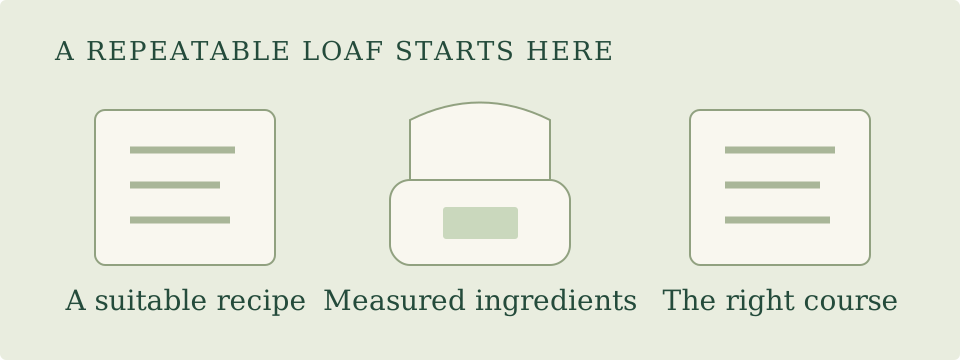
A repeatable loaf starts with a compatible recipe and measured ingredients. Keep the flour, liquid, yeast and selected course consistent before trying to improve a formula.
Use the recipe's weights
Flour can compact in a cup. Weighing the amount specified by the recipe makes it easier to repeat a batch and understand a change. Use the weight for the actual ingredient in that formula; a cup of one flour or blend is not a universal weight for every other flour.
For small quantities, use the measuring method the recipe specifies. Put the scale where you can load ingredients without balancing a pan awkwardly or spilling flour into the appliance. Good setup makes accurate measuring a routine rather than another task to skip.
Start with the flour the formula expects
Bread flour, all-purpose flour, whole wheat and GF blends are not merely different labels for the same ingredient. Their behavior can differ. Begin with the specified flour and introduce substitutions only when you have a baseline or a source that explains the adjustment.
A dedicated whole-grain course can be useful, but it does not turn an arbitrary flour exchange into a compatible recipe. Likewise, a GF course does not make a wheat formula work by replacing one bag of flour with another.
Choose yeast by the recipe
Check the type, condition and storage directions for the yeast you use. Do not use extra yeast as a universal repair for a dense loaf. A loaf can disappoint because of measurement, timing, flour choice or capacity, and more leavening can create a different problem.
Natural-starter recipes add the condition of the starter and fermentation readiness to the process. If the published machine recipe includes both starter and instant yeast, keep that distinction visible rather than treating all sourdough formulas as interchangeable.
Loading order is model-specific
Follow the exact manual and recipe. Some instructions deliberately keep yeast separate from liquid before the cycle starts. A remembered loading order from another breadmaker may not be the one your new machine uses.
Check the paddle and pan installation before adding ingredients. The HomeBaker, for example, uses one fitted paddle despite supplying a spare; the Hi-Rise uses two fitted blades. An ingredient problem and an assembly problem need different corrections.
Use the right visual expectation
A wheat dough and a GF mixture can have different intended consistencies. Follow the recipe's guidance and intervene only as the manual permits. Adding flour until every mixture looks like a smooth wheat dough ball can take a GF formula farther from its intended balance.
Make the next adjustment informative
| Record | Why it helps |
|---|---|
| Recipe and model | Establishes capacity and program context. |
| Actual ingredient weights | Makes a repeated measurement possible. |
| Substitutions | Shows what changed from the original formula. |
| Course, size and crust | Separates recipe changes from machine settings. |
| Result after cooling | Gives the next bake a comparable endpoint. |
Use the baking log for this short record. If the loaf is dense or sinks, follow the relevant troubleshooting route and correct one plausible cause before changing several parts of the recipe.