Owner/document reference: manufacturer-backed numeric model crosswalk and coherent recipe-capacity revision remain unverified.
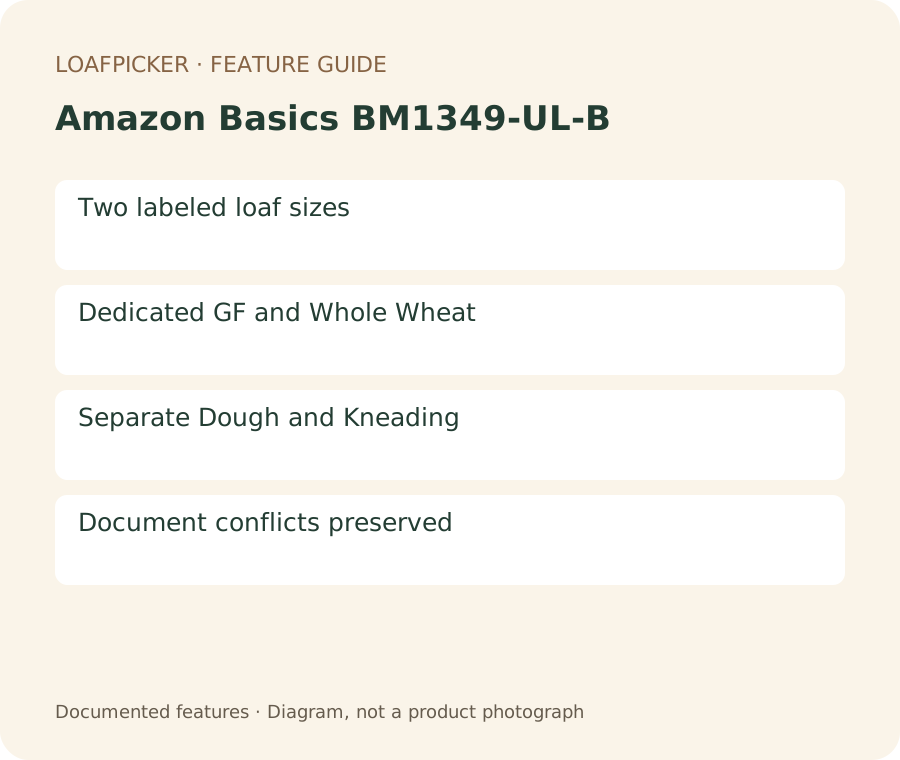 Original LoafPicker feature diagram. Product references appear below. Not a product photograph.
THE FIT AT A GLANCE
At a glance
Owners comparing exact label and booklet revision before using the two-size preset and dough instructions.
Numeric-model crosswalk is not manufacturer-authenticated, dimensions conflict, and some recipe quantities exceed a stated flour maximum.
Shop this model on Amazon ↗Affiliate link · Model search.
The BM1349-UL-B record describes a black, two-size bread maker with a broad fourteen-program menu. Its available instruction material is more informative about course eligibility than about advanced programming or counter fit. There is also a material quantity conflict in a related original Amazon Basics booklet: a stated flour maximum is lower than the amount in some recipes. Those gaps make this an owner and document-reference page while the exact model-to-manual association and correct revision are confirmed.
The BM1349-UL-B manual record and a second model-indexed copy associate the appliance with the instructions. A readable Amazon Basics booklet carrying B07VCFD13V and B07VB8Y1MD identifiers corroborates the operating sections but does not independently print a BM1349-UL-B crosswalk. These are rehosted copies and associations, not a newly authenticated Amazon product offer. A historical ASIN should not be treated as the current seller or the identity of every available unit.
Two loaf choices, with menu-specific exceptions
The instructions provide 1.5 and 2 lb selections. Basic, French, Whole Wheat, Sweet, and Gluten Free are among the named bread courses; Dough, Kneading, Cake, Jam, Yogurt, Bake, and Homemade supply other tasks. Size selection is unavailable on Quick, Dough, Cake, Jam, and Bake. The practical point is that the two-pound headline does not apply as a selectable size to every job the machine can perform.
For a household alternating between ordinary loaves and pizza dough, the distinction between Dough and Kneading is useful. Dough includes rising, while Kneading is a separate mixing task. The oven, shaping, and any later proof remain the cook's responsibility. A cake program is also a different technique from yeast bread. Counting all these entries as interchangeable bread recipes would conceal the choices that actually affect the evening routine.
Gluten Free is present, but the larger recipe needs clarification
The course and recipe tables identify gluten-free bread at both labeled loaf sizes. The formula uses gluten-free flour rather than ordinary wheat flour, with milk powder among the ingredients in the inspected US booklet. However, that same booklet gives a maximum flour capacity of 490 g in its loading instructions and lists 560 g of gluten-free flour for the larger recipe. Some dough recipes also use 560 g. Those statements need reconciliation before following the larger formula.
I therefore preserve the documented menu and size labels while withholding a gluten-free buying recommendation pending a corrected, model-matched recipe or manufacturer clarification. The appropriate response is not to assume that a maximum can be ignored, or to invent a reduced formula that has not been verified. A person buying primarily for dependable gluten-free baking deserves a consistent starting recipe. A named course alone is a weaker basis for that decision than a coherent recipe and capacity limit.
This is a document conflict, not a claim that a particular bake was tested and failed. It may also be affected by the manual revision associated with the unit. An owner can make progress by asking support to identify the correct booklet from the rating plate and purchase record. Until that happens, comparing exact quantities on the original pages is more useful than relying on a summarized online recipe.
Homemade is described more fully than it is explained
The menu description calls Homemade a fully adjustable baking process, and the parts list includes a Cycle button. The inspected operating sections do not supply a complete stage-by-stage editing procedure, allowable ranges, or saved-memory count. This is enough to identify a claimed adjustable mode, but insufficient to promise a particular custom knead-proof-bake sequence. It also does not establish numerical temperature editing.
A buyer who needs custom fermentation should obtain those exact instructions before choosing this model for that reason. A person satisfied with preset sandwich loaves may find that question less important. The distinction prevents two different expectations from being collapsed into the same word “programmable”: selecting an existing menu and designing a process are different capabilities. Separate Bake and Kneading tasks do not, by themselves, establish an automatically linked personal cycle.
Delay can apply to Dough, but ingredients still govern the plan
The instructions describe a timer up to thirteen hours that displays the interval until completion. They exclude Kneading, Yogurt, and Bake, leaving Dough and Gluten Free eligible at the course level. They also prohibit perishable ingredients, hot liquids, and use in high ambient temperatures during a delay. This makes the recipe as important as the menu selection when planning bread or dough to finish later.
A plain appropriate dough formula and a recipe containing fresh eggs or milk are different scheduling cases. The course's eligibility does not grant permission to leave every ingredient combination waiting. Gluten-free delay is also not a solution to the unresolved larger-recipe quantity conflict. Keep the timing capability, ingredient restrictions, and recipe validation as three separate checks. A sixty-minute keep-warm feature is documented, but it does not preserve dough for shaping or make a delayed recipe suitable.
Measure the actual machine and check the pan
The available dimension entry gives incompatible inch and metric measurements, so this record does not select one set or silently convert the other into an apparently reliable footprint. Ask for measurements of the actual unit and allow room to open the lid and remove the pan. The booklet shows one paddle and no automatic ingredient compartment; manual loading remains part of the routine. No evidence establishes a ceramic pan or automatic fruit-and-nut release.
For existing owners, the course exclusions and cleaning guidance can help organize questions for support. For shoppers, the two decisive differences are the unresolved recipe-versus-maximum quantities and the incomplete custom-cycle procedure. Someone needing a confirmed footprint, a verified gluten-free formula, or detailed personal programming should settle those points before treating this historical model record as a purchase recommendation.
Documented specifications
- Model
- BM1349-UL-B
- General loaf sizes
- 1.5 lb, 2 lb
- Dedicated GF course
- Yes
- GF capacity basis
- The associated instructions permit size selection on Gluten Free program 6, and the related original booklet has 1.5 lb and 2 lb recipes. Its larger recipe exceeds its stated flour maximum, leaving a revision conflict.
- Automatic add-ins
- No
- Complete adjustable cycle
- Not confirmed
- Body dimensions
- Not confirmed in the primary sources used here