Manufacturer model-to-manual crosswalk unresolved:17181 retailer menu count differs from14915 original PDF.
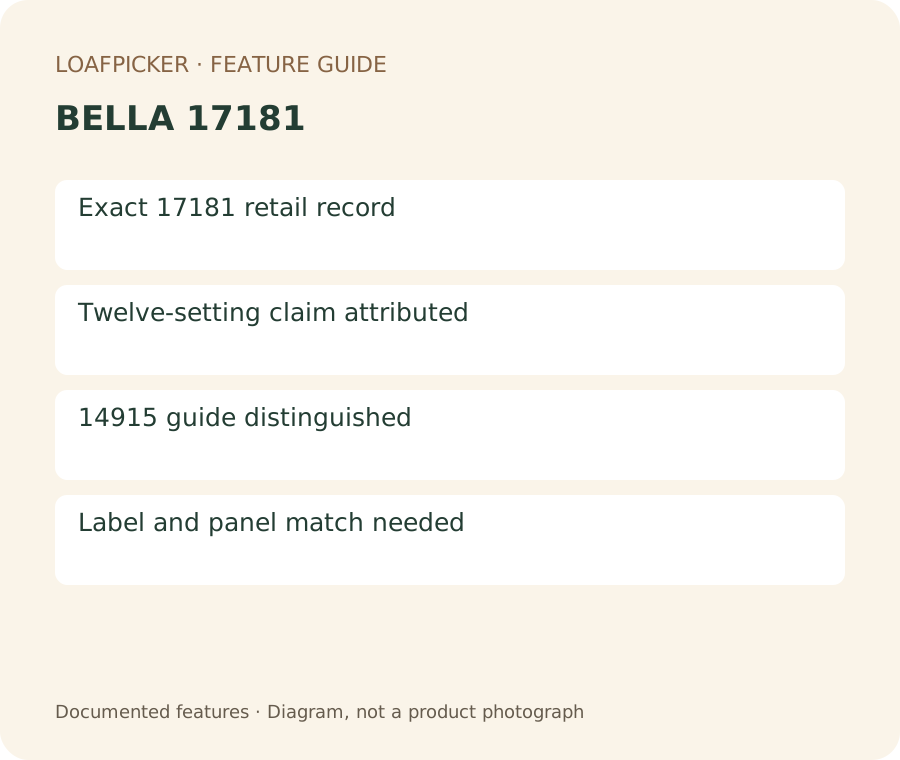 Original LoafPicker feature diagram. Product references appear below. Not a product photograph.
THE FIT AT A GLANCE
At a glance
Owners comparing the actual 17181 panel and booklet before following menu numbers.
Exact retailer says twelve settings; associated original BELLA document carries 14915 and fifteen menus, with no authenticated crosswalk.
Shop this model on Amazon ↗Affiliate link · Model search.
The BELLA 17181 has a clear retailer identity but an unresolved manual association. An exact-model retailer record describes a white, two-pound machine with twelve settings. The accessible manufacturer-branded PDF carries the document identifier 14915 and describes fifteen menus. That difference is too important to hide behind the shared BELLA name. This page is for owners and shoppers comparing the actual control panel with the available documents before following numbered instructions.
The Newegg 17181 record explicitly lists the model. It advertises a 550 W system, three crust colors, a thirteen-hour timer, sixty-minute warming, and uses for jam, dough, and cake. The original BELLA PDF carrying 14915 is a real manufacturer document, but its existence does not establish that it operates the 17181. Current availability, present warranty service, and a current marketplace offer are not verified here.
Why a menu-count disagreement affects more than marketing
Menu numbers tell the owner which sequence will run. If two versions assign different jobs to those numbers, following the wrong booklet can start the wrong process even when the ingredients are measured correctly. A shopper should therefore ask for photographs showing the actual numbered menu and the manual supplied with the machine. A booklet containing the right brand and a two-pound description is useful only when its controls and model association also match.
The mismatch does not prove that the 17181 listing is false or that the 14915 guide is defective. It establishes a missing crosswalk. There could be a documented relationship, but it was not authenticated in this assessment. Until one is available, transferring the PDF's specialty menus, custom settings, or cleaning permissions into a 17181 feature table would be unwarranted. The decision should remain provisional rather than choosing whichever document promises more functions.
The ordinary loaf claim needs its own capacity instructions
The exact-model retailer states two-pound capacity. It does not establish, through a model-matched course chart, which smaller sizes are selectable or what the ingredient maximum is for every task. A nominal loaf weight and the quantity of flour placed in the pan are different measurements. A family evaluating batch size should ask for the appropriate recipe, while a smaller household should establish whether there is an explicitly supported reduced batch.
A used machine can look suitable for either household because an empty pan gives little indication of how a recipe expands. Do not treat that visual impression as permission to enlarge or halve a formula. The missing manual matters especially for dough: the machine may be used primarily to prepare rolls or pizza, but the dough capacity and completion point need to be known separately from its advertised baked-loaf maximum.
Three crust shades do not constitute full process programming
The 17181 retailer description names light, medium, and dark crust choices. That is useful information about the advertised configuration, but it does not show that the user can set each rise or save a custom cycle. A baker who regularly uses presets might not need those controls. Someone adapting a slow-fermenting dough should require a complete stage-editing procedure before selecting this model for that purpose.
The manufacturer PDF's additional menus are tempting because they appear to answer the missing questions. They should instead be used as a comparison document: if the actual panel differs from the guide, that is evidence to resolve with support. A different BELLA model with a more complete manual may be an easier choice when custom timing is central to the purchase. Neither crust control nor the word “programmable” proves independently controllable fermentation.
Specialty baking needs model-specific confirmation
Jam, dough, and cake are retailer-attributed uses for 17181. A dedicated gluten-free course is not authenticated for this code. Even if the associated 14915 PDF includes one, that cannot establish the correct menu or recipe for another configuration. The record therefore leaves dedicated gluten-free support unknown instead of treating the presence of a related recipe as a positive match.
A buyer chiefly interested in gluten-free bread should request the precise course instructions and a coherent formula for the supplied unit. Someone interested in cake should establish whether ingredients are mixed inside the machine or whether a premixed batter is required. These are practical workflow questions: the wrong assumption changes both preparation and the point at which the cook needs to intervene. A broad promise of bakery-style results does not supply those steps.
Scheduling depends on the exclusions
The thirteen-hour timer and one-hour warming period are retailer claims for this exact listing. Their course restrictions are not established by a matching manual. An overnight plain loaf, enriched dough, and jam are different scheduling cases, so a maximum timer number should not imply that every advertised function can wait. Nor does keeping baked bread warm establish that dough may remain in the pan after its program ends.
The retailer's express-cycle language also does not give a verified recipe-and-size-specific runtime. A household needing bread ready within a strict two-hour window should obtain that chart before depending on the claim. General speed language can be enough to attract attention; it is not enough to plan a meal when the machine's exact operating document is unresolved.
The useful next check is the actual label and panel
Read the electrical plate on the unit being supplied. A 550 W claim alone does not identify voltage or frequency, and suspect marketplace voltage fields are not adopted here. Measure its working clearance, inspect the pan and paddle, and establish which replacements fit the exact model. The 17181's appealing advertised combination is ordinary two-pound bread plus several kitchen tasks. Its decisive drawbacks for a confident comparison are the missing manufacturer model crosswalk and the conflicting twelve- versus fifteen-menu descriptions. Resolve those before treating the related PDF as operating permission.
Documented specifications
- Model
- 17181
- General loaf sizes
- Retailer lists 2 lb capacity; selector not authenticated
- Dedicated GF course
- Not confirmed
- GF capacity basis
- No authenticated 17181-specific program table is available. The gluten-free program in the 14915 manual is not transferred to this unresolved model configuration.
- Automatic add-ins
- Not confirmed
- Complete adjustable cycle
- Not confirmed
- Body dimensions
- Not confirmed in the primary sources used here