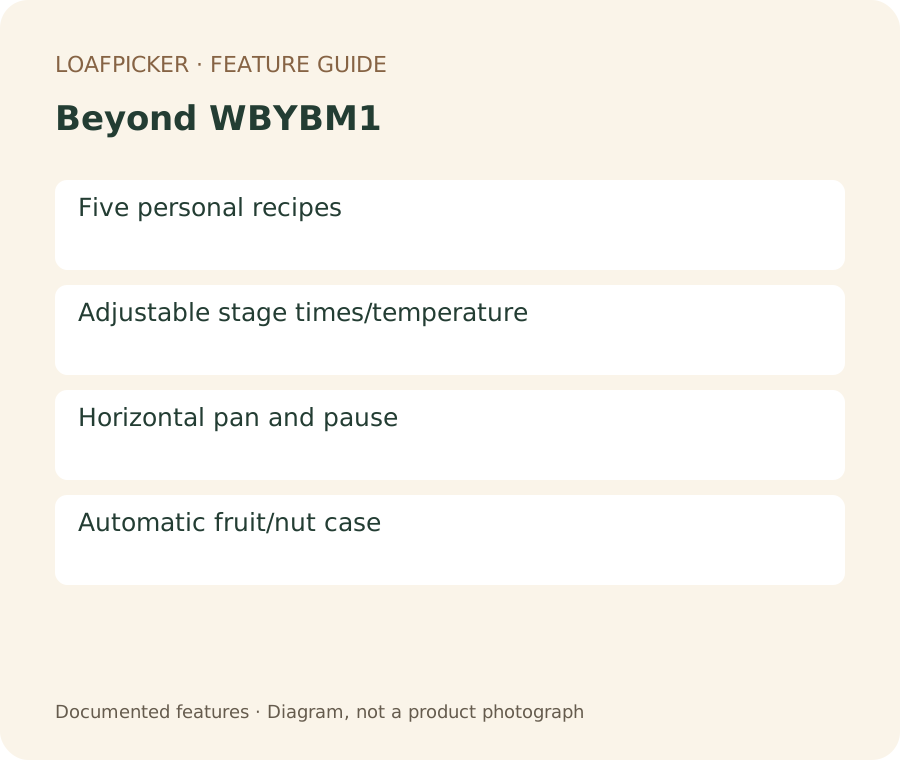
 Original LoafPicker feature diagram. Product references appear below. Not a product photograph.
THE FIT AT A GLANCE
At a glance
Bakers entering repeated personal timing processes locally, or using a horizontal pan and pause for attended shaped loaves.
Legacy barcode updates and remote programming require a Home Hub and information service; present service availability is unverified.
Shop this model on Amazon ↗Affiliate link · Model search.
The WBYBM1 is an unusual older bread maker because its useful local controls sit alongside an ambitious barcode and network system. Its original manual documents five saved personal recipes, editable stage times, temperature adjustment, and a horizontal pan. Those are meaningful baking features even before considering a scanning wand. A buyer should evaluate the machine's ordinary controls on their own, then treat the Home Hub and information service as a separate, unverified ownership question.
The exact WBYBM1 owner manual, also preserved in a second original-manual copy, directs connection to 120 V AC. It gives 1, 1.5, and 2 lb loaf choices. No current retailer offer, supported network subscription, or physical-unit condition is established by this research. The manual is evidence of the documented design, rather than proof that an old online service remains available.
Five recipes can be programmed from the machine
The personal-recipe procedure uses the appliance controls. The user steps through preheat, kneads, rises, punch and shape actions, baking, keeping warm, extras, and temperature, then saves the program. The manual explains skipping a phase by reducing its time to zero. This is substantially more control than simply selecting a preset called Homemade. It also supplies a reason to consider the machine if several repeat recipes need different timing.
For an owner developing a loaf, saving a successful process can reduce repeated setup work. It still requires checking the dough during development: the saved numbers cannot compensate automatically for a different flour or a starter behaving differently. Temperature editing is documented, but it should not be advertised as independent numerical temperature control over every fermentation stage. The programming sequence and permitted settings need to be read together. Printed pages 25–26 describe the local controls.
The Internet features are a separate dependency
The scanning wand reads packaged-mix barcodes, and the manual describes teaching an unrecognized mix a program. Its remote programming and database-update features require a Home Hub and the Beyond Information Service. This is a particular legacy system communicating through household wiring; it is not evidence of modern Wi-Fi, a current phone app, or compatibility with today's packaged mixes.
A buyer attracted mainly by scanning should establish what the actual unit recognizes and whether the required service and hardware can be used. A wand included in the box does not answer those questions. For someone attracted by manual recipe entry, the more relevant check is whether the panel can enter and retain personal settings without relying on a promised remote update. This separates a tangible local function from a service-dependent feature whose present operation has not been verified.
A horizontal pan and pause feature invite hands-on shaping
The manual expressly describes a traditional horizontal pan and a pause lasting up to ten minutes. It illustrates removing and reshaping dough, returning it to the pan, and resuming the process. For a cook making a filled loaf or decorative top, that combination is more relevant than a large menu count. It offers an intervention point while retaining the machine as the baking chamber.
The pause automatically ends if the user does not resume within the stated interval. That makes preparation important: have the work surface, filling, and handling tools ready before interrupting the program. It is not an unlimited holding function for dough. A baker who prefers to shape several rolls may instead use Dough and finish them in an oven; Pizza Dough is another separate preparation route. None of those tasks means the machine shapes the final food automatically.
Automatic additions are documented for suitable recipes
The fruit-and-nut compartment is supported by model-specific recipes directing the user to select Extras and load additions into the dispenser. A dried-fruit loaf or chopped-walnut bread is therefore a more concrete use case than a generic promise of automatic ingredients. The compartment is not a yeast dispenser. Exact ingredient amounts and directions still belong to the chosen recipe.
The presence of a case should not become permission to dispense every wet, sticky, or delicate addition. Nor does it establish automatic release on every dough or sourdough workflow. The evidence is strongest for the explicit Fruit & Nut recipes. An owner seeking automatic additions in a personal program should follow the Extras setting and the matching procedure rather than infer behavior from the hardware alone.
Preset breads and gluten-free requirements
The ordinary menu includes White, Whole Wheat, French, Fruit & Nut, Batter Breads, Jam, Dough, Pizza Dough, and Bake Only, with rapid choices on relevant bread routes. The complete list has no dedicated gluten-free course. The ability to design a process is useful experimentation support, but does not turn the machine into a documented dedicated gluten-free model or validate an arbitrary mix.
For a small household, the one-pound choice may be more valuable than the networking story. For someone wanting large batches, the two-pound option and recipe quantities matter. Neither label establishes the permitted size for a jam or batter recipe. Bake Only additionally permits selectable time and temperature, which is useful for an appropriate already-prepared dough, but does not supply missing recipe development.
Scheduling and condition complete the assessment
The manual describes a twenty-four-hour timer, excludes perishable ingredients from delayed recipes, and limits automatic keeping warm to particular bread courses. It also documents sixty-minute power-loss memory with instructions for interruptions outside that limit. These capabilities do not guarantee unattended results for every formula. Check the exact intended course and recipe rather than combine all maximum numbers into one promise.
Inspect the pan, paddle, dispenser, controls, and stored-program behavior on the unit under consideration. Body dimensions remain unverified here, so measure the machine and open-lid clearance directly. The WBYBM1's strongest differences are genuine local program control and the horizontal-pan shaping workflow. Its barcode-network system is a separate reason for caution: a historical feature description is insufficient evidence of present service support.
Documented specifications
- Model
- WBYBM1
- General loaf sizes
- 1 lb, 1.5 lb, 2 lb
- Dedicated GF course
- No
- GF capacity basis
- Complete original menu has no dedicated GF course; user programming is not equivalent to a dedicated menu or verified GF recipe.
- Automatic add-ins
- Yes
- Complete adjustable cycle
- Yes
- Body dimensions
- Not confirmed in the primary sources used here