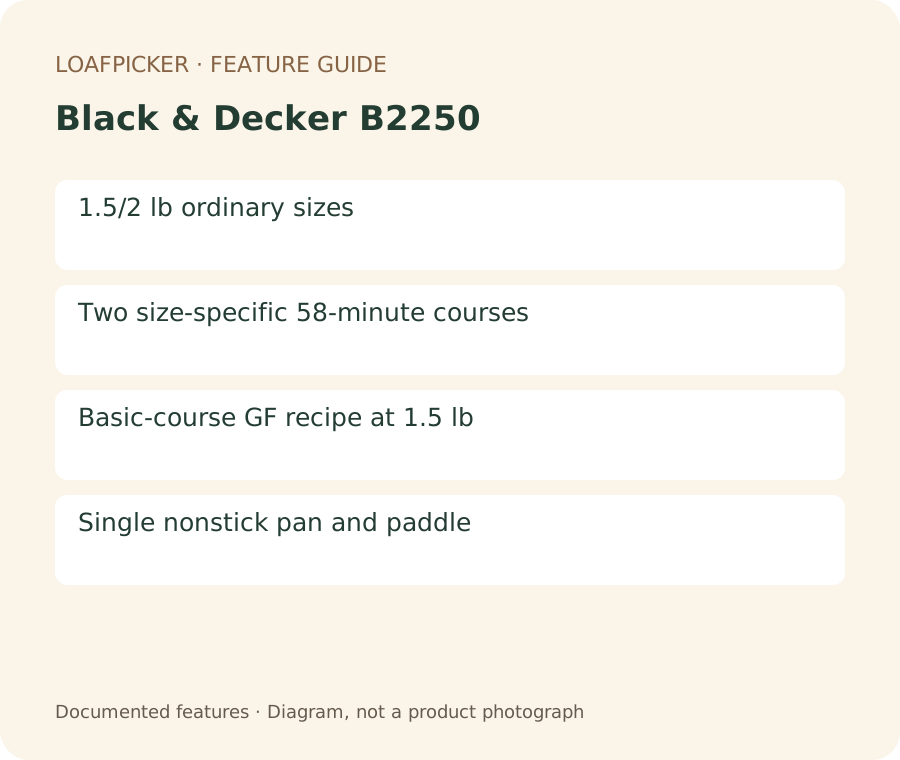
 Original LoafPicker feature diagram. Product references appear below. Not a product photograph.
THE FIT AT A GLANCE
At a glance
Smaller ordinary loaves and an exact-model 1.5 lb gluten-free recipe using Basic.
Manual additions, no dedicated GF preset, and no verified complete-cycle programming.
Shop this model on Amazon ↗Affiliate link · Model search.
The B2250 is most interesting when a 1.5 or 2 lb loaf is enough and waiting less than an hour matters. Both size-specific Rapid-Bake settings are documented at 58 minutes. Its gluten-free support requires a different decision: the manual supplies a 1.5 lb recipe on Basic, rather than a dedicated gluten-free program.
Start with the loaf you actually want
This model has two ordinary size choices, 1.5 and 2 lb. There is no documented one-pound position for someone trying to make the smallest possible loaf, and no larger setting for a household that regularly finishes big batches. That makes its capacity fairly easy to judge. A buyer who can use one of those two sizes gets a familiar selection of everyday functions without needing to work through a long list of specialist presets.
The exact maker-hosted book covers both B2200 and B2250, but it separates their recipes. That distinction matters here: the B2250 has its own recipe section, including the gluten-free example. Shared safety and operating instructions are useful evidence for the controls; recipes belonging to the other named model should not automatically be treated as B2250 instructions. For an older machine sold without paperwork, the model on the appliance should match the B2250 section before following a recipe.
What the 58-minute claim covers
Rapid-Bake I is the 1.5 lb white-bread course, and Rapid-Bake II is the 2 lb version. Each shows 0:58 in the program table. This is a specific finished-cycle claim, rather than a vague promise that a rapid option saves some time. The distinction is useful when comparing older Breadman machines whose similarly named Rapid settings can still take several hours. It does not mean every B2250 recipe or every flour type finishes in 58 minutes.
The rest of the menu includes Basic, Sandwich, Whole Grain, Sweet, Quick Bread, Dough, French and Preserves. Whole Grain gives heavier flour mixtures a longer rise; Quick Bread is intended for chemically leavened recipes. Dough prepares a mixture for shaping and baking elsewhere, while Preserves handles fruit preparations. These are different jobs. Someone mainly making pizza dough may value Dough more than the speed claim; someone using whole-grain recipes should compare the ordinary course, rather than expecting the rapid white-bread timing to carry across.
A gluten-free recipe, with an explicit size
The B2250 recipe section directs its gluten-free bread to Basic at 1.5 lb. That provides a concrete starting workflow for an owner willing to follow the supplied formula. It does not establish a Gluten Free selector, a choice of gluten-free loaf sizes, or automatic adaptation to any commercial mix. Buyers who want a preset expressly designed and labeled for gluten-free bread should recognize this difference before choosing it over a model with a dedicated course.
There is also a small editorial error in the same recipe area: a Multi Seeded heading names the wrong Rapid variant, while its menu number, procedure and 1.5 lb size point to Rapid-Bake I. The course table is clearer. This is a reason to keep the original manual handy and check the program number and size together. It is not a reason to assume the machine offers extra programs beyond the ten shown in its complete menu.
Scheduling needs a course check
The timer schedules completion up to 13 hours ahead, so its displayed interval includes the bread-making process. It cannot be used with either Rapid-Bake course or Dough. The maker also discourages delay for Whole Grain, Quick Bread and Preserves. A household hoping to wake to finished basic bread has a documented scheduling option; a cook wanting dough to start later cannot assume the same timer works for that task. Recipes with perishable ingredients also need the manual's immediate-use precautions.
Add-ins are handled manually. The eligible programs sound a signal near the end of kneading, and the user opens the lid to add fruit or nuts. Both Rapid-Bake courses are excluded from that add-in allowance. There is no automatic ingredient dispenser shown or described. Consequently, a raisin loaf and an unattended plain loaf involve different levels of attention, even though both fit the machine's general bread-making role. One hour of keep-warm can bridge a short delay after baking, but the manual advises removing bread promptly for the best crust.
The pan is part of the buying decision
The B2250 uses one kneading blade and a nonstick pan. Its care instructions explicitly permit washing the pan and blade in warm soapy water or a dishwasher. A stuck blade can be loosened by placing warm water inside for 10–15 minutes. The manual identifies the B2250 pan as B2250-01 and the blade as B2200-02. Those numbers help identify parts, but they do not establish that replacements are currently stocked or that an unrelated listing will fit.
A visual check of the book's back cover confirms 600 W, 120 V AC and 60 Hz. Complete external dimensions were not verified, and the nonstick description does not identify a ceramic coating. Those gaps matter if counter clearance or a particular pan material is essential. The timer buttons also do not document independently editable knead, rise and bake stages. This model suits a buyer satisfied with its supplied courses, especially the two fast white-bread sizes; it offers less evidence for someone whose main requirement is programmable recipe development.
Documented specifications
- Model
- B2250
- General loaf sizes
- 1.5 lb, 2 lb
- Dedicated GF course
- No
- GF capacity basis
- No dedicated GF course. The B2250-specific gluten-free recipe explicitly uses Basic at 1.5 lb; a 2 lb GF recipe was not verified.
- Automatic add-ins
- No
- Complete adjustable cycle
- Not confirmed
- Body dimensions
- Not confirmed in the primary sources used here