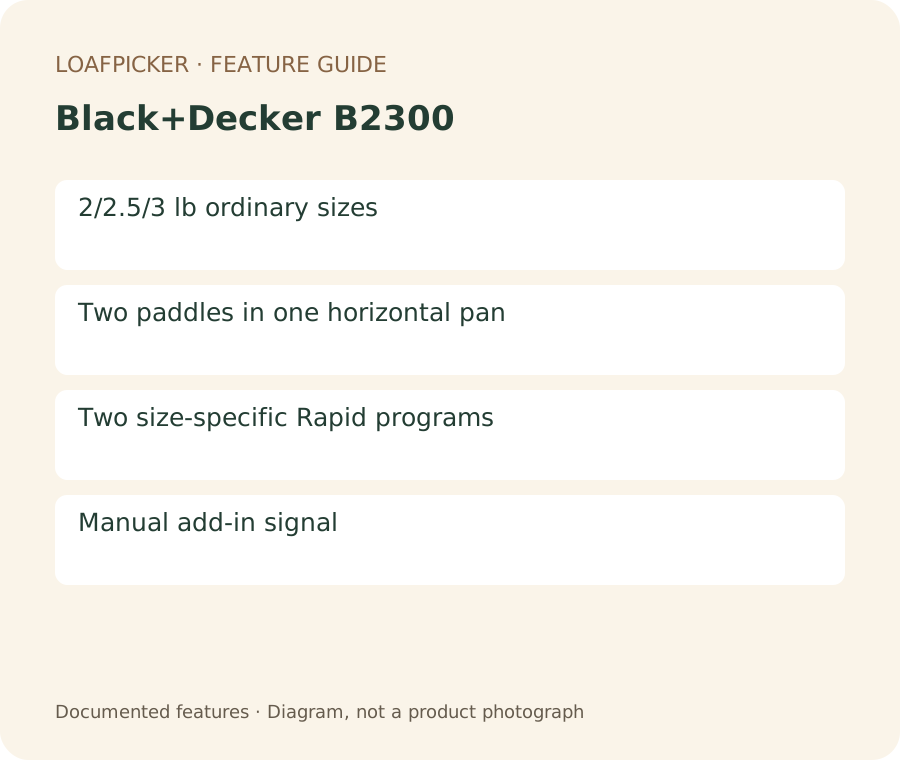
 Original LoafPicker feature diagram. Product references appear below. Not a product photograph.
THE FIT AT A GLANCE
At a glance
Households wanting a large horizontal loaf from one pan with two paddles.
The rapid routes stop at 2.5 lb, and automatic dispensing is not established by the maker-page checkbox.
Shop this model on Amazon ↗Affiliate link · Model search.
The B2300 starts at 2 lb and goes up to 3 lb. That makes it a plausible fit for a household that uses plenty of bread, while its two rapid courses serve smaller portions of that range. Its strongest documented conveniences are the large horizontal pan, two paddles and a broad everyday menu. Automatic ingredient dispensing is not established by the manual.
Its smallest setting is already substantial
The ordinary loaf selector offers 2, 2.5 and 3 lb. A buyer comparing the B2300 with a machine offering one-pound recipes should begin with that difference. The lower setting is not a small trial batch. Someone who eats bread slowly may find the capacity less useful than the headline suggests, while a household making sandwiches frequently may prefer the ability to choose a larger batch without moving to a different machine.
The exact B2300 manual describes a horizontal machine and shows two kneading paddles. Two paddles work in one pan; they do not create two separately flavored loaves. The course choices are Basic, Rapid-Bake I, Rapid-Bake II, Sandwich, Whole Grain, Sweet, Quick Bread, Dough, French and Preserves. This is a practical menu for ordinary bread, shaped dough and fruit preserves. There is no dedicated Gluten Free choice in that complete list, so a buyer should not infer one from the number of programs or from the large capacity.
Rapid baking has two different limits
Rapid-Bake I is documented for a 2 lb loaf at 1 hour 28 minutes. Rapid-Bake II serves 2.5 lb at 1 hour 38 minutes. The program table marks 3 lb unavailable for both. A person wanting the maximum-capacity loaf therefore needs to judge the ordinary baking programs and their longer schedule. Calling this a rapid three-pound machine would blur a restriction that matters in everyday planning.
These timings also distinguish the B2300 from the smaller B2250, whose rapid white-bread settings are 58 minutes. The shared brand and similar course names do not give the two products identical behavior. A household deciding between them is trading capacity against those particular rapid timings, alongside the differences in pan layout. The correct choice depends on the batch actually needed, rather than on treating Rapid as one fixed specification across the brand.
The timer works for some plans better than others
The B2300 schedules completion up to 13 hours ahead. Its examples count from the time ingredients are loaded to the desired finished loaf, so the baking process is part of that interval. Delay cannot be used for either Rapid-Bake course or Dough. The manual discourages it for Whole Grain, Quick Bread and Preserves, and warns against delayed recipes with perishable ingredients. That makes an overnight ordinary loaf a different proposition from delayed pizza dough or a rapid loaf after work.
Dough still has value for an owner who can start it when present: the machine prepares a mixture that can be shaped and baked in a conventional oven. Quick Bread serves recipes using baking powder, and Preserves is for jams. These settings should be chosen for their intended ingredients and handling, rather than assumed to share every loaf-size or timer control. The program table explicitly calls their sizes preset, unlike the ordinary three-position bread selector.
Fruit and nut handling needs careful wording
The Canadian maker page marks a feature called Fruit and Nut Release as present. The manual, however, lists no automatic dispenser in its parts diagram and tells the owner to open the lid and add ingredients at a beep. Its guidance gives roughly 25 minutes for ordinary programs and eight minutes for Rapid, while another passage uses an approximate 30-minute description. The supported practical workflow is to listen for the signal and add the ingredients by hand.
That distinction affects a buying decision more than the checkbox wording. A plain loaf can follow the selected program once loaded, but someone expecting an unattended raisin addition should not purchase on the assumption that an automatic compartment is included. The evidence does not settle that assumption. Check the actual machine and the exact manual before relying on dispensing as a required feature, especially when evaluating an older example with incomplete accessories or a seller's abbreviated description.
Counter space and cleaning
The maker page explicitly states 120 V and 800 W, but its dimension field gives only 15.1 by 13 inches without identifying axes or supplying a third measurement. That is insufficient to establish complete width, depth and height. A buyer fitting the machine below cabinets also needs clearance to open the lid and lift out the pan. Measure an actual unit or obtain a complete specification before classifying it as compact or assuming it will fit a particular shelf.
Cleaning instructions are clearer. The nonstick pan and paddles may be washed in warm soapy water or in a dishwasher. Warm water inside the pan for 10–15 minutes can loosen stuck paddles, and abrasive cleaners or steel wool can damage the coating. The supplied parts numbers identify the pan and paddles but do not prove present replacement availability. One-hour keep-warm can help if bread is not removed immediately, although leaving it inside softens the crust. Overall, the B2300 makes most sense when its large ordinary loaf sizes solve a real household need and the owner accepts manual additions and course-specific scheduling.
Documented specifications
- Model
- B2300
- General loaf sizes
- 2 lb, 2.5 lb, 3 lb
- Dedicated GF course
- No
- GF capacity basis
- No dedicated GF program in the complete ten-course menu; an exact-model GF recipe was not verified.
- Automatic add-ins
- Not confirmed
- Complete adjustable cycle
- Not confirmed
- Body dimensions
- Not confirmed in the primary sources used here