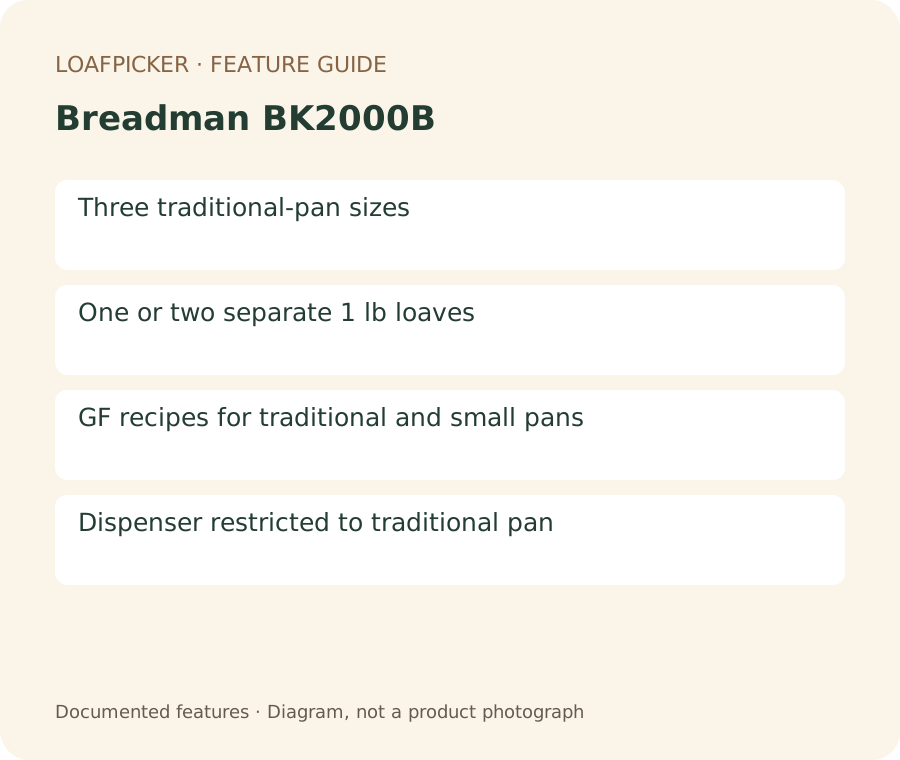
 Original LoafPicker feature diagram. Product references appear below. Not a product photograph.
THE FIT AT A GLANCE
At a glance
Households wanting either a larger traditional loaf or separate one-pound loaves.
Small pans prohibit the automatic dispenser and need their own mode and fixed paddles; all included components matter on a used unit.
Shop this model on Amazon ↗Affiliate link · Model search.
The BK2000B's most useful distinction is its choice of pan arrangements. Its traditional pan serves 1.5, 2 and 2.5 lb loaves; two included small pans each make a one-pound loaf. That flexibility comes with rules: the collapsible paddles and automatic dispenser belong to the traditional-pan workflow, while the small pans use fixed paddles and manual additions.
Choose the pan before choosing the program
The maker's instruction and recipe book explicitly covers BK2000B and BK2000BQ together. For the traditional pan, the loaf button selects 1.5, 2 or 2.5 lb and defaults to 2.5 lb. The separate small-pan procedure allows either one or two small loaves. This is a useful distinction for someone who sometimes wants a large family loaf and sometimes a smaller batch, rather than always being committed to one pan volume.
The small-pan mode is not the ordinary loaf button's missing one-pound setting. The instructions tell the owner to press and hold the two arrow buttons together until the display indicates “(2) 1.0 lbs.” That procedure matters when assessing a used machine without its book. A seller showing only the traditional loaf selector might miss the small-pan capability, while a machine supplied without both small pans would not deliver the complete arrangement described in the manual.
The two paddle systems do different jobs
Two collapsible paddles serve the traditional pan. Each small pan takes a non-collapsible paddle, and the manual explicitly says not to use the folding paddles there. The distinction is not merely cosmetic: pan geometry and the matching drive arrangement determine which parts belong together. An older bundle containing loose paddles should be checked against the illustrated parts list before assuming that every piece is interchangeable.
Parts are identified as BK2000BQ-02 for the traditional pan, BK2000BQ-03 for the small pans, BK2000BQ-04 for collapsible paddles and BK2000BQ-05 for small-pan paddles. These are identification references from the shared book, not a statement that replacements remain stocked. For a buyer considering a missing accessory, the cost and availability of the exact part need separate confirmation. The machine's flexibility is less valuable if the required pan or correct paddle is absent.
Automatic additions stop at the traditional pan
The fruit-and-nut dispenser accepts up to two-thirds of a cup and is intended for the traditional pan. The recipe introduction and small-pan instructions both prohibit using it with the one-pound pans. Those small loaves require additions by hand at the signal. A shopper seeking two unattended raisin loaves should therefore understand that the small-pan convenience does not include automatic fruit delivery.
Capacity also affects larger recipes. The book explains that some 2.5 lb recipes exceed what the dispenser holds and need additions placed directly in the pan when prompted. Liquids and spices do not belong in the compartment, and wet produce must be dried. The dispenser is useful when the chosen recipe and quantity fit its intended role; its presence should not be reduced to a universal yes/no promise that ignores which pan and recipe are being used.
Gluten-free support has two verified routes
Gluten Free is a dedicated course. The large-pan recipe headings explicitly yield two-pound loaves, even though the ordinary pan selector defaults to 2.5 lb. The general operating instructions disable normal size selection for GF. It would therefore be wrong to transfer the traditional pan's maximum capacity into a claim that the GF course produces a 2.5 lb loaf. The specific recipe evidence is more useful than the general capacity number.
A separate gluten-free buttermilk recipe specifies quantities for each one-pound pan and tells the owner to select Gluten Free plus the special “(2) 1.0-lb” mode. This provides a documented smaller GF option through the alternate pans. The two routes are worth preserving when comparing machines: one is a two-pound traditional-pan recipe, the other is one pound per small pan. Neither should be flattened into a claim that the GF button simply offers every ordinary loaf-size selection.
What the remaining controls add
The menu includes ordinary White, Whole Wheat, French and Sweet bread, along with Low Carb, Quick Bread, Dough, Jam and Bake Only. Rapid variants serve White, Whole Wheat and Sweet and are preset to two pounds with medium crust. The manual uses approximate one-hour language, but this assessment does not assign exact Rapid minutes without a checked timing chart. Bake Only is adjustable up to ninety minutes; it does not establish editable knead and rise stages.
The fifteen-hour completion timer excludes Jam, and Dough instructions explicitly discuss delayed operation. Recipes containing perishables should not use that convenience. Keep-warm is described as sixty minutes, with course exclusions that should be checked rather than assumed universal. Pan care is hand washing only: no dishwasher or immersion, with warm water inside for up to thirty minutes if a paddle sticks. Complete dimensions and exact electrical rating were not verified. The BK2000B best suits someone who will genuinely use both pan arrangements and can manage their distinct setup, cleaning and addition rules.
Documented specifications
- Model
- BK2000B
- General loaf sizes
- 1 lb, 1.5 lb, 2 lb, 2.5 lb
- Dedicated GF course
- Yes
- GF capacity basis
- Traditional-pan GF recipe is 2 lb. Small-pan GF Buttermilk recipe is 1 lb per pan using the separate (2)1.0 lb mode; ordinary GF size-button selection is disabled.
- Automatic add-ins
- Yes
- Complete adjustable cycle
- Not confirmed
- Body dimensions
- Not confirmed in the primary sources used here