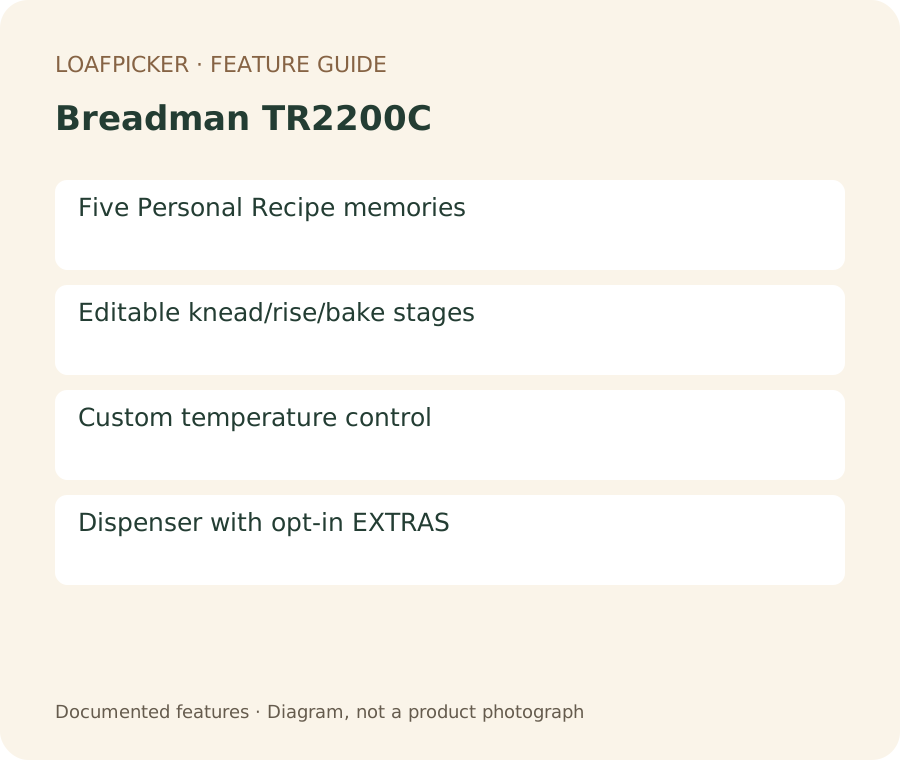
 Original LoafPicker feature diagram. Product references appear below. Not a product photograph.
THE FIT AT A GLANCE
At a glance
Experienced bakers wanting saved control over preheat, kneading, rises, baking and temperature.
No verified GF preset or recipe, and custom capability still requires recipe development and supervision.
Shop this model on Amazon ↗Affiliate link · Model search.
The TR2200C is more compelling for a baker who wants to change the process than for someone seeking the longest preset list. It can edit individual stages, save five personal recipes and control baking temperature in the documented custom workflows. Its ordinary loaf sizes are 1, 1.5 and 2 lb. There is no dedicated Gluten Free course in the complete menu.
What “custom” actually means here
Personal Recipe allows the owner to set preheat, two kneading stages, three rises, punch, shape, bake, keep-warm, temperature and dispenser use. A stage can be omitted by setting its duration to zero. Five memory slots keep those recipes separate from the ordinary selections. This is materially different from a bread maker that merely lets the owner add ten minutes of baking after a loaf comes out pale.
Custom Program also alters an existing preset while retaining its loaf-size and crust framework. The manual describes changes to kneading and baking for Batter Breads, heating and stirring for Jam, and kneading and rising for Dough. A baker experimenting with a formula can therefore work from an existing process or create a saved sequence. That flexibility also brings responsibility: choosing times and temperatures is part of recipe development, rather than an automatic guarantee that an unfamiliar dough will work.
The ordinary menu remains useful
White, Whole Wheat, French and Fruit & Nut are the main bread families, each with Rapid variants. Batter Breads/Cake, Jam, Dough, Pizza Dough and Bake Only cover other tasks. The selection list reaches 86 numbered combinations and personal memories, but those numbers do not represent 86 unrelated kinds of bread. Many entries are the same course expressed through different size and crust choices. Buyers should compare the course families and controls rather than the largest possible program count.
The general size range is one to two pounds. The maker specifically recommends 1.5 and 2 lb recipes for more uniform loaves, explaining that smaller mixtures may not fill the pan, particularly with whole grains or special ingredients. A one-pound position exists, but it is not the machine's strongest documented use case. Someone whose daily priority is a small, neatly proportioned loaf should consider that guidance alongside the nominal minimum size.
Rapid is a time saving, not a one-hour loaf
The White Rapid table gives two hours at one pound with medium crust, 2:05 at 1.5 lb and 2:10 at two pounds. Light and dark settings change the totals again. Those precise combinations are more useful than assuming that Rapid means a 58- or 59-minute process. The ordinary White Medium course is longer, so Rapid still has a defined purpose, but the owner needs a realistic window for the selected size and crust.
Pizza Dough is separately listed at 55 minutes. Ordinary Dough has size-dependent times and leaves final shaping and baking to the owner. Batter Breads supports suitable chemically leavened mixtures and cake mixes. Low-carb recipes appearing in the book should not be converted into an invented Low Carb preset, and the custom programmer should not be converted into an invented GF course. No checked gluten-free recipe was established for this exact manual.
Automatic additions have a named scope
The two-thirds-cup fruit-and-nut dispenser is operated through EXTRAS, which defaults to no additions. The instructions name White, Whole Wheat, French, Fruit & Nut, Batter Breads and Dough as supported workflows for loading it. That list is useful for planning a nut loaf or enriched dough without returning at an add-in beep. It does not establish automatic dispensing on every unnamed course. Liquids and spices are excluded, and wet fruit or vegetables must be dried.
Personal Recipe also includes an Extras yes/no setting, so the owner can incorporate the dispenser deliberately into a custom sequence. This is a meaningful interaction between the programming system and the hardware. It remains subject to the compartment's quantity and ingredient limits. Someone whose recipe needs more than two-thirds of a cup should not assume that saving a custom program expands the dispenser or removes the need to manage additional ingredients.
Timing and ownership details
The completion timer reaches 24 hours and works with personal recipes. Jam is excluded. Batter Breads can be delayed, but the maker says its included batter recipes did not mix well that way, so availability and recommendation are different questions. Perishable ingredients further restrict delayed use. Bake Only offers up to ninety minutes at 300–375 F, and the manual describes sixty-minute power-failure memory. These capabilities should be matched to the intended recipe rather than treated as universal permission to leave every mixture overnight.
The pan and single paddle have nonstick surfaces and require careful hand washing. The pan must not go in a dishwasher, be immersed or left soaking; warm water placed inside for up to thirty minutes can loosen the paddle. Pan 22399, paddle 22400 and lid 22398 are listed, without a verified current supply. Operating instructions specify 120 V AC, 60 Hz, while wattage and full external dimensions remain unverified. The TR2200C suits a hands-on baker who values genuine saved process control and accepts the practical limits of an earlier model.
Documented specifications
- Model
- TR2200C
- General loaf sizes
- 1 lb, 1.5 lb, 2 lb
- Dedicated GF course
- No
- GF capacity basis
- No dedicated GF course in the full menu and no checked model-specific GF recipe; custom controls do not establish a tested GF formula.
- Automatic add-ins
- Yes
- Complete adjustable cycle
- Yes
- Body dimensions
- Not confirmed in the primary sources used here