Only recovered maker-authored booklet has TR2828G on its front and TR2828 on its warranty/back. No independent maker declaration resolves the suffix; detailed capabilities remain conditional owner evidence.
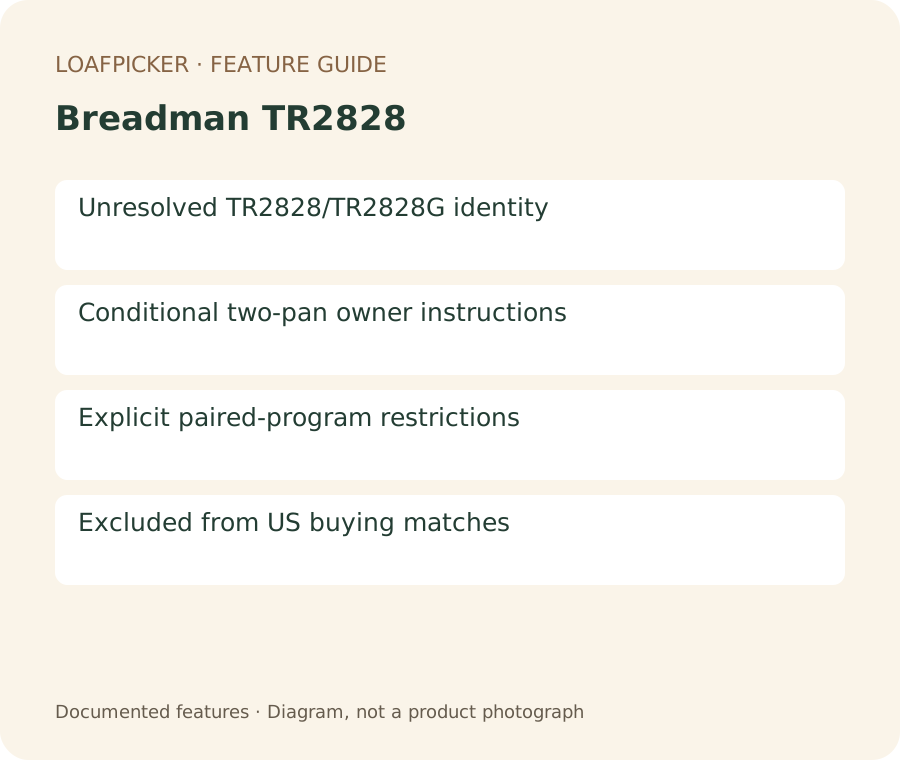 Original LoafPicker feature diagram. Product references appear below. Not a product photograph.
THE FIT AT A GLANCE
At a glance
Conditional owner guidance when the rating label and two-pan controls match the booklet.
The source does not resolve whether unsuffixed TR2828 and TR2828G are the same configuration.
Shop this model on Amazon ↗Affiliate link · Model search.
The preserved TR2828 record needs an identity warning before any buying advice. The available Breadman-authored booklet is hosted by Bread Machine Digest. Its front cover calls the appliance the TR2828G Cool Touch Bread Maker; its back cover and warranty call it the TR2828 Corner Bakery. That is useful evidence for an owner whose machine and controls match the booklet, but it does not establish that every unsuffixed TR2828 has the same specification. This research reference therefore stays outside buying matches until an exact model association is resolved.
Within that limitation, the booklet describes an unusually practical arrangement: two separate pans, each intended for a one-pound loaf. It is a different proposition from a large machine with two paddles in one pan. An owner can make one loaf or two, and can use different recipes in the two pans when the operating rules permit. That could suit a household wanting two modest loaves, rather than one large loaf that must be divided after baking. Neither a current selling price nor present availability has been verified.
Two pans still share important decisions
The appealing picture of two independent bread makers needs qualification. Bread menus include White, Sweet, French, and Wheat, with Basic, Rapid, and Fast Bake time modes. When baking bread on both sides, the recipes must use the same time mode. The booklet's example rules do not permit a Basic loaf on one side and a Fast Bake loaf on the other. Someone planning two different breads should compare the recipes' mode requirements before measuring ingredients, because the second pan does not remove this restriction.
The dough programs have their own pairing table. It permits Pasta/Pasta, Pasta/Dough, Dough/Dough, Dough/Pasta, Pizza/Pizza, Pizza/Bagel, Bagel/Pizza, and Bagel/Bagel. That specific list matters more than a broad claim that two doughs can run together. A pasta dough and pizza dough are not shown as an approved combination. For an owner using the machine to prepare dinner and tomorrow's bread, choosing a supported pair is part of the workflow.
Special modes impose another boundary: both sides must use the same special program type. Two different cake flavors are an example of a sensible pairing, but a cake on one side and jam on the other does not qualify. The booklet also says both drive shafts turn when only one side is being used, although only the selected side heats. That detail helps explain the machine's behavior and argues for keeping the unused compartment clear and following the one-pan instructions carefully.
What the short cycles actually mean
The Fast Bake table gives White 45 minutes, Sweet 50 minutes, French 55 minutes, and Wheat 58 minutes. Rapid is a separate, longer mode: the corresponding table gives 80, 90, 100, and 110 minutes. These are program-specific times, not a promise that every recipe finishes in under an hour. Crust choice is available in Basic and Rapid modes; it is not a universal control carried into every menu. Recipes, yeast handling, and liquid temperatures should follow the selected mode's directions.
There is no dedicated gluten-free menu in this booklet. It does include gluten-free recipes directed to the Fast Bake White selection. That establishes a documented recipe route for the covered appliance; it does not create a gluten-free preset or establish a separate gluten-free size selector. The recipes describe a one-loaf yield, but an explicit finished gluten-free loaf weight was not confirmed. It would be misleading to turn the pan's nominal one-pound capacity into a verified gluten-free recipe weight.
Scheduling requires a look at the table
The booklet presents the timer as approximately thirteen hours, but the detailed chart gives different maximum settings for different bread menus: White 12 hours 20 minutes, Sweet 12 hours 30 minutes, French 12 hours 40 minutes, and Wheat 12 hours 50 minutes. Those limits apply to the listed Basic and Rapid programs. Fast Bake, dough, and special programs are excluded from delayed operation. An owner planning breakfast should use the table for the actual menu instead of assuming a universal thirteen-hour setting.
Additions are manual, with a signal to prompt the baker; an automatic fruit-and-nut compartment is not documented. This is an attended step for recipes that need additions during mixing. Bake Only is a fixed sixty-minute operation in this edition, and the keep-warm period is sixty minutes. Neither establishes an editable knead-and-rise sequence. Full-cycle customization remains unverified rather than being inferred from the number of menu choices.
Check the actual machine before relying on the booklet
The source specifies 120 volts and 60 hertz, but verified dimensions and wattage were not recovered. Power-interruption guidance is internally inconsistent, with seven- and fifteen-minute references in different passages. That is not a sound basis for promising automatic recovery after an outage. A used example also deserves an inspection of both pans, both paddles, the two lids, and the drive engagement. The booklet's part references include pan 21703, kneading blade 21704, and separate left and right lids 21707 and 21708; these are historical identifiers, not proof that replacement stock exists.
Care instructions require hand washing and prohibit putting any part in a dishwasher. The pans should not be immersed, and nonstick surfaces need gentle cleaning. Two pans double the number of removable pieces to inspect and clean, even when they reduce the need to cut a large loaf. The strongest reason to retain this reference is its precise explanation of the paired-pan workflow. The strongest reason to withhold a buying recommendation is the unresolved TR2828 versus TR2828G association. An exact rating-label match and matching controls should come before importing these conditional specifications into an unsuffixed product record.
Documented specifications
- Model
- TR2828
- General loaf sizes
- Exact size settings not confirmed
- Dedicated GF course
- Not confirmed
- GF capacity basis
- Exact-model association is unresolved. Conditional booklet has no GF preset and uses Fast Bake White for GF recipes, without an explicit GF loaf weight.
- Automatic add-ins
- Not confirmed
- Complete adjustable cycle
- Not confirmed
- Body dimensions
- Not confirmed in the primary sources used here