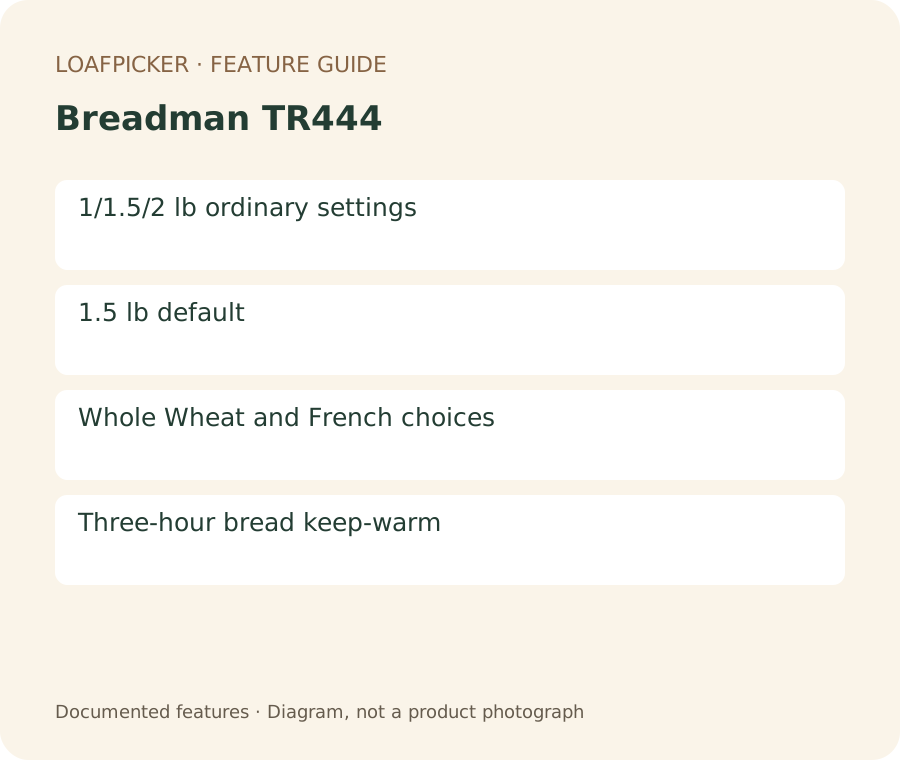
 Original LoafPicker feature diagram. Product references appear below. Not a product photograph.
THE FIT AT A GLANCE
At a glance
Ordinary wheat bread and separately shaped dough across three nominal sizes.
Deluxe Rapid completion time is unverified, and the menu lacks dedicated GF, Jam and Cake programs.
Shop this model on Amazon ↗Affiliate link · Model search.
The TR444 centers on ordinary wheat bread rather than a long collection of specialty settings. Its manual documents nominal one-, one-and-a-half-, and two-pound loaf sizes, a Whole Wheat choice, a French choice, and a Dough program. The attraction is easy to understand for someone who wants one machine to cover a small loaf during the week and a larger loaf when more people are eating. The limitation is equally concrete: the complete menu does not supply a dedicated gluten-free, jam, or cake program.
This reference uses the exact TR444 booklet from the maker's use-and-care archive. The archived PDF is laid out as imposed and repeated booklet pages, so its file length should not be confused with the number of unique instruction pages. Its back cover identifies TR444, and the Salton-era artwork establishes it as a legacy appliance reference. Present production, a current retail price, and replacement-pan availability have not been verified. These notes help assess the model's documented workflow, not the condition of an unseen example.
The default is the middle size
One detail worth learning before the first bake is the default loaf setting: one and a half pounds. A baker accustomed to a machine that starts at two pounds should check this explicitly. Selecting the correct size is part of following a formula, since the program's baking treatment is matched to the intended quantity. The three nominal sizes describe the ordinary loaf controls; they should not be used as proof that every specialist recipe has been validated at every size.
For White bread, the time table lists 180 minutes at one pound, 200 minutes at one and a half pounds, and 210 minutes at two pounds. Those differences make the size setting relevant to scheduling as well as capacity. The menu gives White three separate shade choices—Medium, Dark, and Light—alongside Whole Wheat, Fruit & Nut, Deluxe Rapid, French, and Dough. Counting those choices accurately is more useful than describing all of them as different bread recipes. The three White entries primarily offer crust treatment within the same bread family.
Deluxe Rapid needs particular care in a comparison. The manual includes recipes labeled for one-and-a-half- and two-pound loaves, but the inspected timing chart does not provide a reliable Deluxe Rapid completion time. A one-pound rapid recipe was not verified either. It would be misleading to fill those gaps with a fifty-eight- or fifty-nine-minute time from another Breadman. Someone whose main purchase criterion is a specific quick-bread deadline should confirm the actual machine and recipe instructions before relying on this menu name.
A useful dough maker without documented stage programming
Dough is the natural choice when the owner wants the machine to handle preparation while the loaf or rolls are shaped and baked outside the pan. That can extend the appliance's usefulness beyond its own finished-loaf shape. It still leaves shaping, proof assessment, and oven baking to the baker. The reviewed booklet does not establish a user-programmable sequence of knead, rise, and bake stages, or saved personal recipes. Having a Dough button should not be presented as that more advanced kind of customization.
The absence of a dedicated gluten-free preset is confirmed by the complete program list. A model-specific gluten-free recipe route was not verified in this booklet, so a dedicated GF workflow is not established. The same disciplined reading applies to Jam and Cake: neither appears as its own selection. An owner may have other ways to use a bread pan, but a buying reference should describe supported instructions rather than assume that neighboring Breadman machines share the same capabilities.
Manual additions are part of the routine
The appliance uses a signal for hand-added ingredients; an automatic fruit-and-nut dispenser is not documented. The manual specifically discusses the addition step for White, Fruit & Nut, Whole Wheat, and French. A broader passage is less precise about other programs, so rapid-course eligibility should not be inferred from it. For a fruit loaf, the owner should expect to be nearby at the indicated point rather than assuming ingredients can be loaded into a compartment and forgotten.
Delay operation runs from four to thirteen hours and is excluded for the rapid selection and Dough. The booklet uses more than one rapid-course wording, but the practical restriction is clear enough to keep Deluxe Rapid outside a delayed-bread promise. For eligible bread, the timer should be set around the desired completion time and used only with suitable ingredients. A program accepting a timer setting does not remove the need to avoid holding perishable mixtures for an extended period.
The three-hour keep-warm period, excluding Dough, gives the finished bread a broad collection window. That is not the same as a recommendation to leave every loaf inside for all three hours. Following the removal and cooling instructions is still useful for managing crust texture and getting a loaf that slices cleanly. The timer and keep-warm feature solve different scheduling problems: one decides when bread finishes, while the other begins after the baking program ends.
Inspect the removable parts before buying an older unit
A single nonstick pan and kneading paddle do the mixing and baking work. The care directions call for hand washing, prohibit dishwasher cleaning, and caution against long soaking. On a used appliance, check the coating, the paddle's fit, and the pan's drive connection before being persuaded by a working display. These pieces face heat and repeated mixing loads, and their condition directly affects whether the documented programs are usable. Exact replacement-part numbers and present stock were not established in this research.
Verified outside dimensions and a model-specific electrical rating were not recovered from the inspected booklet, so they remain checks for the appliance label and a tape measure. The TR444's best fit is a baker who wants three ordinary loaf sizes and is comfortable choosing from a small menu. Its tradeoff is limited verified specialty support and unresolved rapid timing. Those boundaries make a much more useful decision guide than borrowing features or specifications from another TR-series machine.
Documented specifications
- Model
- TR444
- General loaf sizes
- 1 lb, 1.5 lb, 2 lb
- Dedicated GF course
- No
- GF capacity basis
- No dedicated GF selection in the complete menu and no verified model-specific GF recipe.
- Automatic add-ins
- No
- Complete adjustable cycle
- Not confirmed
- Body dimensions
- Not confirmed in the primary sources used here