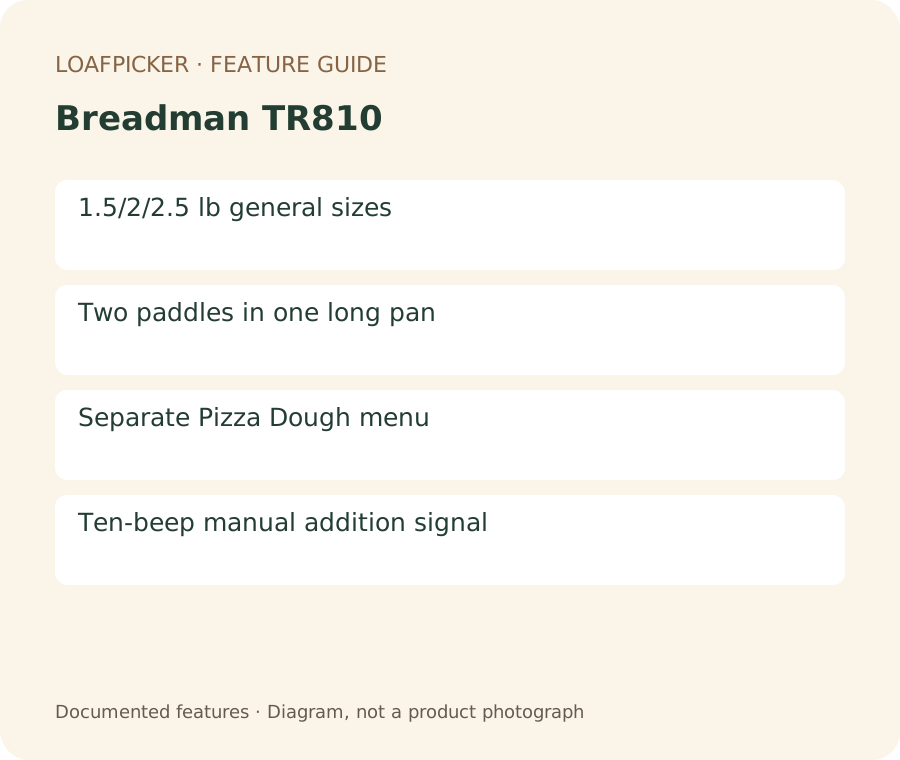
 Original LoafPicker feature diagram. Product references appear below. Not a product photograph.
THE FIT AT A GLANCE
At a glance
An owner wanting a larger single loaf and separate Bread Dough/Pizza Dough menus.
Several program totals and Rapid control rules conflict between the chart and operating prose.
Shop this model on Amazon ↗Affiliate link · Model search.
The TR810's defining arrangement is a long pan worked by two kneading paddles. It makes one loaf, with nominal one-and-a-half-, two-, and two-and-a-half-pound settings. That could appeal to a household wanting a substantial loaf from a machine with ordinary bread and dough menus. It should not be confused with a two-pan Breadman that can make separate recipes at once. The two paddles serve the same mixture, and the condition of both paddles and their drive connections matters on an older unit.
The exact TR810 manual survives as a scanned PDF in the maker's archive. Its model heading and illustrated parts identify the appliance directly, and the program chart carries 1998 copyright information. Several program descriptions disagree with the chart, so this reference keeps those conflicts visible. Current production, a current price, and present replacement-part support have not been established. The research describes documented behavior and open checks rather than a hands-on test of a particular machine.
A two-pound default and ten menu choices
Two pounds is the default size. The menu covers White, Fruit & Nut, Whole Wheat, Whole Wheat Rapid, French, Rapid White, Bread Dough, Pizza Dough, Jam, and Batter. The variety can be useful for someone who wants both finished bread and dough to shape separately. It does not include a dedicated gluten-free preset. A model-specific gluten-free recipe route was not verified in the inspected source, so ordinary size controls should not be converted into supported gluten-free loaf sizes.
Rapid White is a good example of why the complete manual matters. The chart lists medium-crust times of 100 minutes at one and a half pounds, 105 minutes at two pounds, and 110 minutes at two and a half pounds. Operating text elsewhere says to skip the size step for Rapid and indicates no crust choice for French and Rapid. That conflicts with the more expansive table. The times can be recorded as chart evidence, but selectable Rapid sizes and crust controls should not be presented as settled facts.
This is also not a one-hour express machine based on the documented Rapid White table. A buyer comparing it with later fifty-eight-minute programs should compare recipe, loaf quantity, and the actual sequence. Whole Wheat Rapid is a separate menu from Rapid White; neither name permits assuming a duration from another Breadman. For an owner with the appliance already present, the control panel's response and a matching instruction edition may help resolve the selection conflict.
Two dough routes, with a timing caveat
Bread Dough and Pizza Dough are distinct selections. They provide routes to mixing and dough preparation before hand shaping and separate baking. The chart gives Pizza Dough sixty minutes, which is a specific, useful schedule for that program. Bread Dough is less certain: the chart gives ninety minutes while a prose passage gives one hundred. An owner planning the next oven step should allow for that uncertainty until the actual unit's countdown has been checked against the booklet.
Jam and Batter have similar documentation problems. Jam is eighty minutes in the chart and 110 minutes in prose; Batter is 110 minutes in the chart and 120 minutes in prose. Their presence as menu choices is supported, but a single definitive total is not. Keeping the function while withholding an uncontested time is a more accurate assessment than discarding the program or selecting whichever number looks more plausible. These conflicts are practical scheduling issues for anyone hoping to coordinate bread, dinner, and an oven bake.
The timer has a narrower menu scope than expected
The delay setting runs from four to thirteen hours, but it excludes Fruit & Nut, Batter, Bread Dough, Pizza Dough, Jam, and Rapid. That is a significant limitation for someone who wants a fruit loaf ready without being present. A timer headline by itself would hide that restriction. Eligible ordinary bread still needs an ingredient check; the availability of a delayed setting is not permission to leave a perishable mixture at room temperature for many hours.
Additions are manual, prompted by ten beeps where directed. There is no documented automatic fruit-and-nut compartment. The owner must therefore be present when the recipe calls for ingredients during mixing, and should not assume the two-paddle layout changes that workflow. A sixty-minute keep-warm period is shown for the bread programs. It provides a short collection window after baking, while removal and cooling remain important parts of handling the finished loaf.
Useful presets do not establish full-cycle customization
The reviewed instructions do not document saved personal recipes or user-editable knead, rise, and bake stages. Full-cycle customization remains unverified. The presence of several dough and bread selections gives choices within the preset structure; it does not prove the kind of stage control found on a TR2200C or TR4000. A ten-minute power-interruption backup is explicitly described, but that limited interval should not become a promise that bread will recover after a long loss of power.
The two nonstick paddles and pan need gentle hand cleaning. The booklet prohibits putting the pan or lid in the dishwasher, and warns against soaking the pan or the sensor-equipped lid. On a used example, inspect the coating, both paddle attachments, the pan's underside, and the way it locks into the machine. An appliance that heats but has a damaged drive or missing paddle may not be practical to restore. Verified replacement part numbers, current stock, exterior dimensions, and a model-specific electrical rating remain open checks.
Who should investigate this model
The TR810 is most plausible for someone wanting a larger single loaf and accepting an older, preset-based machine with manual additions. Its two-paddle pan and separate pizza-dough route are concrete reasons to investigate a sound example. The tradeoff is documentation that cannot support precise timing promises for several programs. A matching label, complete removable parts, and a check of the actual controls are especially valuable here. They turn unresolved details into specific owner checks instead of allowing an attractive capacity figure to stand in for the whole buying decision.
Documented specifications
- Model
- TR810
- General loaf sizes
- 1.5 lb, 2 lb, 2.5 lb
- Dedicated GF course
- No
- GF capacity basis
- No GF course in the complete ten-choice menu; no checked GF recipe route.
- Automatic add-ins
- No
- Complete adjustable cycle
- Not confirmed
- Body dimensions
- Not confirmed in the primary sources used here