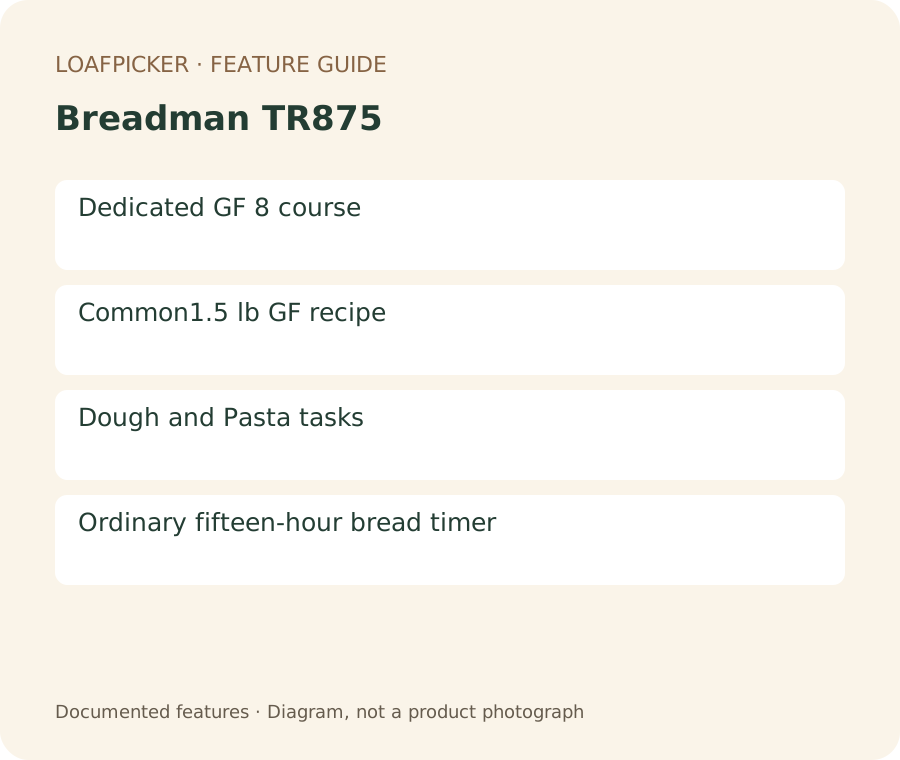
 Original LoafPicker feature diagram. Product references appear below. Not a product photograph.
THE FIT AT A GLANCE
At a glance
Bakers wanting ordinary1.5/2 lb presets and a dedicated GF course with a documented1.5 lb starting recipe.
GF capacities and dough/timer details differ across original editions; verify the actual unit/booklet before depending on disputed options.
Shop this model on Amazon ↗Affiliate link · Model search.
The TR875 combines ordinary 1.5 and 2 lb bread settings with a dedicated Gluten Free course and separate dough, pasta, jam, and bake tasks. Its strongest buying case is a household that wants everyday bread and a documented gluten-free starting recipe without needing a full custom-cycle editor. The complication is that original manual editions disagree on some capacities and scheduling details. Owners should identify the booklet that matches their machine rather than combine the most generous statement from each edition.
The officially archived TR875 instruction manual provides the principal evidence. A second original TR875 edition dated 2006 in its production filename has a more detailed cycle chart and several different entries. Both describe the same named model and a 120 V appliance. This assessment preserves the differences, with no claim of a present new-unit offer or hands-on performance comparison.
Ordinary loaf sizes do not settle gluten-free capacity
The standard loaf control offers 1.5 and 2 lb. The official archive's Gluten Free menu list gives 1.5 lb for each crust shade, while the other edition lists both 1.5 and 2 lb. Both include a specific 1.5 lb gluten-free country-white recipe. That shared recipe and label are stronger ground than assuming the two-pound ordinary setting applies universally. The two-pound gluten-free option remains edition-dependent.
A buyer who needs a larger gluten-free batch should settle that distinction before choosing this machine for capacity. A household happy with the documented 1.5 lb recipe has a more straightforward starting point, subject to checking the actual booklet and controls. The recipe is not simply white bread with wheat flour swapped out: it uses several specified flours and starches with xanthan gum, eggs, and dry milk. The instructions call for checking mixing and scraping the sides during kneading.
That attendance requirement matters. The course offers a defined sequence, but does not guarantee that every gluten-free blend will incorporate without help. The provided recipe also includes ingredients that make delayed waiting inappropriate under the manual's perishable-ingredient cautions. A person looking for completely unattended breakfast bread should evaluate the recipe and timer together rather than combine a dedicated-course badge with a fifteen-hour headline.
Timer eligibility needs the correct edition
The official archive describes a fifteen-hour delayed finish and expressly discusses using delay with Dough. The older detailed chart marks Dough, Pasta, and Gluten Free delay as unavailable, while the newer general section gives a narrower explicit exclusion. These are real document differences. This record does not promise delayed dough or gluten-free operation as a stable feature across all TR875 examples.
For ordinary eligible bread, the timer represents the interval to completion rather than an extra fifteen hours added after the bake begins. The manuals also restrict perishable ingredients. If an owner intends to prepare a plain loaf later, the relevant question is whether the selected course and formula match the booklet supplied with that unit. If arriving home to dough ready for shaping is essential, verify that actual control behavior with model-matched instructions before relying on the feature.
Rapid modifiers and Super Rapid are different choices
The controls provide rapid options within bread families as well as a separately named Super Rapid course. The older chart gives Super Rapid totals of 1 hour 17 minutes and 1 hour 20 minutes by size, despite a general description referring to approximately an hour. A strict sixty-minute requirement should therefore not be treated as met. Recipe-specific yeast and liquid directions remain important when moving to a shorter process.
Someone baking after work may find the roughly eighty-minute route useful if its recipe suits the meal. Someone expecting an ordinary whole-wheat formula to behave identically on a faster setting has a different problem. Shortening fermentation is a recipe change, not only a convenience button. The chart is useful for planning, but the manual's inconsistent wording means an owner should avoid treating a rounded promotional time as an exact promise.
Dough and pasta have different finishing jobs
Dough prepares a risen mixture for shaping and finishing outside the appliance. Pasta is a separate mixing route. These can be useful even if the machine's baked-loaf size is not the main attraction: rolls and pizza allow the cook to choose a shape and oven finish. They still require removing the mixture at the appropriate point, and the instructions warn against leaving completed dough to over-rise in the machine.
Bake Only is another distinct task, useful for appropriate prepared dough or additional baking, but its time descriptions also differ within the documentation. It should not be promoted as a complete editor for arbitrary kneading and fermentation stages. The TR875 has no documented saved personal-cycle system. A baker who wants to specify an entire long fermentation process needs a different, expressly described control capability.
Additions, recovery, and condition
The parts and operating instructions show a single paddle and manual ingredient handling, with no automatic fruit-and-nut compartment. An addition signal requires a person to act. This may be unimportant for a plain loaf and decisive for a raisin loaf scheduled while everyone is absent. The seven-minute outage memory is documented, but longer interruptions have additional instructions and should not be treated as harmless.
The pan and lid must not go into a dishwasher in the official archive's care instructions. Inspect the pan coating, shaft, paddle fit, and exact label on an older example, and measure the body because verified exterior dimensions are not supplied here. The TR875's clearest strengths are its dedicated gluten-free route and practical preset tasks. Its clearest limitation is edition-dependent detail: capacity, timer, and some bake behavior should be verified for the actual machine before they become deciding purchase features.
Documented specifications
- Model
- TR875
- General loaf sizes
- 1.5 lb, 2 lb
- Dedicated GF course
- Yes
- GF capacity basis
- The official archive and both original recipe editions document a 1.5 lb gluten-free loaf. Only the 2006 edition adds 2 lb, so that larger capacity is not treated as consistent across editions.
- Automatic add-ins
- No
- Complete adjustable cycle
- No
- Body dimensions
- Not confirmed in the primary sources used here