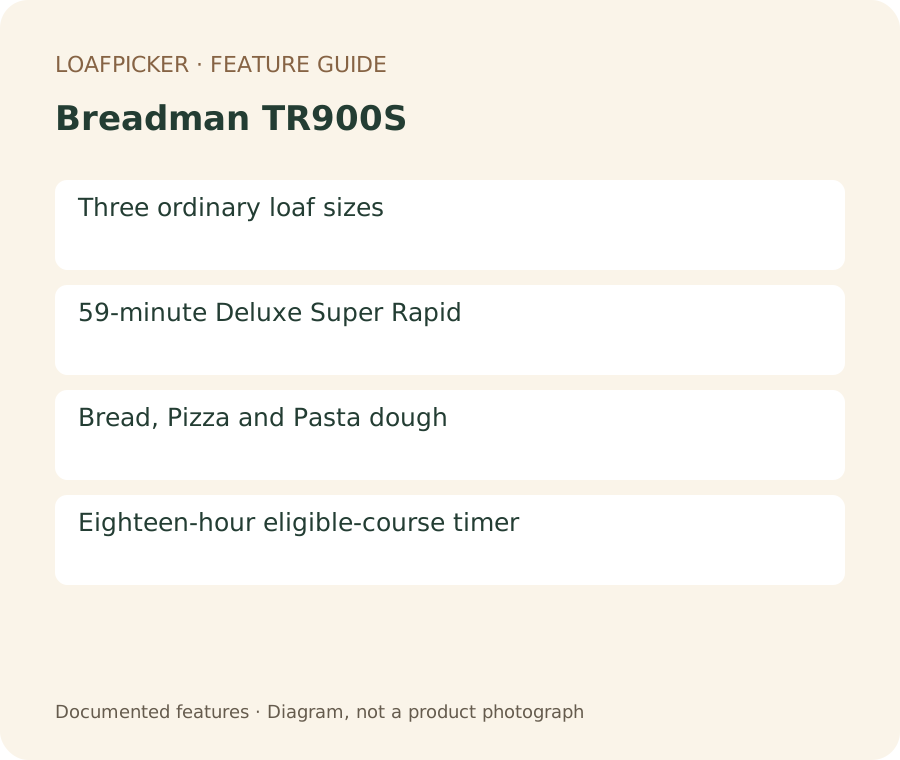
 Original LoafPicker feature diagram. Product references appear below. Not a product photograph.
THE FIT AT A GLANCE
At a glance
Households alternating ordinary loaf sizes and preparing rolls, pizza or pasta for separate finishing.
Fruit-and-nut additions are manual; presets do not form a custom stage editor, and Pasta delay instructions conflict.
Shop this model on Amazon ↗Affiliate link · Model search.
The TR900S Pro makes the most sense for a household that wants ordinary pan bread and also shapes food for oven finishing. Its original manual distinguishes Dough, Pizza Dough, and Pasta Dough, instead of hiding all three under one generic task. It also gives 1, 1.5, and 2 lb bread settings and a genuinely separate fifty-nine-minute Deluxe Super Rapid course. Those are concrete differences a buyer can compare against a weekly baking routine.
The original TR900S instruction and recipe guide identifies fourteen courses. Its specification page gives 120 V, 60 Hz power and an approximately 16 by 9 by 13 inch body in width-depth-height order. These are manufacturer-document figures, not a measurement of the particular used unit offered for sale. Present availability, replacement parts, and baking performance have not been tested here.
Ordinary size selection is well documented
The program chart supplies three labeled loaf sizes across ordinary bread families and gives different times by size and crust. For a household alternating between a small weekday loaf and a larger weekend batch, those explicit choices are more useful than a maximum-capacity headline. The one-pound option does not mean every recipe in the book can be reduced to that amount: batter breads, jam, and individual dough tasks have separate instructions.
Whole Wheat begins with a rest that lets the flour absorb liquid. The manual warns that no movement during that period is normal. An owner seeing an apparently inactive pan should therefore check the selected course and stage before concluding that the drive has failed. This is a practical reason to keep the complete guide with an older machine. It explains behavior that a short seller description is unlikely to cover.
Fruit & Nut is not an automatic ingredient case
The Fruit & Nut course changes the bread process for recipes with sweeter ingredients and additions. The manual describes audible prompts for checking the mixture and adding ingredients by hand. Its parts and operating sections do not identify an automatic dispensing compartment. A buyer who wants raisins or nuts released without returning to the machine should not treat the course name as proof of that hardware.
For a cook who is already nearby, the prompt can be a useful intervention point. For a loaf scheduled while the household is away, it changes the recipe choice and routine. A plain loaf and a bread requiring late additions are not equally unattended. This distinction matters particularly when comparing the TR900S with a design that explicitly documents an automatic case for the intended course.
Rapid courses and Deluxe Super Rapid have different roles
The manual includes rapid counterparts to several bread families and a distinct Deluxe Super Rapid course. The detailed chart gives fifty-nine minutes for Deluxe Super Rapid at each of the three loaf labels. Ordinary Rapid White can take substantially longer, depending on crust and size. A claim that this machine makes every bread in an hour would therefore be inaccurate.
A person choosing the fifty-nine-minute process should follow its matching recipe and ingredient temperatures rather than transfer an ordinary loaf unchanged. Someone who wants a particular whole-wheat formula may prefer the longer course. Speed is useful when the appropriate formula is acceptable; it is not evidence that shortening fermentation preserves every recipe's texture. The manual's chart supports planning different meals around different routes.
Dough, Pizza, and Pasta are meaningfully different
Dough includes a proof and varies from 1 hour 24 minutes to 1 hour 30 minutes by its listed batch size. Pizza Dough has a fifty-minute sequence with less kneading and rising. Pasta Dough is a fourteen-minute mixing task without a yeast-bread proof. A baker making rolls, a cook planning pizza, and someone mixing fresh pasta consequently have different appropriate selections. Printed pages 8–10 explain and chart these courses.
All require finishing decisions outside the machine. Rolls need shaping and subsequent baking; pizza needs shaping, toppings, and an oven or other appropriate baking method; pasta needs forming and cooking. None of those uses proves a user-editable fermentation stage. The TR900S's many preset variations are not a saved custom-cycle library. Someone designing an arbitrary long sourdough process should not confuse a detailed timing chart with controls that permit changing every row.
The eighteen-hour timer needs a course-specific reading
The delayed-finish section excludes Deluxe Super Rapid, Jam, and Pasta Dough, and prohibits perishable ingredients. It supports delayed ordinary Dough and Pizza Dough with an appropriate recipe. Another dough-method paragraph includes Pasta Dough in a general delay instruction, creating a conflict for that one course. I retain Pasta delay as unresolved rather than use the broad sentence to override the explicit exclusion.
For someone wanting pizza dough ready after work, the documented Pizza route is a relevant advantage, provided the recipe and pickup time are suitable. Someone preparing an egg-rich roll recipe cannot assume the timer makes those ingredients appropriate for waiting. The display represents time until completion, not eighteen hours of waiting followed by the full course. This distinction prevents a simple timer calculation from becoming an incorrect dinner plan.
Dietary requirements and ownership limits
No dedicated gluten-free course appears in the complete fourteen-course list. Batter Bread uses chemical leavening for suitable recipes, which is a different statement from dedicated gluten-free support. A machine's ability to mix and heat ingredients does not validate a particular dietary formula. Buyers whose central requirement is a dedicated gluten-free route should compare a model that documents one.
The guide describes sixty-minute outage memory and course-specific one-hour keeping warm, excluding the rapid specialty, batter, and dough-related tasks listed in the chart. Inspect the actual pan, paddle, coating, cord, and controls, and check the open-lid working space beyond the stated body dimensions. The TR900S's strongest fit is flexible everyday batch size plus distinct dough preparation. Its tradeoffs are manual additions, preset rather than personal-stage control, and a Pasta-delay contradiction that deserves to stay visible.
Documented specifications
- Model
- TR900S
- General loaf sizes
- 1 lb, 1.5 lb, 2 lb
- Dedicated GF course
- No
- GF capacity basis
- Complete fourteen-course menu has no dedicated GF course. Batter Bread is not automatically gluten-free.
- Automatic add-ins
- No
- Complete adjustable cycle
- No
- Body dimensions
- 16 × 9 × 13 in (W × D × H)