Owner/regional-configuration reference: no authenticated North American electrical rating, with unresolved GF recipe ingredient conflict.
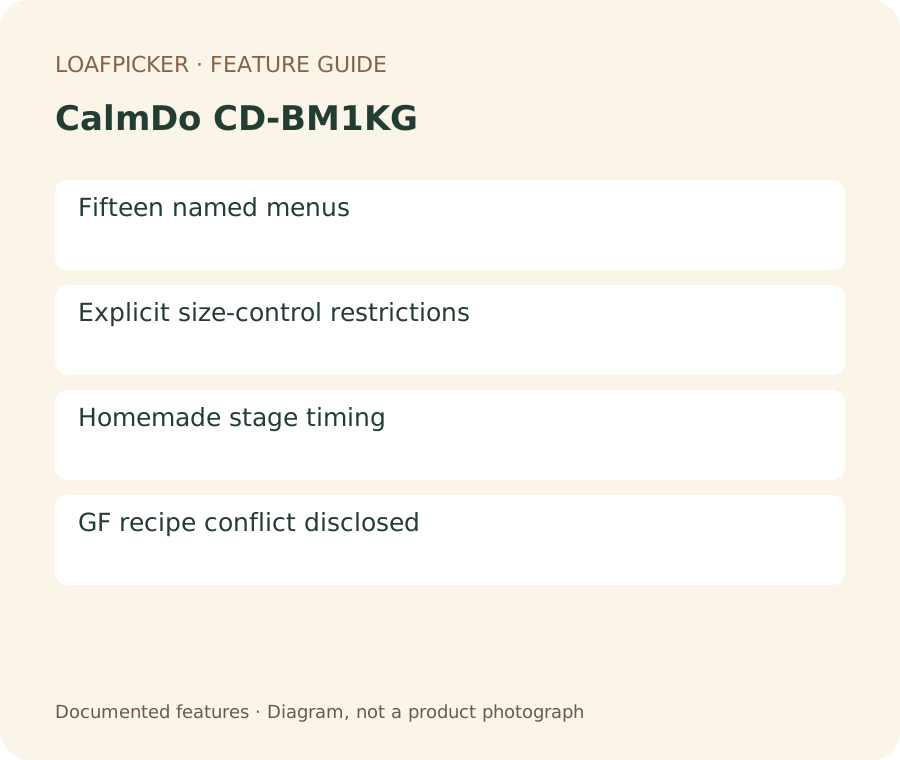 Original LoafPicker feature diagram. Product references appear below. Not a product photograph.
THE FIT AT A GLANCE
At a glance
Owners matching CD-BM1KG controls and exploring documented Homemade stage times for suitable non-GF recipes.
Electrical region and automatic fruit-box release unverified; GF recipe contains a conflicting high-gluten flour label.
Shop this model on Amazon ↗Affiliate link · Model search.
The CD-BM1KG has an exact model-labeled manual and a documented Homemade editor for individual process times. It also names a dedicated Gluten Free course. The latter needs a significant qualification: the inspected French manual's gluten-free recipe includes an ingredient labeled high-gluten flour. Until a corrected exact-model formula is verified, this page does not recommend the machine for gluten-free buying decisions. A dedicated course and a coherent dietary recipe are separate requirements.
The original-format CalmDo CD-BM1KG manual is preserved by an independent host. It identifies fifteen menus and a rotary Menu/Weight/Color control. An electrical rating and an authenticated North American configuration were not established from the inspected material. This record therefore remains an owner and regional-configuration reference, with no asserted current offer, ASIN, price, or tested performance.
The printed loaf labels are program-specific
The instructions pair 500 g with 1 lb, 750 g with 1.5 lb, and 1000 g with 2.2 lb. These are the source's nominal labels, not newly calculated conversions. Weight selection applies to menus 1–7 and is unavailable on 8–15. The Gluten Free course is number 7, so the program instructions establish its selector eligibility; the ordinary maximum is not being copied into gluten-free data merely because a recipe exists.
For someone alternating plain bread sizes, the control scheme is comparatively clear. For someone preparing dough, jam, or cake, those same loaf buttons do not establish a selectable quantity. A task's recipe determines the amount. The model name's “1KG” should not be interpreted as one kilogram of flour or an unrestricted batch size for every menu. The ingredients, nominal loaf label, and final food weight remain different measurements.
The gluten-free ingredient conflict must remain explicit
Menu 7 is titled gluten-free bread, and its introduction discusses gluten-free flour. The accompanying table nevertheless labels one ingredient “farine riche en gluten,” meaning high-gluten flour, alongside corn flour. That wording contradicts the recipe's stated purpose. The problem could require a corrected document or clarification, but it should not be silently replaced with a guessed ingredient. The conflict appears on displayed page 24, printed page 22.
For an owner, the useful next step is to obtain a corrected formula from an identifiable manufacturer source for the exact unit and manual revision. It would be inappropriate to present the printed formula as gluten-free or to claim that changing one word yields a verified recipe. For a prospective buyer with this as the primary requirement, a model with a consistent, complete recipe is a more defensible comparison. This page retains the existence of the course while withholding the dietary recommendation.
Homemade is a real timing editor
The Homemade section provides separate times for mixing, rests, fermentation stages, baking, and keeping warm. The table gives adjustment ranges, and the instructions explain selecting menu 15. This is stronger evidence than a marketing phrase such as “customizable bread.” It supports changing the sequence's stage durations, rather than only choosing a preset size or crust. Displayed page 31 contains the stage table.
A baker who wants a longer rest or different proof sequence can investigate those controls for a suitable recipe. The document does not establish several saved personal memories or numerical temperature selection for each stage. It also does not prove an independent fermentation-only program. Someone seeking unrestricted starter management should read the actual ranges and determine whether the desired process fits them, rather than treating Homemade as unlimited control.
Quick is not a verified rapid yeast-loaf promise
The manual describes Quick in terms that include baking powder or baking soda, while also discussing shorter preparation. That makes it important to follow the selected recipe's leavening method. A quick chemically leavened bread and a shortened yeast loaf are different foods and workflows. The name does not establish a strict under-an-hour bread option or justify applying its time to an ordinary French or whole-wheat formula.
The menu also separates Mix, Dough, Bake, Cake, Dessert, Yogurt, and Jam. For pizza or rolls, Dough prepares a mixture that still needs shaping and finishing; Mix is a different task. Those distinctions are more useful than describing all fifteen entries as bread types. A yogurt recipe's sample milk amount likewise does not establish the pan's maximum yogurt capacity or an appropriate amount for unrelated foods.
The fruit box does not prove automatic dispensing
The parts illustration labels a fruit box and a single kneader. The inspected operating instructions do not establish an automatic release procedure or a course-by-course eligibility chart for that box. This record therefore leaves automatic dispensing unknown. A compartment in a drawing can be worth investigating, but it is insufficient evidence that fruit will enter a gluten-free or dough recipe at the correct time.
A shopper interested in automatic additions should obtain the instructions showing when the box opens, how it is enabled, and which ingredients and courses are supported. An owner should also check that the physical unit matches the illustration. This is a meaningful distinction from machines whose manuals explicitly instruct loading nuts into a timed case and selecting an Extras function.
Confirm the regional label and timer details
The manual describes up to fifteen hours until completion, a one-hour warming period, and ten-minute interruption recovery. It prohibits delayed recipes with dairy, eggs, and similar ingredients. A complete program-specific delay table was not established, so the general timer claim does not become an assured delayed gluten-free or dough workflow. Read the actual rating plate before making any regional electrical assumption; a French-language manual does not itself identify voltage.
Measure the unit and open-lid clearance because verified exterior dimensions remain unknown. The decisive attractions are the explicit size-control rules and adjustable Homemade times. The decisive limitations are the gluten-free ingredient conflict, unverified automatic box behavior, and unresolved electrical configuration. Those are concrete reasons to treat this as an owner reference until the missing evidence is supplied.
Documented specifications
- Model
- CD-BM1KG
- General loaf sizes
- 1 lb, 1.5 lb, 2.2 lb
- Dedicated GF course
- Yes
- GF capacity basis
- Size control applies menus 1–7, including dedicated GF 7; recipe table also labels all three. These are manual labels, not new metric-to-pound conversions.
- Automatic add-ins
- Not confirmed
- Complete adjustable cycle
- Yes
- Body dimensions
- Not confirmed in the primary sources used here