Owner reference: the English operating source covers BMKR-200 Series, while the exact-PC Spanish document is a Mexican-import edition. Confirm the actual region and panel before applying series instructions.
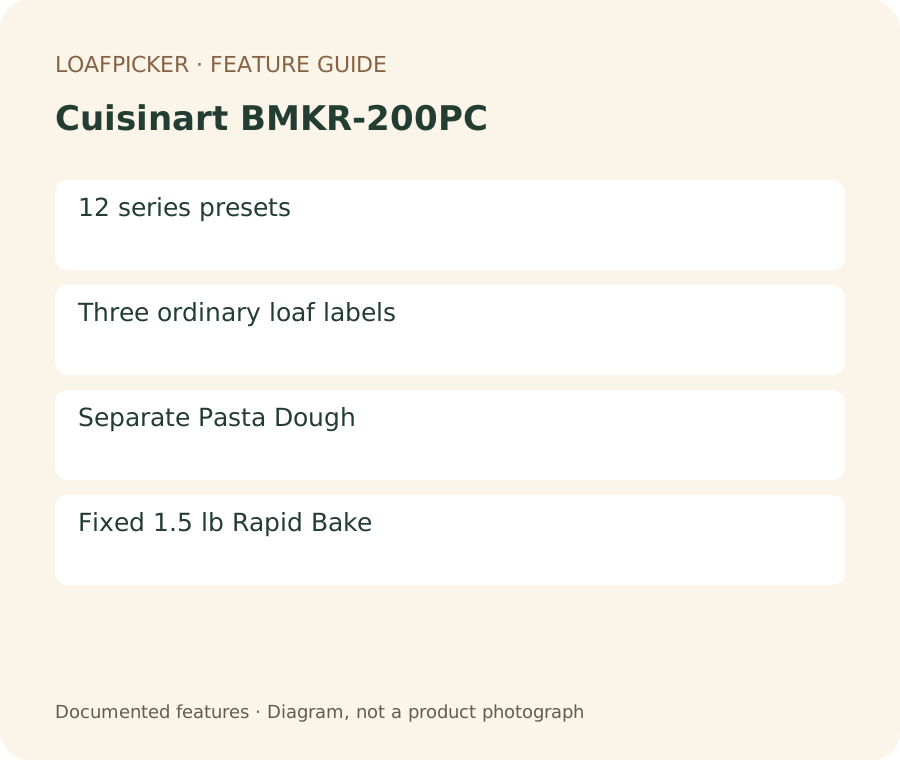 Original LoafPicker feature diagram. Product references appear below. Not a product photograph.
THE FIT AT A GLANCE
At a glance
Preset conventional bread plus separately documented yeast Dough and Pasta Dough tasks.
No full stage editor; delay is discouraged for Dough, Jam and Gluten Free, and forbidden on Rapid Bake.
Shop this model on Amazon ↗Affiliate link · Model search.
The BMKR-200PC is worth identifying carefully because its retailer-style code resembles other Cuisinart machines with different features. The appropriate starting document is the original BMKR-200 Series booklet, which describes twelve programs, three ordinary loaf sizes, and a separate Pasta Dough function. It does not justify assigning the convection features or Artisan Dough program of the BMKR-400PC to this machine. The 200-series machine suits a cook who wants established presets and occasional dough preparation, provided the supplied panel matches the booklet.
Cuisinart's official compatible-model list explicitly names BMKR-200PC. The Costco-hosted original BMKR-200 Series instructions provide the operating evidence used here. An exact-PC Spanish booklet also identifies a Mexican importer, so the suffix should not be treated as proof of a particular country's electrical version. Read the rating label on the actual appliance and match its menu before using these series instructions.
Size flexibility has an important rapid-baking exception
The ordinary size control offers one-, one-and-a-half-, and two-pound labels, alongside light, medium and dark crust choices. This makes the series potentially useful for households whose bread demand changes during the week. The labels describe the intended loaf program and recipe combination, rather than a promise that every specialty task takes the same quantity. Follow a matching recipe instead of filling the pan to an assumed visual level.
Rapid Bake is deliberately more restrictive. The manual fixes that separate button to a one-and-a-half-pound loaf with medium crust; neither setting can be changed. It also requires rapid-rise yeast. A family hoping to make its usual two-pound loaf faster should therefore examine the Rapid Bake recipe first. The dedicated button is convenient for a compatible batch, but it is not a universal acceleration control for all three sizes.
Gluten-free bread has its own mixing sequence
The series includes a dedicated Gluten Free program. Its description calls for one rise and longer baking suited to a wet, batter-like mixture, with additions loaded at the beginning. That is a meaningful difference from merely including a gluten-free recipe that runs on Basic. However, the instruction booklet reviewed here does not establish a precise gluten-free weight range. The ordinary three-size control should not be used as evidence that every gluten-free batch is supported.
There is also a scheduling restriction: the manual discourages delay on Gluten Free. For a buyer whose main use is an unattended overnight gluten-free loaf, that limitation deserves more weight than the general thirteen-hour timer. An owner can still investigate immediate-start gluten-free baking with an appropriate model-matched recipe, but should not assume that a large ordinary loaf setting or the Rapid Bake button is a suitable substitute.
Dough and Pasta Dough perform different jobs
The Dough program mixes, kneads and takes yeast dough through its first rise. The user then removes it, shapes it, and completes the remaining proofing and baking elsewhere. The manual specifically excludes gluten-free dough from this general Dough description. For pizza or rolls, it provides a practical division of work: the appliance handles early mixing and rising, while the cook controls shape and the oven finish.
Pasta Dough instead mixes and kneads a dough that is removed and rested before rolling or processing. That separate task is a useful distinction for someone who already owns a pasta roller. It does not establish adjustable fermentation or a saved homemade cycle. The machine's Bake-Only setting, adjustable in ten-minute intervals up to ninety minutes, adds a finishing tool; it still does not provide an editor for every knead and rise.
Additions require the cook to return
The instructions describe an audible addition signal on Basic/White, Whole Wheat, French/Italian and Sweet. The owner opens the lid and adds the extra ingredients during the second knead. There is no documented automatic fruit-and-nut release system. Raisin bread may therefore require a visit to the kitchen even when an ordinary plain loaf could run without that intervention.
The later paddle-removal signal serves another purpose. It identifies a point after mixing when the cook may remove the paddle or reshape the dough. Doing so is optional and requires handling a hot pan carefully. It can also serve as a transfer point for a loaf that will finish in another pan. If removing the dough permanently, stop the machine properly; the manual warns that the process can otherwise resume after its pause interval.
Use the timer only for compatible bread
The thirteen-hour setting is the time until completion, adjusted in ten-minute steps. The manual prohibits it on Rapid Bake and does not recommend it for Dough, Jam or Gluten Free. It separately prohibits delaying recipes with perishable ingredients such as milk, eggs, cheese or yogurt. These are distinct restrictions: a course being available in the menu does not make every recipe appropriate for an overnight wait.
The manual also describes fifteen minutes of power-failure memory and an hour of warming after baking. Memory preserves the stage through a short interruption; it is not a fresh start time for ingredients already sitting in the pan. Cuisinart recommends removing finished bread promptly and cooling it on a rack, which is more helpful for planning good slicing texture than treating warming as a reason to leave a loaf inside indefinitely.
A useful older machine when its identity is checked
Choose the BMKR-200PC for its documented conventional presets and the distinction between yeast Dough and Pasta Dough. Verify the actual label, menu, pan and paddle before relying on a series booklet or ordering replacements. Choose a differently documented machine if precise gluten-free sizes, automatic additions, or programmable fermentation are essential. The main buying decision is whether those established preset workflows cover your baking; a similar Cuisinart model number cannot supply missing capabilities.
Documented specifications
- Model
- BMKR-200PC
- General loaf sizes
- 1 lb, 1.5 lb, 2 lb
- Dedicated GF course
- Yes
- GF capacity basis
- Dedicated Gluten Free described in BMKR-200 Series instructions; no exact GF loaf quantity established in the reviewed instruction section.
- Automatic add-ins
- No
- Complete adjustable cycle
- No
- Body dimensions
- Not confirmed in the primary sources used here