Discontinued Canadian CBK-110C owner/regional reference; regional suffix and service terms must remain explicit.
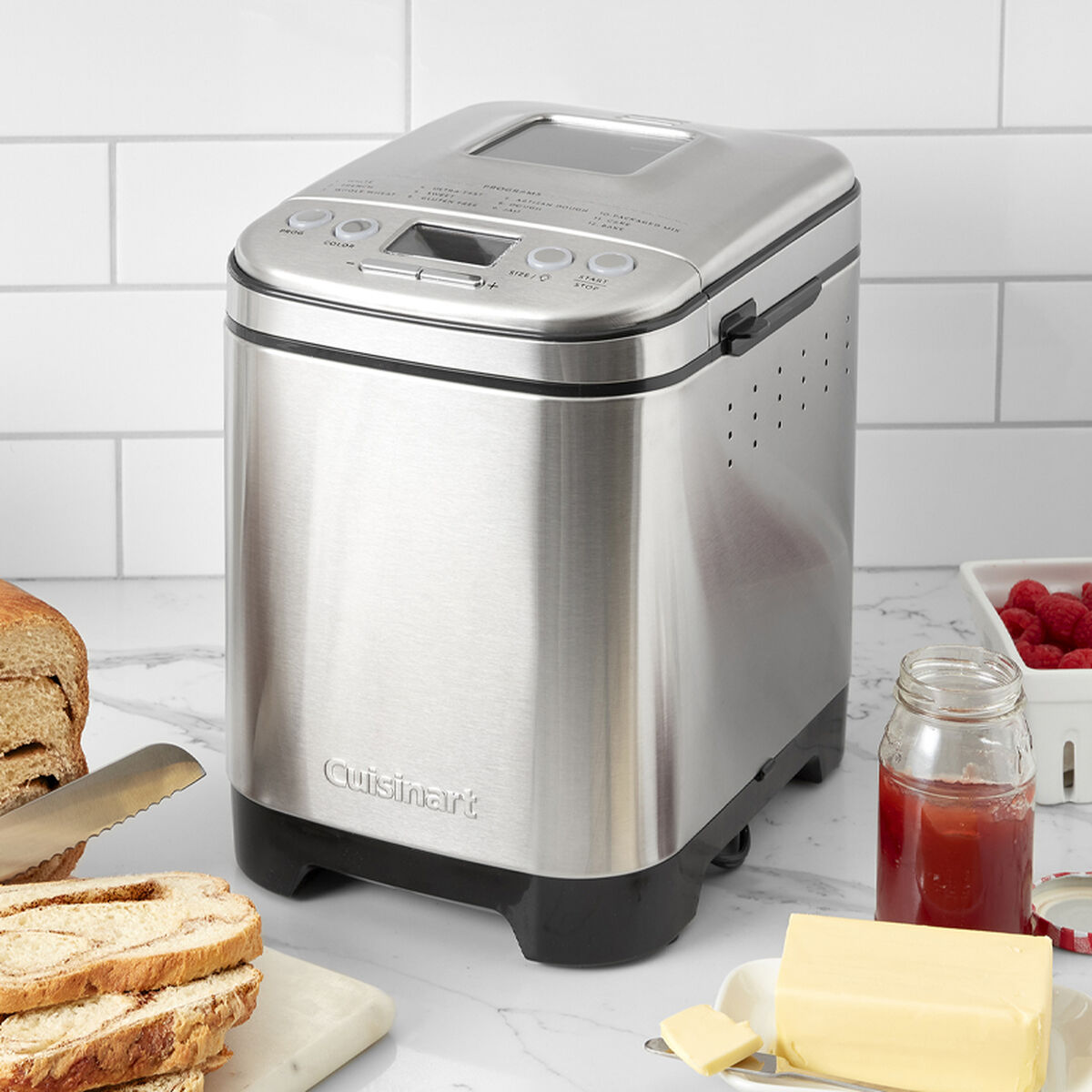 Cuisinart CBK-110C. Product photo: Cuisinart Canada.
THE FIT AT A GLANCE
At a glance
Canadian owners making vertical ordinary loaves or choosing between 1:30 Dough and 5:05 Artisan Dough.
Discontinued Canadian suffix, one listed GF batch, and no stage editor.
Shop this model on Amazon ↗Affiliate link · Model search.
The CBK-110C is the Canadian compact automatic bread maker, and Cuisinart Canada now marks the exact model as discontinued. It remains useful to an owner or a secondhand shopper because the manufacturer still supplies a model-specific manual. Its main attractions are a vertical pan, ordinary one- through two-pound choices, and a separate long Artisan Dough program. The Canadian suffix and its documented gluten-free quantity matter more than a general description of a compact Cuisinart machine.
The exact Cuisinart Canada product page identifies the model and discontinued status. The CBK-110C instruction booklet supplies its operating restrictions. This is a Canadian owner and regional reference; it should not silently stand in for a currently sold US model. The manual specifies use in 120-volt outlets, but electrical compatibility alone does not transfer country-specific service arrangements or make another suffix identical.
Compact housing still produces a vertical loaf
The manual explicitly identifies the removable pan as a vertical loaf pan with a nonstick surface. That can suit a household willing to slice a taller machine loaf. Someone wanting a conventional horizontal sandwich shape directly from the appliance should include pan orientation in the comparison, rather than deciding only from maximum loaf weight. A two-pound vertical loaf and a two-pound horizontal loaf are different shapes to handle and slice.
Ordinary bread choices include one-, one-and-a-half-, and two-pound labels on eligible programs. The timing tables show those choices for White, French and Whole Wheat. The general size button is not proof of universal support: the Sweet table lists smaller quantities, and the Gluten-Free table lists only one-and-a-half pounds. Check the program chart before scaling a familiar recipe or interpreting a missing size as a control fault.
The gluten-free table is more specific than the headline capacity
The CBK-110C has a dedicated Gluten-Free program. Its timing table identifies a one-and-a-half-pound, 680-gram batch taking two hours fifteen minutes. That is the documented gluten-free quantity in this manual; the two-pound maximum for ordinary bread does not establish a larger gluten-free batch. Nor does the existence of a one-pound ordinary setting establish a smaller gluten-free program.
The table provides an addition prompt and an optional paddle-removal point for this program. Those are useful intervention times for an owner, rather than evidence of an automatic ingredient dispenser. The troubleshooting section also advises checking wetter cake or gluten-free mixtures for ingredients stuck in the corners and pausing to scrape when needed. This supports a practical, attentive approach to the first batch instead of assuming every mixture will combine without inspection.
Artisan Dough asks for a different part of the day
The five-hour-five-minute Artisan Dough program uses several long, slow, cool rises. It prepares dough rather than delivering a baked loaf. Afterward, the user can shape and bake in a conventional oven or use the separate Bake program when appropriate. This is a useful option for a weekend bread project, but the timing needs to include shaping, final preparation and baking after the dough program finishes.
The ordinary Dough program is listed at one hour thirty minutes and takes dough through two rises. The manual excludes gluten-free dough from that general route. For pizza or rolls, it is a shorter preparation workflow with further shaping and rising performed by the cook. The distinction between these two dough programs is more meaningful than simply counting both as extra menu choices.
Ultra-Fast is a recipe choice, not a universal shortcut
The manual requires rapid-rise yeast for Ultra-Fast and explicitly excludes gluten-free recipes from that program. Its table gives one hour fifty-three minutes for a one-pound batch and two hours three minutes for one-and-a-half pounds. Someone planning a strict meal deadline should use the size-specific time, rather than assuming that the program's name means every batch takes under two hours.
Cake and Packaged Mix are separate tasks again. Packaged yeast mixes of one-and-a-half or two pounds are described as working best, while Cake concerns mixtures leavened with baking powder, soda and eggs. These distinctions help avoid sending a batter through the wrong yeast-bread process. They also show why the twelve-menu total is less useful than knowing which of your own recipes belongs on each setting.
The timer does not remove ingredient restrictions
The completion timer reaches thirteen hours, adjusted in ten-minute steps. Cuisinart prohibits delay for recipes containing perishables such as milk, eggs, cheese or yogurt. The general timer instructions do not establish every dough or gluten-free combination clearly enough to promise them here. A household depending on a particular overnight recipe should confirm that exact use before choosing this older Canadian model.
Additions are made by hand when the relevant signal sounds. A later prompt offers the option of removing the paddle before the final rise, which can reduce the paddle-shaped opening in a finished loaf. Neither operation is compulsory for every bread, but both require someone nearby. If unattended fruit-and-nut release is important, the CBK-110C's audible prompts should not be mistaken for a dispensing compartment.
Follow the manual's cleaning directions
The Canadian product page calls the pan and paddle dishwasher safe, while the model-specific manual directs hand washing with warm water and soap. Follow the manual's more conservative instruction for the nonstick parts. Inspect a used pan for wear, confirm the paddle turns appropriately, and avoid using metal utensils that can damage its surface. The disagreement is a reason to check cleaning guidance rather than assume a broad product-page statement overrides it.
The CBK-110C is most persuasive as a documented Canadian owner reference for ordinary vertical loaves and two distinct dough schedules. Its discontinued status, the single listed gluten-free quantity, and regional service context limit its usefulness as a general US buying recommendation. Select it with those specifics in view, especially if a seller is using the shorter CBK-110 name without showing the actual label.
Documented specifications
- Model
- CBK-110C
- General loaf sizes
- 1 lb, 1.5 lb, 2 lb
- Dedicated GF course
- Yes
- GF capacity basis
- The exact CBK-110C manual lists a 1.5 lb / 680 g gluten-free loaf at 2:15. Additional gluten-free sizes and active size-button behavior are not established.
- Automatic add-ins
- No
- Complete adjustable cycle
- No
- Body dimensions
- Not confirmed in the primary sources used here