1992 vintage owner and secondhand reference; exact unit condition and model-specific parts must be checked.
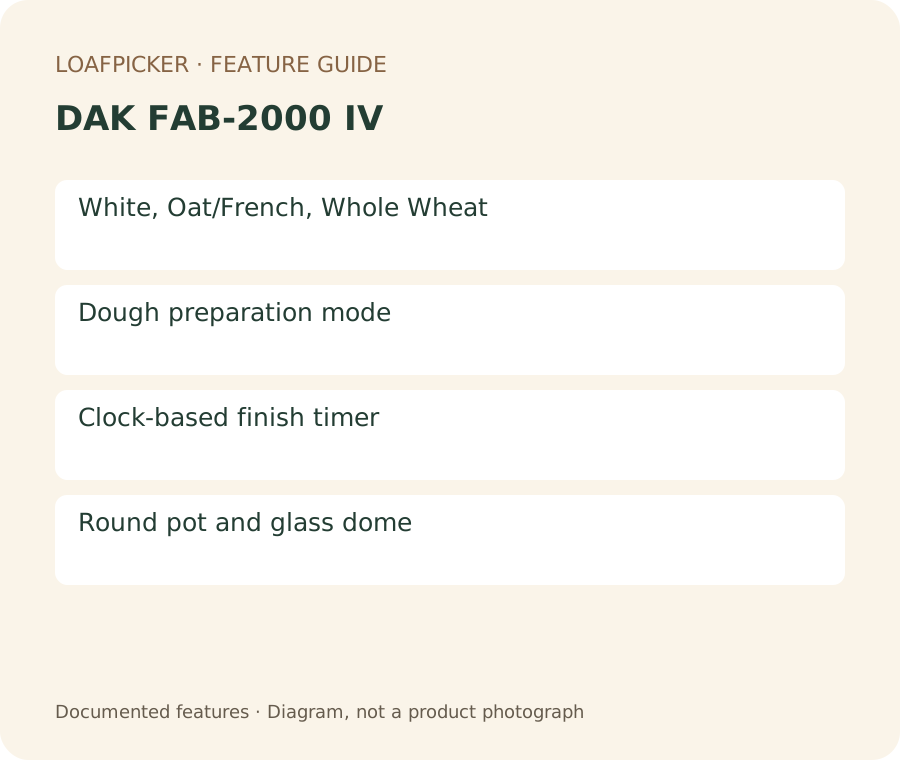 Original LoafPicker feature diagram. Product references appear below. Not a product photograph.
THE FIT AT A GLANCE
At a glance
Owners maintaining a complete vintage machine, or cooks interested in round loaves and dough for oven finishing.
Manual mode is dough-only preparation; it does not edit stages, and historical parts numbers do not establish present availability.
Shop this model on Amazon ↗Affiliate link · Model search.
The DAK Turbo Baker IV is most useful today as an owner and secondhand reference. Its original 1992 manual identifies model FAB-2000 IV and a distinctive round inner pot beneath a glass dome. This is a different proposition from a modern machine with a rectangular pan and a large named menu. An existing owner can use the original document to understand the controls and identify missing parts; a prospective buyer should decide whether maintaining this particular older appliance is part of the attraction.
The manual specifies 120 VAC, 60 Hz power, and gives the machine's dimensions as 14.75 inches high, 10.63 wide, and 12 deep. That means the footprint and shape need checking separately: a cylindrical loaf is not a conventional horizontal sandwich loaf. A counter location also needs room to open the dome and lift out the pot. These details are confirmed in the original DAK owner manual, cover and printed pages 4 and 18, rather than inferred from a marketplace description.
The capacity claim is not a set of size buttons
The specification page describes approximate bread weight “up to 4.5 lbs.” That is an unusually large claim, and it should remain exactly that: a historical specification, not permission to put an arbitrary 4.5-pound recipe into the pot. The inspected controls do not provide a modern sequence of 1, 1.5, and 2 lb settings. A recipe intended for another brand cannot be scaled to that maximum simply because the resulting number fits the description.
This matters for someone attracted to a large family loaf. First establish an exact FAB-2000 IV recipe and the condition of the pot and drive. Then decide whether the round slices suit the way the household eats bread. A person preparing standard rectangular sandwiches has a different requirement from someone serving thick round slices with soup. The historical maximum does not establish small-batch performance, so the machine is also a poor evidence-based choice when a reliably tiny loaf is the primary goal.
Three bread types and a separate dough workflow
The panel identifies White, Oat/French, and Whole Wheat bread types. Its “Manual” indicator means a dough-making route for bread that will be shaped and baked elsewhere. It does not mean that the user can enter independent kneading, rising, and baking durations. There is no documented saved custom-cycle library. That distinction is easy to miss when a used listing describes the machine as manual or programmable. Printed pages 4–8 show the controls and dough procedure.
For pizza or cinnamon rolls, the dough route is potentially the more interesting use: the machine handles its preparation sequence, and the cook controls the shape and subsequent oven work. That workflow still requires attendance when the dough is ready. It is not a complete pizza-making cycle and does not document unrestricted fermentation for sourdough. A baker who wants to change each proof to suit a starter would need a different, expressly documented control system.
No dedicated gluten-free course is identified in the complete control scheme. The manual's wheat-oriented troubleshooting even discusses adding gluten in some circumstances. Those instructions must not be repurposed for a gluten-free diet. An adventurous owner might experiment independently, but that would not turn the FAB-2000 IV into a documented gluten-free recommendation. This distinction matters more than whether a general recipe collection happens to include a loaf made without wheat.
Turbo and clock scheduling require their own instructions
The Turbo button shortens the programmed process; it is not a separate contemporary “Express” recipe guarantee. The manual describes approximate standard and Turbo preparation times, with cooling considered separately in parts of the explanation. Read the matching recipe and cycle chart before planning dinner around the name. A faster sequence also does not prove that a recipe designed for the longer process will give equivalent results.
Scheduling uses a clock and an end time, with an AM/PM distinction. The timer instructions include the dough, baking, and cooling period and prohibit delaying operation for more than twelve hours. They also exclude easily spoiled ingredients such as eggs, butter, milk, and meat. Someone accustomed to entering a number of hours remaining on a newer machine could set this clock-based timer incorrectly. An evening setup deserves a deliberate check of the current clock and the intended morning time. See printed pages 6–7.
The manual does not promise automatic recovery after a power cut; it says the process ends and directs the owner to start again with fresh ingredients. This makes reliable overnight completion a different proposition from a machine with documented short-outage recovery. There is also a manual add-in signal during kneading, rather than an automatic fruit-and-nut case. A loaf requiring additions therefore adds another attendance point to the schedule.
Completeness and condition outweigh a nostalgic feature list
The original parts diagram names the inner pot, dough blade, pot washer, glass lid, and handle components. The pot washer is particularly worth identifying because the troubleshooting section links leakage to a worn or damaged washer. Historical part numbers help an owner describe a component; they do not establish that it remains available or that an unbranded substitute is suitable. Old telephone numbers and warranty terms in the booklet should likewise be treated as historical information.
Inspect the exact unit's condition before assigning value to its functions. A missing blade prevents the documented mixing workflow; a damaged coated pot changes the ownership calculation; a control fault cannot be diagnosed from the machine's appearance. The manual describes a fluorine-resin coating and gentle cleaning, so there is no basis for calling the pot ceramic or assuming dishwasher permission. For an owner with a complete working machine, this documentation is useful. For a buyer seeking straightforward supported everyday baking, the age, round loaf, clock timer, and parts questions deserve more weight than the Turbo name.
Documented specifications
- Model
- FAB-2000 IV
- General loaf sizes
- Approximate bread weight up to 4.5 lb in specification; no verified size selector
- Dedicated GF course
- No
- GF capacity basis
- Complete control scheme lists White, Oat/French and Whole Wheat; no dedicated GF course or verified GF recipe.
- Automatic add-ins
- No
- Complete adjustable cycle
- No
- Body dimensions
- 10.63 × 12 × 14.75 in (W × D × H)