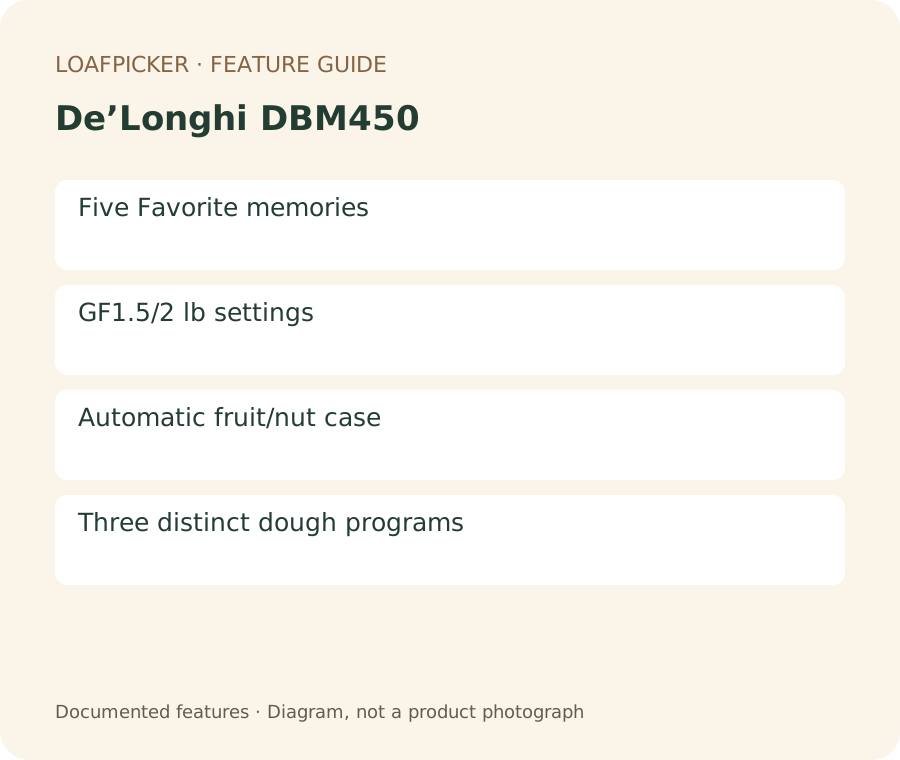
 Original LoafPicker feature diagram. Product references appear below. Not a product photograph.
THE FIT AT A GLANCE
At a glance
Bakers saving repeated timing processes, using compatible dry automatic additions, and shaping dough for oven baking.
No 1 lb GF setting; standard delay excludes GF, Dough, Artisan Dough and Pizza Dough.
Shop this model on Amazon ↗Affiliate link · Model search.
The DBM450 is interesting for a baker who wants to develop a repeatable process and save it. Its original North American manual identifies a 120 V, 60 Hz, 780 W appliance and documents five Favorite programs, P1–P5. Those are real personal programs with editable stage durations. That capability is more consequential than a long list of preset bread names, particularly if the same household alternates between a familiar sandwich loaf and a recipe needing different kneading or proofing time.
It also has a documented automatic ingredient dispenser and several dough routes. The tradeoff is that convenient features do not combine on every course: the fifteen-hour timer excludes Gluten Free, Dough, Artisan Dough, and Pizza Dough. An owner who imagines loading a gluten-free mix at night for a timed morning finish would encounter a firm program restriction. The DBM450 manual, printed pages 11–13, is the useful comparison source.
Match the size to the course, especially for gluten-free bread
Everyday bread programs provide 1, 1.5, and 2 lb settings. Gluten Free has entries for 1.5 and 2 lb, with no 1 lb option in the program chart. The same row limits flour input to 1 lb/500 g. That is an ingredient limit, not evidence of a one-pound gluten-free loaf setting. Keeping those two numbers separate prevents a misleading small-batch recommendation.
For a household that eats a little wheat bread at a time, the ordinary 1 lb setting may be useful. For someone seeking a similarly small gluten-free loaf, this machine's documented course choices do not supply the equivalent option. The decision should therefore start with the bread actually being made most often. A recipe intended for a different size should not simply be squeezed into the smaller label or assumed to work because the pan can hold a larger loaf.
Wholewheat and Wholewheat Rapid also serve different purposes. The rapid version is expressly unsuitable for 100 percent wholemeal loaves. A baker committed to an all-wholemeal formula should investigate the ordinary Wholewheat course and its recipe guidance, rather than choosing the quicker menu to fit an evening deadline. A recipe containing some wholemeal flour is not proof that the rapid course accommodates every whole-grain formulation.
Favorite programs support process adjustment, not every imaginable control
Favorite permits timed preheating, separate kneads, rises, baking, and keeping warm. Some later brief kneading actions are fixed and depend on whether the corresponding rise is used. The manual gives the adjustment ranges and a method for saving the result. It does not establish numerical temperature selection for each phase. A crust-color button or adjustable baking duration should not be represented as laboratory-like control of every aspect of fermentation.
For a baker maintaining several dependable recipes, five memories can remove the nuisance of entering the same timing changes repeatedly. For someone who wants to watch the dough and make decisions by feel, separate dough preparation may be simpler. Custom settings still require a suitable recipe and observation during development; the machine cannot infer when a new starter, flour, or room condition needs a longer proof. Saving a process is useful once it has been worked out, rather than a guarantee that an untested formula will succeed.
The dispenser has both course and ingredient restrictions
The chart documents automatic release on ordinary bread courses 1–6, Gluten Free 9, Dough 10, Artisan Dough 11, and Pizza Dough 13. This is a fruit-and-nut system, not a separate automatic yeast dispenser. Dry chopped fruit, chopped nuts, and larger seeds are the intended sorts of additions. Small seeds and finely cut herbs can escape through the door gap; wetter or sticky ingredients need the manual's specific handling guidance. See the suitability table on printed page 10.
That makes a dry walnut loaf a more direct use of the compartment than bread with cheese, chocolate, or very small seeds. An automatic case is helpful when its contents can wait and release cleanly. It is less useful if the chosen ingredient still requires attendance at the manual alert. For a buyer comparing two machines chiefly for mix-ins, the right question is whether the intended ingredient and course are supported together.
Three dough routes imply three different schedules
Dough and Pizza Dough each have a ninety-minute preset, while Artisan Dough is a much longer five-hour-fifteen-minute route. These are preparation programs; shaping and subsequent baking remain the cook's job. The longer name does not establish a complete automatic sourdough loaf, and none of the three can use the standard delayed-start function. An after-work pizza plan therefore requires someone to start the dough at an appropriate time.
A person who regularly bakes rolls in a conventional oven may value these choices more than the machine's baked-loaf options. Someone who wants dough ready precisely on arriving home needs to account for the absence of dough delay. The five saved Favorite programs are a separate capability, with their own documented setup and ingredient constraints; they should not be used in the shopping description to erase the explicit exclusions on the named preset courses.
Rapid baking and ownership details
The separate Rapid Bake button documents a fifty-eight-minute process using particular ingredient adjustments, but its description does not establish a size for that time. It should not become a promise of a two-pound loaf in under an hour. Quick Bread, meanwhile, refers to non-yeast batter bread, so it is a different technique from a shortened yeast-bread cycle.
Counter dimensions remain unverified in the primary manual inspected. Before buying a used unit, confirm the space, the exact rating label, and the presence and condition of the pan, kneader, and dispenser. The care instructions require gentle cleaning and do not permit treating the pan as a dishwasher-safe accessory. This is a good documented feature match for saved timing processes and compatible automatic additions. Its clearest limitations are the missing 1 lb gluten-free choice and the inability to delay the named gluten-free or dough courses.
Documented specifications
- Model
- DBM450
- General loaf sizes
- 1 lb, 1.5 lb, 2 lb
- Dedicated GF course
- Yes
- GF capacity basis
- Gluten Free program 9 permits 1.5 lb and 2 lb selections, with no 1 lb setting. The 500 g flour maximum is an ingredient limit, not a finished-loaf capacity.
- Automatic add-ins
- Yes
- Complete adjustable cycle
- Yes
- Body dimensions
- Not confirmed in the primary sources used here