Original family manual and exact-code retailer archive found, but manufacturer-backed numeric model crosswalk remains unresolved.
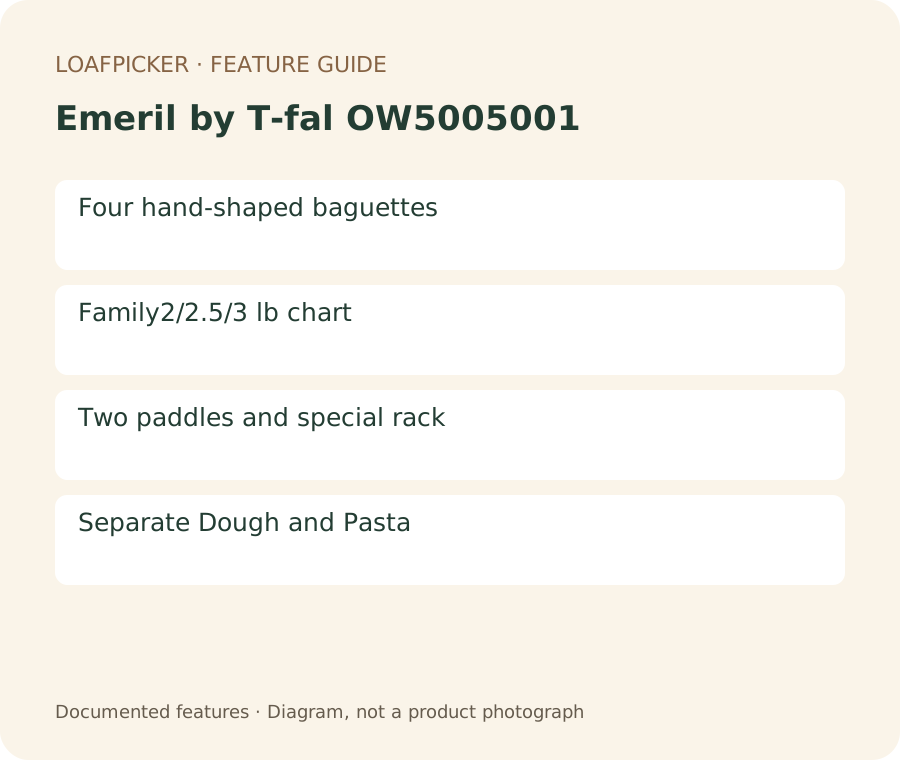 Original LoafPicker feature diagram. Product references appear below. Not a product photograph.
THE FIT AT A GLANCE
At a glance
Owners with the matching two-paddle pan, baguette rack and two trays who want large loaves or hands-on miniature baguettes.
Baguettes require shaping and restart within one hour; GF, baguette and dough courses cannot delay.
Shop this model on Amazon ↗Affiliate link · Model search.
The Emerilware Bread and Baguette Maker is most distinctive when a cook wants to shape four small baguettes and bake them inside the machine. That is a hands-on activity with a specialized rack, rather than an unattended alternative loaf shape. A complete accessory set is therefore central to the value of a secondhand unit. A machine missing that rack and its two trays cannot deliver the workflow that makes this design unusual.
This record retains the OW5005001 identifier because an exact-code retailer archive connects it with the Emeril product, and an original manufacturer-written booklet is available under that filename. The booklet itself identifies the Emerilware by T-fal family without printing the numerical model on its cover. I therefore preserve this as an owner and identity-reference page until the actual appliance label and included booklet are matched. The BuyDig record is a retailer crosswalk; the original instruction booklet supplies the operating evidence.
Baguettes require a return to the machine
Program 9 first kneads and rises the dough. The cook then removes it, divides it into four portions, shapes and scores the baguettes, and places them on the trays and rack before restarting baking. The manual allows up to an hour for this intervention before the program is lost. It also distinguishes the earlier ingredient-addition signal from the signal telling the cook to remove the dough. Confusing those two events would disrupt the recipe.
For a weekend meal, this can be an enjoyable compromise: the machine handles dough preparation and supplies the baking chamber, while the person controls the shape. For a morning routine that depends on loading ingredients and leaving, it is a poor match. The product's “automatic” wording refers to parts of the process and ordinary pan loaves; it cannot remove the baguette shaping step. An oven-baked roll workflow on a simpler dough machine may be a more practical alternative if the special rack is missing.
The ordinary pan is geared toward larger loaves
The family manual lists 2, 2.5, and 3 lb choices on eligible bread programs. Those are distinct from the four baguettes. They also do not apply to every menu: Express fixes the loaf at 2.5 lb, while several non-bread and dough tasks have no loaf-size selection. A three-pound headline is consequently not a universal setting that can be selected regardless of recipe or course. The loaf-size instructions and printed page 23 cycle chart show the distinctions.
A larger household may find that range useful, particularly if bread is sliced and shared promptly. A person who wants a truly small daily loaf has no documented one-pound option here. It is better to treat this as a large-pan design than assume every recipe can be halved. Two kneading paddles are shown in the manual, which also explains removing them if they remain in the baked loaf. They are required parts to check when assessing a used machine.
Gluten Free is documented, but it is not an overnight course
Gluten Free is program 6, and the cycle chart supplies all three loaf labels. The manual instructs the user to scrape the pan sides with a flexible plastic spatula during kneading. That is an explicit attendance requirement, not evidence that the machine automatically incorporates every flour blend without help. Its cleaning and ingredient cautions also make clear that a named course does not establish freedom from cross-contact.
The delayed-start instructions exclude this program. Someone choosing the machine chiefly for gluten-free bread ready at a scheduled breakfast time should stop at that restriction rather than combine a general fifteen-hour timer claim with the gluten-free menu. The course can still be relevant to an owner baking while present, but the right comparison is with other documented attended recipes. The inspected booklet does not supply a complete gluten-free formula that would justify recommending arbitrary flour substitutions.
Dough, pasta, and warming are separate tasks
Program 13 kneads and rises dough for pizza, rolls, and shaped breads that will be baked in an oven. Pasta 12 mixes dough without the same bread-proofing purpose. Warming 14 supplies additional heat for a limited selectable period and cannot bake the baguettes. These separate jobs are useful, but they do not constitute an editable sequence of custom kneads and rises. There is no documented personal-cycle memory system in this booklet.
A cook planning pizza after work should allow time to run the dough program when someone can start it: Dough is excluded from delayed start, along with Pasta and Baguette. This is a meaningful difference from machines that permit delayed dough preparation with appropriate ingredients. Warming also carries an instruction to remain present. It should not be promoted as an unattended workaround for a missed program or an uncertainly proofed dough.
The timer and add-ins place limits on convenience
Ordinary eligible breads can be scheduled for completion within fifteen hours, with exclusions for fresh dairy or fruit. Express, Gluten Free, Baguette, Cake, Jam, Pasta, Dough, and Warming cannot use that delay. Fruit, nuts, and other additions enter by hand when the relevant signal sounds; the manual documents no automatic fruit-and-nut compartment. A raisin loaf and a plain overnight loaf therefore impose different demands on the person using the machine.
Express is specifically an eighty-minute, 2.5 lb basic-white route with no size or crust adjustment. That is a firmer statement than simply calling the whole appliance fast, but it does not describe every loaf. For ordinary bread, the chart gives program-specific times. Use those when comparing meal schedules rather than assuming the Express time applies to whole wheat or gluten-free baking.
How to judge a complete example
Ask for the rating plate, pan, both paddles, rack, trays, and original instructions together. This research does not establish exact exterior dimensions or an electrical rating for every unit carrying the retail name, so measure the actual appliance and read its label. The manual prohibits putting parts in a dishwasher; condition and gentle cleaning history matter. With identity and completeness resolved, its strongest case is large pan loaves plus attended miniature baguettes. Without those checks, this remains a useful historical reference rather than a verified current purchase recommendation.
Documented specifications
- Model
- OW5005001
- General loaf sizes
- 2 lb, 2.5 lb, 3 lb
- Dedicated GF course
- Yes
- GF capacity basis
- The original Emeril family manual lists 2 lb, 2.5 lb and 3 lb selections for Gluten Free program 6. The numeric model association remains unconfirmed, so this entry is a reference.
- Automatic add-ins
- No
- Complete adjustable cycle
- No
- Body dimensions
- Not confirmed in the primary sources used here