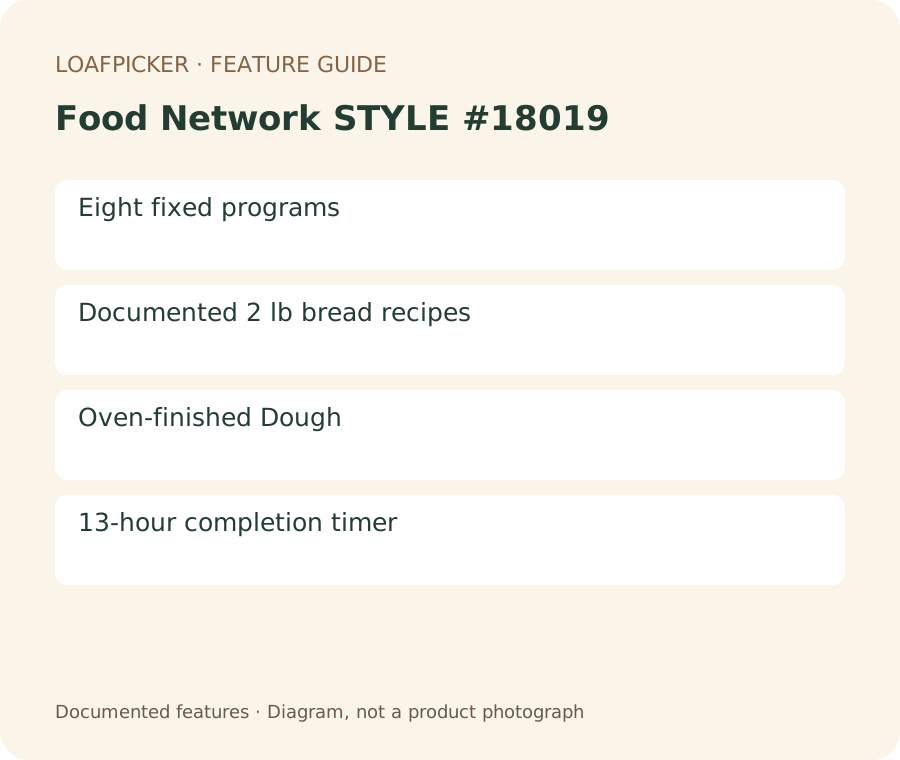
 Original LoafPicker feature diagram. Product references appear below. Not a product photograph.
THE FIT AT A GLANCE
At a glance
Owners using the documented two-pound conventional recipes or preparing shaped oven dough.
No dedicated GF course, verified smaller size choice, automatic basket or adjustable fermentation.
Shop this model on Amazon ↗Affiliate link · Model search.
The Food Network STYLE #18019 is best approached as an older, straightforward bread maker for owners or secondhand buyers who value a short menu. Its original booklet identifies eight programs, a thirteen-hour completion timer, and a two-pound default loaf. The supplied conventional bread recipes also name two-pound yields. It does not document a selectable range of smaller loaf sizes, a dedicated gluten-free cycle, or a full editor for fermentation stages.
The relevant source is the original Food Network instruction and recipe booklet, carrying STYLE #18019 on the cover. An accessible transcription of that booklet preserves its operating and recipe pages. The manual, rather than a guessed manufacturing cross-reference or the appearance of a used listing, should guide identification. Read the style number on the actual unit before following the program instructions.
The two-pound evidence comes from recipes as well as the default
The machine defaults to making a two-pound loaf, and the booklet labels its Sandwich Bread and Rustic Country Loaf as two-pound results. That establishes a useful intended conventional batch without proving additional size positions. The controls described in the manual include program, crust, start/stop and time adjustments; no independent loaf-size selection is documented. A smaller household should therefore avoid treating a seller's generic “up to two pounds” wording as confirmation of a tested one-pound recipe.
For a family that regularly uses a full loaf, the documented batch may fit the routine. For someone who wants several small experimental loaves each week, a model with explicit smaller recipes and corresponding controls offers a clearer path. Changing ingredient quantities is a recipe-development decision, not a capability established merely because the pan has room for less dough.
Basic, Rustic and Wheat have distinct purposes
Basic is described for white breads and most prepackaged bread mixes. Rustic uses a longer rise and is intended for lower-fat and French-style breads with a crisper crust. Wheat is the manual's recommendation when a recipe contains more than fifty percent whole-wheat flour, or when the recipe specifically calls for it. These distinctions give a cook a workable starting point without requiring a large bank of specialty buttons.
They also make clear what the machine does not establish. Rustic is a preset with a particular rise schedule; it does not let the user assign arbitrary fermentation time. Wheat is not permission to run any heavy flour mixture at the ordinary maximum. Match the formula to the course, especially with dense grain breads whose hydration and structure differ from a simple white loaf.
Rapid bread and Cake are different kinds of speed
The Rapid program is described as taking less than two hours and producing a potentially shorter, denser loaf. Its recipes generally use warmer water and more yeast. That is a tradeoff worth accepting when timing matters, but it does not show that an unchanged Basic recipe will finish equally well on Rapid. The booklet's size and recipe guidance remains the appropriate reference for the intended batch.
Cake handles mixtures leavened with baking powder or soda instead of yeast. The cook may need to scrape the sides during initial mixing and check the result for doneness. A separate Bake program can extend heating if required. This distinction is useful for a household interested in banana bread or dessert loaves: a chemical-leavened batter and a quick yeast loaf use different preparation and checking procedures.
Add-ins are a scheduled visit to the kitchen
Basic, Rustic and Wheat have an addition signal approximately forty to seventy-five minutes into the process, depending on the program. The owner opens the lid and adds fruit, herbs or nuts by hand. The manual says that opening the lid at that point does not stop kneading, so additions need to be prepared and added promptly. There is no documented automatic fruit-and-nut release compartment.
That makes plain bread and an inclusion loaf different unattended tasks. An ordinary loaf can follow its preset without a late ingredient addition, while a raisin or nut recipe may require the cook to return. A delay timer does not automate that visit. Someone who mainly wants fruit bread ready on waking should consider whether that manual step fits the intended schedule.
Dough is for shaping and baking elsewhere
The Dough cycle prepares dough that the user shapes before baking in a conventional oven. It can be a useful way to move mixing out of the hands-on portion of making rolls or pizza. It does not promise a finished loaf at the end of the cycle, and the final rise and oven time still belong in the meal plan. No adjustable proofing-only stage is established by the documented controls.
The Bake program provides separate heating for prepared dough or a loaf needing more color. The manual's timing language for Bake is unusually broad, so it should not be treated as permission to leave additional baking unattended for a long period. Its practical instruction is to check frequently and stop when done. This feature is a finishing tool, not evidence of temperature programming or a saved homemade sequence.
The timer's exclusions decide what can wait
The thirteen-hour completion timer includes the selected program's own duration. The booklet explicitly excludes Rapid and Jam and prohibits delay when ingredients may spoil, including eggs, fresh dairy, meat and fish. Dough is not among the listed program exclusions, but any delayed dough still needs a compatible nonperishable formula and a plan to remove it at completion. The timer does not refrigerate ingredients or hold shaped dough for later baking.
The manual specifies a 120 V AC outlet and describes an hour of warming after baking, with repeated reminder beeps. A used unit needs its actual electrical label, pan condition and paddle checked before purchase. The STYLE #18019 is a reasonable reference for conventional two-pound recipes and a simple oven-dough workflow. It is a weaker choice when small selectable batches, dedicated gluten-free bread, automatic inclusions or editable fermentation are central requirements.
Documented specifications
- Model
- STYLE #18019
- General loaf sizes
- 2 lb
- Dedicated GF course
- No
- GF capacity basis
- No dedicated gluten-free course is documented for this model.
- Automatic add-ins
- No
- Complete adjustable cycle
- No
- Body dimensions
- Not confirmed in the primary sources used here