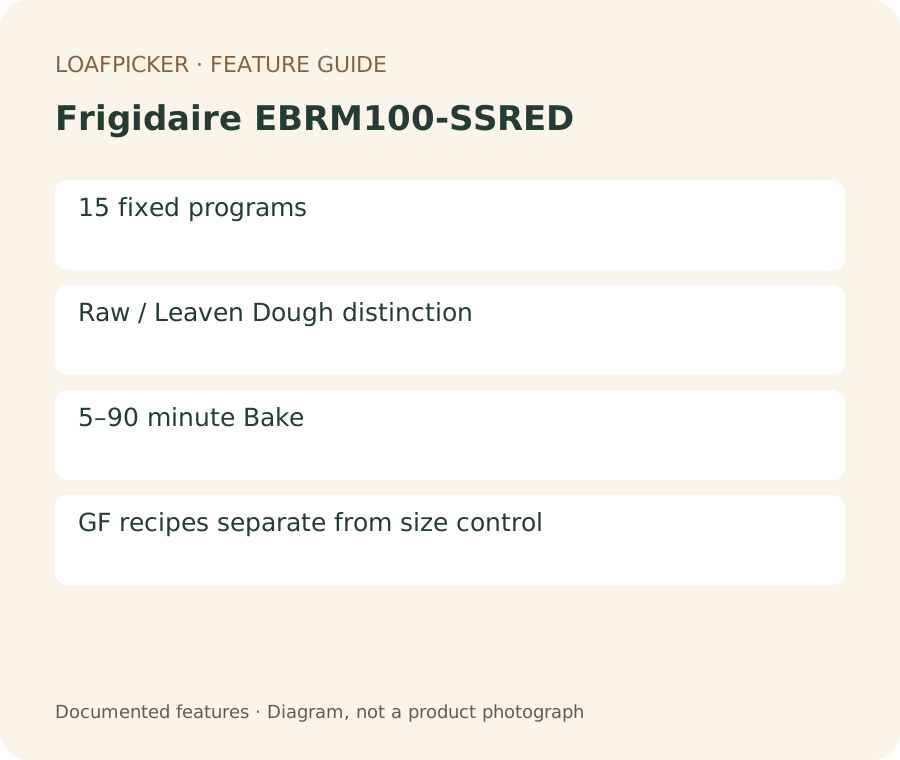
 Original LoafPicker feature diagram. Product references appear below. Not a product photograph.
THE FIT AT A GLANCE
At a glance
Distinct 23-minute Raw Dough and 1:24 Leaven Dough, with attended separate proof and bake tools.
No saved custom editor; Yogurt's documented dough-rise range is long and specialty delay eligibility is unclear.
Shop this model on Amazon ↗Affiliate link · Model search.
The EBRM100-SSRED belongs to a Frigidaire-licensed bread maker family whose original manual explicitly names the red and black finish variants. It offers more than a basic bread preset: the manual lists fifteen programs, including Raw Dough, Leaven Dough, Gluten Free, Bake and Yogurt. Its most useful buying distinction is the separation between mixing unyeasted dough and preparing risen dough. Its most important capacity caveat is that the loaf-size control applies only to the first nine programs.
The original EBRM100 family manual names EBRM100-SSRED on its cover. The manufacturer's EBRM100 specification sheet adds a vertical baking cavity, a fifteen-hour delay claim and ordinary one-, one-and-a-half-, and two-pound sizes. The shared family document is appropriate because it identifies the exact finish code; that does not make every other Frigidaire bread maker interchangeable.
Ordinary bread sizes are explicitly selectable
The first nine programs include Soft, Sweet, Natural Sourdough, French, Whole-Wheat, Quick, Sugar-Free, Multigrain and Milky Loaf. The manual permits one-, one-and-a-half-, and two-pound selections on those programs. Those are genuine labeled loaf choices, useful for a household choosing between a smaller weekday batch and a larger loaf. The specification sheet's vertical-cavity description also tells you that the result differs in shape from a conventional horizontal machine loaf.
Whole-Wheat begins with a thirty-minute soaking period. During that stage the machine may appear inactive even though the program is working. This is a useful practical difference from a course that immediately kneads. An owner who expects instant movement should check the selected program before stopping a normal preconditioning stage or assuming the motor is faulty.
Gluten-free recipes do not restore the size button
Gluten Free is program thirteen, outside the range for which the manual permits loaf-size adjustment. The recipe section nevertheless prints gluten-free formulas under one-, one-and-a-half-, and two-pound headings. Both pieces of information matter: the book supplies multiple labeled recipe quantities, but does not establish an active size selection for that course. Do not expect the ordinary loaf button to behave identically when Gluten Free is selected.
The gluten-free table names gluten-free flour and corn flour rather than ordinary bread flour. That provides a more relevant starting point than substituting a gluten-free blend into Soft Bread. It does not guarantee a particular blend or justify doubling a mixture. An owner should follow the course-specific recipe, check that all supplied ingredients meet the intended dietary requirements, and resolve any uncertainty about the printed quantities before relying on a particular batch for routine use.
Raw Dough and Leaven Dough should not be confused
Raw Dough is program eleven and has a default time of twenty-three minutes. The manual describes it as a kneading task without selectable color or loaf weight. That is the relevant route when the recipe needs mixing but not a yeast rise. Leaven Dough, program twelve, has a default duration of one hour twenty-four minutes and prepares fermented dough. It also disables crust and loaf choices.
A cook making a shaped yeast bread should account for the work after Leaven Dough finishes: removing, shaping and completing the recipe's final proof and bake. Someone making an unyeasted wrapper or noodle dough should not choose Leaven Dough merely because both names contain “dough.” The two program durations and purposes are concrete reasons to read the panel carefully.
Separate heating can support an attended process
Bake, program fourteen, defaults to ten minutes and is adjustable from five to ninety minutes. The manual specifically describes combining it with Raw Dough or Leaven Dough. This gives an attentive baker a way to separate preparation from the final bake instead of accepting one continuous bread preset. There is no documented editor that saves arbitrary knead, rise and bake stages as a new automatic course.
Yogurt, program fifteen, defaults to eight hours and is adjustable from five to thirteen hours. The manual says it can also be used to rise dough. That is a distinct warm-stage option, but its long stated range is not the same as freely setting any short proof duration or choosing a precise temperature. A baker using it for dough must judge the recipe and progression rather than assuming that the yogurt default suits a conventional final proof.
“Natural Sourdough” still needs its actual recipe examined
The manual's Natural Sourdough formula includes yeast powder. The program name therefore does not prove a flour-and-water starter process without added commercial yeast. A buyer seeking a particular naturally leavened method should inspect the formula and timing rather than treating the word “natural” as a complete fermentation specification. The available separate dough and heating tools also do not establish a tested unattended starter-only cycle.
This distinction is relevant when comparing program counts. Fifteen menu names cover several different kitchen tasks, but the presence of a sourdough name does not automatically make this machine more suitable for a slow starter than a simpler appliance. The useful question is whether its actual recipe and stage control match the bread you intend to make.
Plan additions and scheduling conservatively
The operating instructions describe a kneading-stage buzzer to remind the cook to add ingredients. They do not document an automatic fruit-and-nut compartment. The specification sheet advertises a fifteen-hour delay, while the manual explains reserve time as the interval until completion and warns against delaying eggs. It does not give a sufficiently clear course eligibility chart to promise delayed gluten-free or dough-only work.
Check the rating plate of the exact red unit, the locking pan and paddle, and the space needed to raise the lid. The specification sheet's dimension table does not identify units clearly enough to settle counter fit by itself. The EBRM100-SSRED is most useful for someone who values distinct dough tasks and attended finishing control. Its restricted size button, yeast-containing sourdough recipe and incomplete specialty-delay guidance are the main reasons to compare the details instead of the fifteen-program headline.
Documented specifications
- Model
- EBRM100-SSRED
- General loaf sizes
- 1 lb, 1.5 lb, 2 lb
- Dedicated GF course
- Yes
- GF capacity basis
- Exact-family manual p.25 GF recipe columns explicitly label 1 lb/1.5 lb/2 lb. These are recipe quantities, not selectable GF program settings (p.6 limits size control to programs 1–9).
- Automatic add-ins
- No
- Complete adjustable cycle
- No
- Body dimensions
- Not confirmed in the primary sources used here