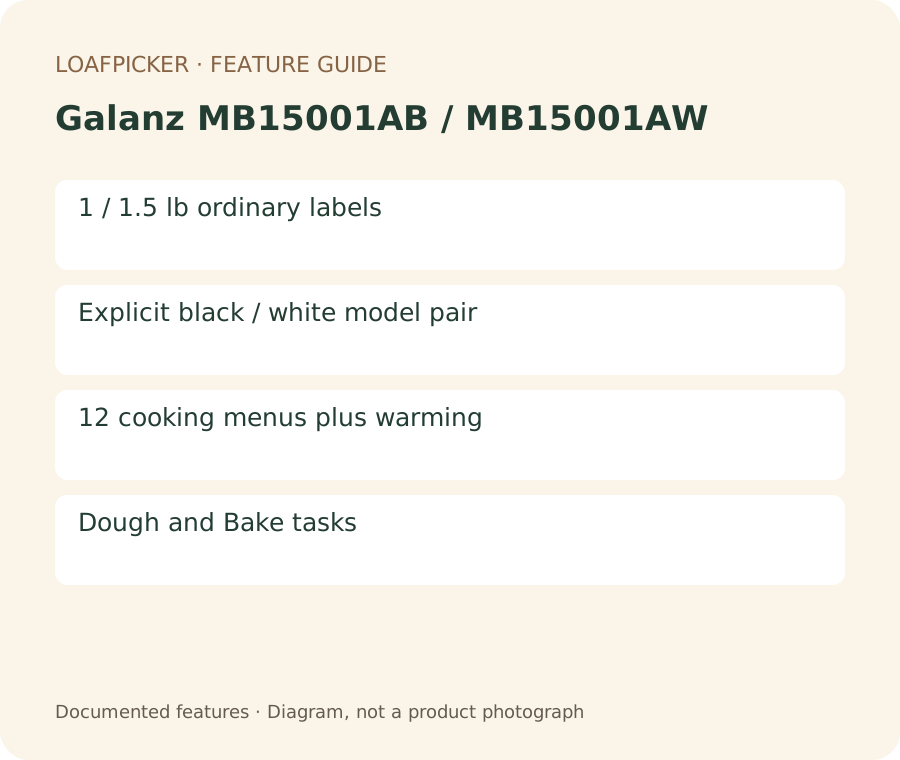
 Original LoafPicker feature diagram. Product references appear below. Not a product photograph.
THE FIT AT A GLANCE
At a glance
Smaller conventional loaves with documented one-pound recipes and explicitly paired finish variants.
No dedicated GF course or stage editor; specialty scheduling and Pasta wording need clarification.
Shop this model on Amazon ↗Affiliate link · Model search.
The Galanz MB15001AB in black and MB15001AW in white are explicitly paired in the manufacturer's product information and original manual. Their useful distinction is a smaller one- to one-and-a-half-pound capacity, rather than the two-pound maximum common in many comparison lists. They offer familiar conventional bread presets and separate preparation tasks. A buyer wanting dedicated gluten-free bread or individually programmable fermentation should look elsewhere.
The manufacturer's published model information identifies both finishes and their shared specifications. The original MB15001AB/MB15001AW manual transcription provides the menu and recipes. The manufacturer's direct support page and PDF were unavailable when checked, so an owner should keep the correct supplied booklet. The explicit two-model pairing is the reason to discuss these finishes together; it is not an assumption based only on their similar codes.
The smaller maximum is useful when it matches demand
The maker describes selectable one- and one-and-a-half-pound loaves, and the conventional recipe tables provide both quantities. That is a practical advantage for a household that does not regularly finish a large loaf. It also sets a firm comparison boundary: this is not a two-pound bread maker simply because a larger recipe might physically fit inside the empty pan.
The safety instructions limit flour to 450 grams and dry yeast to two teaspoons or four grams. Follow the appropriate recipe rather than enlarging a smaller batch to imitate another machine's maximum. For someone making a full week's sandwich bread, the smaller capacity may mean more frequent baking. For an occasional baker, the same limitation may fit the routine well.
Thirteen functions include warming
Galanz advertises thirteen cooking programs, listing Basic, Sweet, French, Whole Wheat, Rapid, Super Rapid, Cake, Rice Bread, Jam, Dough, Pasta, Bake and Keep Warm. The manual describes twelve distinct menu choices plus warming. That explains the headline count without inventing an additional bread course. It is more useful to compare the jobs you need than to treat thirteen as thirteen different complete bread recipes.
Basic and Sweet address conventional yeast loaves, French uses its own crust-oriented schedule, and Whole Wheat is a separate course for a wheat-flour mixture. Rapid is described at around two hours and Super Rapid at around one hour. Those approximate descriptions are not a complete recipe-and-size timing chart. Use the displayed program and matching formula when a meal depends on the finish time.
Rice Bread is not gluten-free bread
There is no dedicated Gluten-Free course in the manufacturer's list. Rice Bread combines rice flour with ordinary bread flour in the supplied recipe. Its name therefore does not establish a wheat-free formula or a substitute gluten-free setting. That distinction is important for a buyer searching by ingredient names rather than reading the actual program list.
Nor does Cake imply gluten-free support. The manual describes a mixture based on eggs, milk and low-gluten flour, with preparation appropriate to cake. “Low gluten” and “gluten free” are different descriptions. A cook who needs a dedicated gluten-free process should compare a machine that explicitly documents one and supplies an appropriate formula, rather than treating either Rice or Cake as an equivalent course.
Dough and Pasta need their actual instructions
The manual lists Dough as a kneading task and supplies a kneaded-dough recipe. It also calls Pasta a fermented-dough task in the recipe section, while its short process description is less clear. This is a reason to check the matching booklet and selected display rather than assume that “Pasta” necessarily means the same unyeasted noodle routine used by another brand.
If your main use is shaping pizza or rolls for an oven, establish exactly which program stops at the desired dough stage and account for any external rise afterward. The presence of Dough, Pasta and Bake does not document a saved editor for arbitrary kneading and fermentation times. This is a preset appliance with additional tasks, and an experienced baker should plan intervention accordingly.
Additions are made by hand
The operating instructions describe beeps that tell the user when to add nuts or fruit. The nut-bread recipe likewise calls for chopped additions at the signal. There is no documented automatic ingredient compartment. A plain loaf and a nut loaf therefore impose different demands on the cook's schedule, even if both start from the same Basic setting.
Some recipes also include preparation outside the machine, particularly cakes whose ingredients are mixed before being placed in the pan. That matters when assessing convenience: a menu name does not always mean pouring every raw ingredient into the machine and walking away. Read the preparation steps before selecting the appliance mainly for desserts or specialty dough.
Preset scheduling is not a verified universal delay
The Hour and Minute controls provide a preset function, and the manual warns against using it with perishable ingredients such as eggs. The reviewed material does not establish a clear maximum delay or all course combinations. Do not replace that missing information with a familiar thirteen-hour figure from another brand merely because this Galanz advertises thirteen functions.
Eligible bread baking is followed by an hour of warming. That is a post-bake hold, not a refrigerated wait before mixing. If you want bread ready on waking, obtain the exact preset procedure and confirm that the chosen recipe may wait. If you want dough ready later, establish that task's permission separately rather than assuming the bread scheduling controls apply.
Fit and electrical information are explicit
Galanz specifies 120 V, 60 Hz and 500 W, with dimensions of 13.39 inches wide, 9.45 deep and 10.79 high. The manual asks for at least four inches of clearance on all sides and room to open the lid and remove the pan. The maker calls the nonstick pan and paddle dishwasher safe, while the manual describes gentle cleaning and soaking a stuck paddle.
The MB15001AB and MB15001AW suit conventional smaller loaves when their preset workflows cover the household's recipes. Their concrete strengths are the documented one-pound option and explicit shared finish identity. Their limits are the smaller maximum, manual additions, missing dedicated gluten-free course and unclear specialty scheduling. Those details make a clearer decision than the broad thirteen-program headline.
Documented specifications
- Model
- MB15001AB / MB15001AW
- General loaf sizes
- 1 lb, 1.5 lb
- Dedicated GF course
- No
- GF capacity basis
- No dedicated gluten-free course is documented for this model.
- Automatic add-ins
- No
- Complete adjustable cycle
- No
- Body dimensions
- 13.39 × 9.45 × 10.79 in (W × D × H)