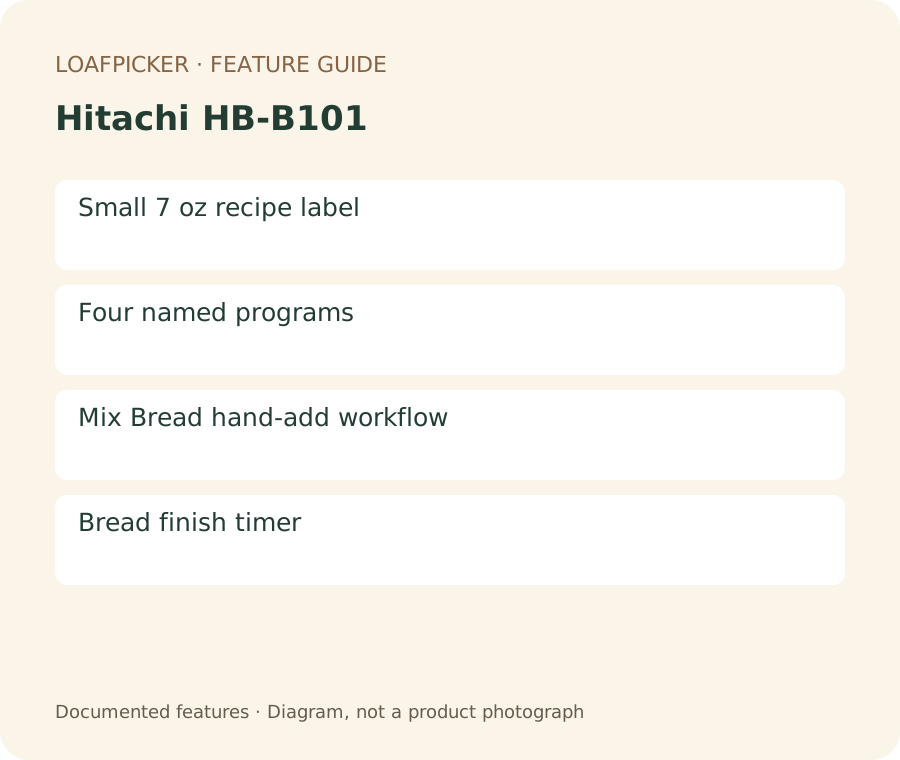
 Original LoafPicker feature diagram. Product references appear below. Not a product photograph.
THE FIT AT A GLANCE
At a glance
Households wanting the exact small recipe sizes and straightforward plain-bread or attended mix-in workflows.
Mix Bread requires hand additions; detailed timer instructions exclude Rapid, Mix Bread and Dough despite an overview conflict on Rapid.
Shop this model on Amazon ↗Affiliate link · Model search.
The HB-B101 is worth understanding when small batches matter. Its exact manual describes small, medium, and large loaves as 7 oz/200 g, 14 oz/395 g, and 1.3 lb/590 g. Those are the document's labels, and they should be preserved even when an older buying guide or seller calls the machine a one-and-a-half-pound model. A household trying to avoid leftover bread needs the actual recipe sizes, rather than the most familiar rounded capacity description.
The original Hitachi instruction-manual transcription identifies four programs: Bread, Bread Rapid, Mix Bread, and Dough. A preserved manual scan provides another exact-model reference. The specification lists 120 V, 60 Hz and 680 W. This is an older appliance assessment, with no claim of a current new-unit offer, present replacement-part stock, or tested condition.
The smallest recipe is a real distinction
The documented 7 oz option is substantially smaller than the lowest setting on many large-pan designs. It could be relevant to someone who eats a few slices and dislikes repeatedly storing a large loaf. That does not establish that the recipe can be reduced further. The manual warns against using more or less than its prescribed quantities, so its small recipe should be treated as a specified batch rather than the start of unlimited scaling.
Likewise, the largest printed 1.3 lb label should not be silently rewritten to match a historical 1.5 lb listing. Ingredient weight, nominal loaf weight, and the final bread after baking are different measurements. An owner should select the correct recipe column and corresponding control choice. If a used machine comes with a handwritten recipe for another Hitachi model, that recipe does not resolve the exact HB-B101 capacity question.
Mix Bread is an attended addition workflow
Mix Bread is intended for loaves receiving raisins, nuts, or similar additions during kneading. The manual describes an audible prompt for adding them by hand. It does not describe an automatic fruit-and-nut case. This difference is useful for deciding whether the machine fits a breakfast routine: a plain loaf and a loaf requiring a return to the pan impose different demands.
An owner making a raisin loaf can use the exact recipe's addition amount and signal rather than loading everything at the beginning and expecting intact fruit. The manual explains that later addition helps preserve the pieces. That is a process distinction, not a guarantee of a particular texture. If automatic mix-ins are essential, the HB-B101's documented manual workflow is a reason to compare another design.
The timer has a specific, conservative use
The delayed-completion range is 4 hours 20 minutes to 13 hours. The detailed timer instructions exclude Bread Rapid, Mix Bread, and Dough, leaving ordinary Bread as the documented scheduling route. An overview appears to suggest Rapid can also be timed, creating an internal disagreement. The sensible assessment preserves that conflict and does not recommend Rapid delay. Compare the feature overview with the detailed timer section on printed page 12.
Someone planning a plain morning loaf can investigate the Bread timer with the prescribed ingredients. Someone planning rolls ready to shape on arriving home cannot assume that the same timer applies to Dough. Fresh milk and eggs also have explicit delay cautions. A maximum thirteen-hour interval is therefore not general permission for every recipe to wait in the machine.
The minimum timer setting matters as well. A person who wants a loaf finished in three hours cannot force a shorter delayed schedule by entering that number. Bread Rapid is a separate immediate process, described as about 2 hours 50 minutes. Treat its speed and the Bread timer as different options rather than combine the two in a shopping claim.
Dough prepares food for a different finishing process
The Dough program is for preparations such as dinner rolls or French-style bread that are shaped and finished separately. A cook interested mainly in these foods may find that more relevant than the baked-loaf size. It still requires the correct batch and attendance when the dough is ready. The machine does not turn a dough program into automatic shaping or oven baking.
There is no documented full cycle editor, independently selectable fermentation stage, or library of personal programs. The word “automatic” describes the built-in process rather than unrestricted control. A baker experimenting with starter fermentation would need to manage the recipe outside those preset assumptions. Similarly, no dedicated whole-wheat or gluten-free course appears in the four-program list. Recipe adaptations, where available, should not be confused with dedicated menu support.
Older controls and cooling affect everyday use
The manual describes a lock function intended to prevent accidental changes after starting. It also describes cooling and ventilation at the end, which should not be renamed a generic one-hour keep-warm cycle. These details affect the routine of removing the loaf and resetting the machine. Someone familiar with newer controls should read the sequence rather than assume the same button behavior.
A short interruption may be recoverable within the manual's stated conditions, but the document notes that the interval can vary with temperature. It does not justify a blanket promise that every ten-minute outage is harmless. For an actual older unit, a working display and heater do not by themselves establish the condition of the pan shaft, cord, or control system.
The practical ownership decision
The specification's metric dimensions are 25.2 by 36.5 by 34.5 cm in width-depth-height order. Allow additional working clearance for removing the pan. Inspect the coated pan, blade, mounting arrangement, and label, and establish a compatible parts source before buying an incomplete example. The HB-B101's main strengths on paper are its unusually small documented batch and straightforward separation of plain bread, rapid bread, additions, and dough. Its main limits are attended mix-ins, a Bread-only conservative timer route, and the lack of dedicated gluten-free or custom-stage controls.
Documented specifications
- Model
- HB-B101
- General loaf sizes
- 1.3 lb
- Dedicated GF course
- No
- GF capacity basis
- Four named programs are Bread, Bread Rapid, Mix Bread and Dough; no dedicated GF course or verified GF recipe.
- Automatic add-ins
- No
- Complete adjustable cycle
- No
- Body dimensions
- 9.9213 × 14.3701 × 13.5827 in (W × D × H)