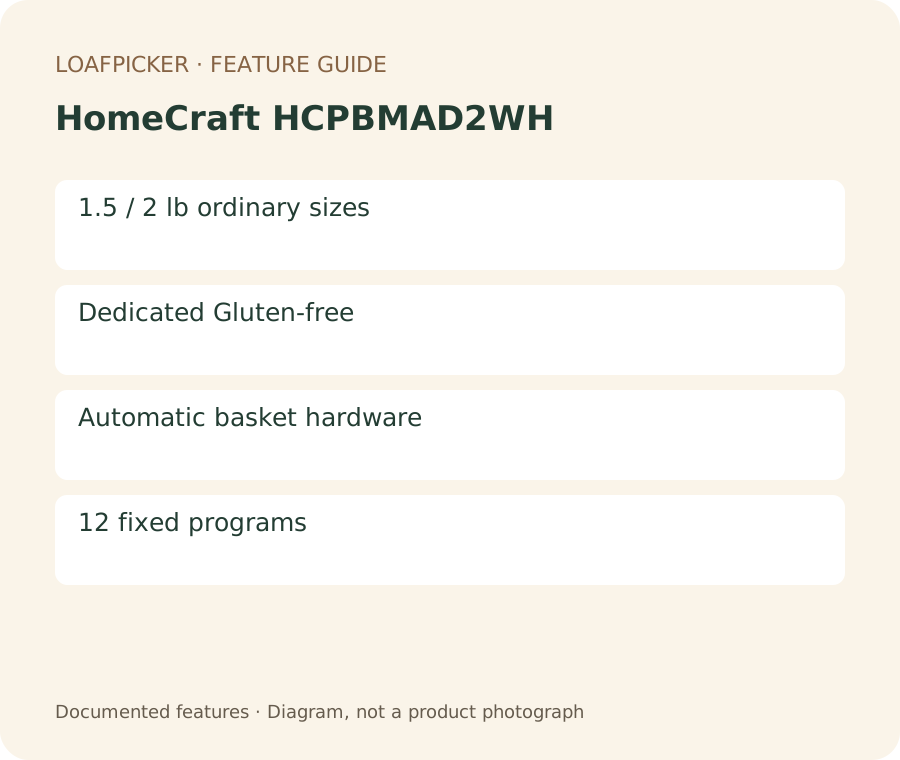
 Original LoafPicker feature diagram. Product references appear below. Not a product photograph.
THE FIT AT A GLANCE
At a glance
Ordinary 1.5–2 lb bread and preset dough for shaping and baking elsewhere.
No small 1 lb choice or stage editor; complete specialty-course dispenser and delay charts are missing.
Shop this model on Amazon ↗Affiliate link · Model search.
The HomeCraft HCPBMAD2WH is a 120-volt bread maker with twelve fixed programs, a dedicated Gluten-free course, and an automatic fruit-and-nut compartment. Its two ordinary loaf labels are one-and-a-half and two pounds; there is no documented one-pound choice. It suits a household whose usual bread demand falls within those batches and whose recipes fit the presets. The main qualification is that the manual describes automatic dispensing broadly without a complete course-by-course release chart.
The manufacturer's HCPBMAD2WH manual names the exact model and gives its electrical specification as 120 V, 60 Hz and 550 W. It documents a thirteen-hour completion timer, an hour of warming, and ten-minute power-interruption memory. Those features make ordinary bread scheduling possible, but the operating restrictions and ingredient rules still decide whether a particular recipe can run unattended.
The size button has a clear exclusion list
The loaf control selects one-and-a-half or two pounds. The manual disables that button for Quick, Dough, Jam, Cake and Bake. That exclusion list is useful because it prevents the ordinary capacity claim from being read as a universal set of choices. A recipe can have a printed quantity without offering a corresponding active size button on its chosen program.
Gluten-free is not included in the size-button exclusions, so the documented control instructions support the two labeled choices on that dedicated course. That is different from guessing its capacity from the pan maximum. However, the reviewed recipe section does not provide a matching gluten-free formula. A buyer should obtain an appropriate recipe for this machine rather than merely replacing bread flour in one of its conventional recipes and expecting the named course to correct the mixture.
The program list covers familiar bread tasks
Basic, French, Whole Wheat, Sweet and Sandwich provide different ordinary bread approaches. French uses a longer rise for a lighter texture and crisper crust; Whole Wheat accommodates heavier flours with longer kneading and rising. Sandwich is described for a lighter texture and thinner crust. Those differences can matter more in daily use than the total count of twelve programs.
Quick and Rapid Bake are separate entries. The manual describes Quick as similar to Basic with a shorter process and a potentially smaller, denser loaf. Rapid Bake shortens the process further and can produce a smaller, rougher result. These names do not establish a single universal fast time or permission to use every recipe unchanged. Choose the recipe and program together, especially when a meal depends on a strict completion time.
Cake and yeast dough have different finishing jobs
Cake is intended for mixtures using baking powder or soda rather than yeast. Dough mixes and rises without baking, after which the cook removes the mixture for rolls, pizza or another shaped result. The separate Bake course provides additional heating without kneading or rising. These three functions should not be treated as interchangeable ways to finish the same mixture.
For a cook already using a conventional oven, Dough can reduce mixing work while leaving control over shape and crust with the cook. It still requires time afterward for shaping, any remaining proof and baking. The machine does not document a full editor for assigning and saving individual kneading and fermentation stages. A selection of Dough and Bake presets therefore does not equal a programmable homemade course.
The dispenser needs a more careful interpretation
The manual explicitly identifies an automatic dispenser and instructs the owner to load fruit or nuts before starting; it says that the ingredients are released into the bread pan during bread making. That establishes actual dispensing hardware, rather than an audible-only addition system. It is a useful feature for a compatible ordinary inclusion loaf when the ingredients and quantities are suitable.
Elsewhere, the operating steps tell the user to add ingredients at beeps on Basic, French, Whole Wheat, Quick, Sweet, Rapid Bake and Sandwich. The booklet does not reconcile that hand-addition instruction with the automatic compartment or provide a complete eligibility table. Do not assume that Gluten-free or a dough-only task automatically opens the basket. If one of those combinations is essential, obtain an exact-model demonstration or clarification before depending on it.
The timer includes making the bread
The thirteen-hour value is the total interval until completion, including the selected program's duration. The manual's example works backward from an evening setup to a morning finish. It also prohibits delayed recipes containing easily spoiled ingredients such as eggs, fresh milk, fruit or onions. An automatic ingredient compartment does not refrigerate its contents or override that restriction.
The booklet does not provide a sufficiently explicit specialty-course delay chart to promise delayed Gluten-free or Dough. For those uses, establish the course and recipe permission separately. Ten-minute interruption memory means that the process can continue after a brief outage; after a longer interruption, the manual's restart guidance depends on how far the mixture has progressed. It should not be interpreted as a reason to restart partially processed ingredients indiscriminately.
Check the supplied parts before selecting a used unit
The removable nonstick pan and paddle are central to the machine's usefulness, as is a complete ingredient compartment if automatic additions matter. Inspect the pan surface, attachment, paddle and dispenser before purchase. The manual lists the pan and blade as dishwasher safe, but gentle cleaning and avoiding damage to the nonstick surface remain sensible handling priorities. Confirm the exact HCPBMAD2WH label when seeking replacements.
The manual warns against using the machine in countries that do not support 120 V AC, even through a converter. It should therefore be matched to its intended electrical environment. The HCPBMAD2WH is an understandable choice for ordinary one-and-a-half- or two-pound bread and occasional oven-finished dough. A buyer needing one-pound batches, independent fermentation controls, or guaranteed automatic additions on a particular specialty course has a concrete reason to compare a differently documented machine before deciding.
Documented specifications
- Model
- HCPBMAD2WH
- General loaf sizes
- 1.5 lb, 2 lb
- Dedicated GF course
- Yes
- GF capacity basis
- Dedicated GF course 6 (p.7); size control p.8 offers 1.5/2 lb and explicitly excludes Quick, Dough, Jam, Cake and Bake, not GF. No matching GF formula found in reviewed recipe section.
- Automatic add-ins
- Yes
- Complete adjustable cycle
- No
- Body dimensions
- Not confirmed in the primary sources used here