Retail model is named, but exact maker operating configuration and claimed specialty features lack an authenticated manual.
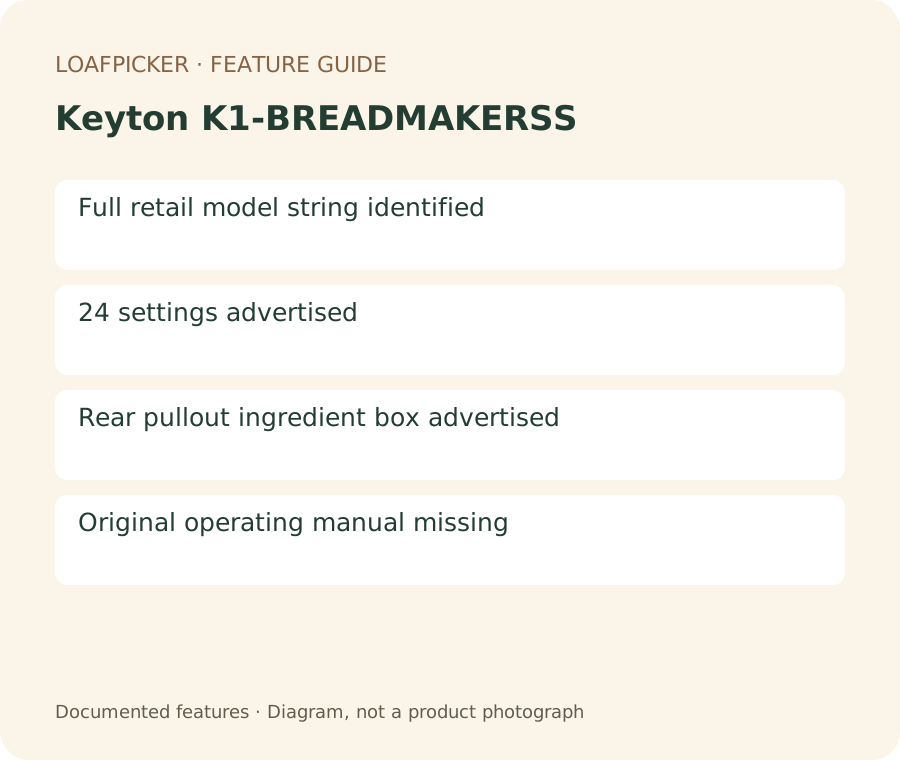 Original LoafPicker feature diagram. Product references appear below. Not a product photograph.
THE FIT AT A GLANCE
At a glance
A precise owner-identification lead for a machine advertised with24settings and a rear box.
Automatic release, genuine stage control and every specialty workflow lack maker instructions.
Shop this model on Amazon ↗Affiliate link · Model search.
The Keyton K1-BREADMAKERSS is identifiable in historical retailer records as a silver, stainless-steel bread maker advertised for two-pound loaves. Its more interesting claim is a rear ingredient box, alongside twenty-four settings and an LCD interface. Those claims suggest a machine worth understanding, but no authenticated exact-model operating manual was recovered in this research. Without that document, the ingredient box cannot be treated as verified automatic dispensing and the setting count cannot stand in for a usable program table.
This is therefore an identification and buying-decision reference. It does not promise the feature set of an unseen unit, report a test bake, or establish present stock. An owner can use the exact model string to seek the correct instructions; a shopper can use the unresolved points to decide whether a particular listing provides enough evidence. The complete K1-BREADMAKERSS designation should remain intact, including the SS ending. A generic Keyton appliance page is not a substitute for that match.
What a twenty-four-setting claim does not answer
The retailers describe twenty-four digital settings without supplying an authenticated numbered menu. That leaves basic questions unanswered: which are complete bread cycles, which prepare dough, and which are separate tasks? A high count can include several related breads or individual operations. It does not reveal whether a specific whole-wheat, gluten-free, rapid, or jam workflow is present in the exact configuration. These should stay unknown until the menu and its instructions can be read.
The same restraint applies to the word programmable. Choosing among preset programs is different from editing the durations of kneading and fermentation. A retailer-hosted owner comment describes a do-it-yourself option, but a comment is not a maker's programming procedure. This reference does not adopt it as proof of a fully adjustable cycle, saved memories, or custom temperature control. A buyer who wants to develop a natural-starter recipe should request the page that actually explains the relevant stages and their adjustment ranges.
The ingredient box is a function to verify
A box at the back of a bread maker may be an appealing convenience for fruit and nut loaves. For the K1-BREADMAKERSS, the inspected retailer wording names the box but does not establish its release mechanism. It remains unclear whether ingredients drop automatically, whether an addition prompt requires the owner to act, how much the box holds, or which programs can use it. Those are practical differences for someone planning bread while away from the kitchen.
A convincing demonstration would connect the exact model, the compartment, and the relevant program instructions. A lid or container visible in a photograph is only part of that evidence. A recipe can also exceed a dispenser's capacity even on machines with verified automatic release, so a capacity limit matters as much as the mechanism. The Keyton record should not be grouped with verified automatic-addition machines until those details are available.
Capacity needs more than a maximum
The two-pound description is an advertised maximum, not a recovered list of size-selector choices. No supported smaller setting or course-specific gluten-free weight has been established from a maker document. That distinction changes the buying decision for someone baking small quantities. A large nominal maximum does not guarantee that a small loaf has a suitable program, and it does not establish how much raw dough the pan can safely handle.
For an owner whose booklet is missing, the best recipe source would be the exact manual or a recipe explicitly developed for the covered machine. It would be risky to reconstruct ingredient quantities from the maximum alone. The number of settings also does not resolve the issue: size, crust treatment, and program sequence have to agree with the formula. No complete set of labeled size controls is verified; the advertised maximum is not a substitute for that list.
The timer headline leaves course rules open
Indexed retailer descriptions advertise a thirteen-hour timer, three crust shades, and an hour of keep-warm operation. No inspected maker table establishes which programs allow the timer or how the display expresses the target. A timer might represent elapsed time until completion or another scheduling convention; its exact procedure should be checked before relying on it for breakfast. The keep-warm claim is separate and does not establish eligibility for every setting.
Those unknowns matter most when a recipe needs an attended addition or contains ingredients unsuitable for a long wait. A timer and an ingredient box are not enough, by themselves, to establish an unattended workflow. The full instructions should explain when inclusions enter the mixture and whether the chosen recipe can be delayed. Until then, the advertised convenience remains a question to resolve, rather than a reason to hard-match the machine to a scheduling requirement.
Inspect the unit and its document package together
Woot gives dimensions of fourteen by twelve by nine inches without identifying the measurement order, so a dependable width-depth-height set was not established. It specifically describes a nonstick pan and paddle as dishwasher-safe, but matching maker care instructions were not recovered. Electrical rating and historical replacement-part numbers also remain unverified. Before cleaning an owned unit or buying a used one, obtain the exact care instructions and inspect the pan, paddle, drive engagement, and rating label.
The most plausible reason to pursue the K1-BREADMAKERSS is interest in its particular combination of a listed two-pound capacity, numerous settings, and rear box. The tradeoff is the work needed to turn those descriptions into dependable operating facts. If a seller can supply the matching booklet, panel photograph, and intact accessories, the open questions become much easier to answer. With the evidence currently recovered, this remains a reference-only record rather than a confident US buying match.
Documented specifications
- Model
- K1-BREADMAKERSS
- General loaf sizes
- 2 lb retailer maximum; no authenticated selector choices
- Dedicated GF course
- Not confirmed
- GF capacity basis
- No authenticated operating manual, named gluten-free program or recipe capacity was recovered. A general count of 24 settings does not establish a gluten-free course.
- Automatic add-ins
- Not confirmed
- Complete adjustable cycle
- Not confirmed
- Body dimensions
- Not confirmed in the primary sources used here