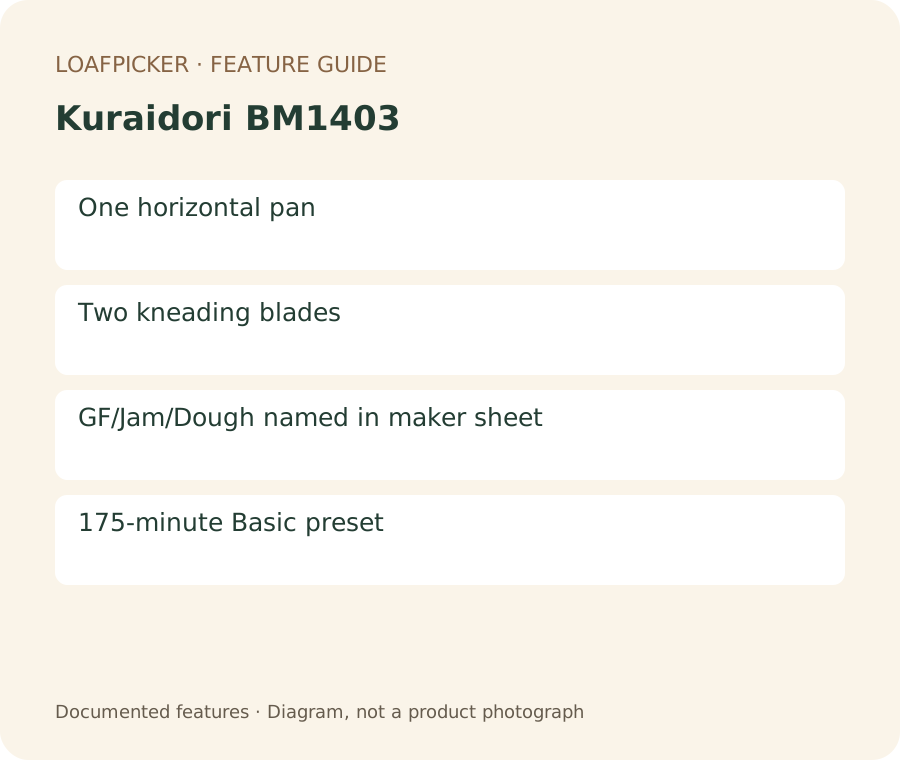
 Original LoafPicker feature diagram. Product references appear below. Not a product photograph.
THE FIT AT A GLANCE
At a glance
Investigating a larger horizontal single loaf with two paddles and named GF/Jam/Dough selections.
Recovered maker sheet stops during menu explanation; recipe weights, timer eligibility and custom stages remain unverified.
Shop this model on Amazon ↗Affiliate link · Model search.
The BM1403's strongest documented distinction is physical: one horizontal bread pan with two kneading blades, advertised for a three-pound loaf. Home Hardware's own Kuraidori instruction sheet describes that arrangement, and its exact-item retailer record names BM1403. That makes it worth investigating for a household wanting a larger loaf rather than a small daily batch. The same evidence does not establish the complete set of selectable loaf weights, so the three-pound headline should remain a maximum-capacity description.
This research uses the Home Hardware sheet associated with item 3817-125 and the Brantford Home Hardware exact-model page. The recovered PDF is one page of instructions and troubleshooting, not a complete course-and-recipe book. Its menu explanation begins with Basic but does not continue through all twelve program descriptions. This limitation is important for deciding which specifications can be compared confidently and which need the missing instructions. No bake performance, present stock, or current purchase price is claimed here.
Two blades work the same loaf
A horizontal pan may suit someone wanting a broader loaf shape, and two blades work the larger batch in that single pan. It is not an arrangement for baking two different doughs at once. The pan's capacity also does not provide a raw-dough limit for every formula. Rich doughs, high-inclusion mixtures, and different flours should follow a matching recipe rather than a volume estimate based on the finished-loaf headline.
The sheet warns against overfilling and explains that a motor running without effective mixing can indicate a poorly seated pan, incorrectly fitted blades, or an excessive dough quantity. Those are concrete checks for an owned machine. For a secondhand example, confirm that both blades are present, fit their shafts, and engage correctly when the pan is installed. A large pan is only useful if the two mixing positions and their seals are in sound condition.
Basic is explained; the rest needs more documentation
Basic is described as a knead, rise, and bake program for ordinary white bread, preset to run for two hours fifty-five minutes. The sheet separately advertises twelve digital programs, including gluten-free, jam, and dough settings. Those named functions are supported, but a complete list of their timings and restrictions is not. It would be inappropriate to fill the remaining program names from a similar-looking bread maker or a secondary page that presents an expanded menu without an authenticated original.
For gluten-free baking, the key missing information is the supported formula and its quantity. A gluten-free setting is documented, but no course-specific loaf weight, size-selection rule, or recipe was verified in the available sheet. The general three-pound capacity should not be transferred to that setting. A shopper choosing primarily for gluten-free bread needs the actual recipe and program directions before deciding whether the machine makes the amount of bread wanted.
Dough is likewise named without enough detail to promise a particular duration or a selectable fermentation period. There is no verified full-cycle customization procedure in the recovered material. Buttons or a potentially suggestive menu label are not enough to establish user-editable kneading, proofing, and baking stages. A baker seeking natural-starter control should ask for those exact instructions, rather than assuming that the word programmable in a timer description covers recipe development.
The controls are simple to start, but scheduling rules are missing
The START/STOP instructions call for holding the button for approximately one and a half seconds. A short beep and flashing colon indicate that the program has begun. Once running, the sheet says only START/STOP and LIGHT remain available. That is useful owner guidance: attempting to alter other settings after starting is not the documented way to change a recipe. The machine's twelve programs are selected before the run.
A thirteen-hour timer and one-hour keep-warm feature are advertised in the Home Hardware material. The recovered sheet does not supply a full delay eligibility table or the exact timer-setting procedure. It also does not establish warming behavior for every nonbread program. Anyone planning an overnight loaf should obtain the remaining pages and check the recipe's ingredients and course together. The timer's maximum is a scheduling limit, not evidence that all twelve programs can be delayed.
Care instructions deserve priority over a convenient checkbox
The sheet tells the owner to unplug and cool the machine before cleaning, wipe the pan gently, protect its nonstick coating, and dry it before returning it to the housing. Blade cleaning uses a damp cloth, with troubleshooting suggesting a short hot-water treatment to loosen a blade stuck to its shaft. It warns against banging the pan to remove bread and against immersing the complete appliance. These directions give a practical starting point for protecting the removable parts.
The retailer separately calls the pan and blades dishwasher-safe, while the recovered Home Hardware sheet does not explicitly authorize dishwasher cleaning. That difference is retained as a care question rather than resolved by assumption. The retailer also lists 120 volts, 60 hertz, and a 700–800-watt range; the sheet itself directs the owner to match the outlet to the rating plate. Confirm the actual label for the offered unit. Dependable exterior dimensions and replacement-part numbers were not established.
The BM1403 fits someone investigating a larger horizontal loaf and willing to obtain its complete instructions. Its tradeoff is the gap between a useful hardware description and course details that remain incomplete, especially gluten-free quantity, timer eligibility, and genuine stage control. The existing evidence supports those specific questions without turning missing pages into invented features.
Documented specifications
- Model
- BM1403
- General loaf sizes
- 3 lb
- Dedicated GF course
- Yes
- GF capacity basis
- The Home Hardware sheet names a gluten-free setting among twelve programs but supplies no verified gluten-free recipe weight or size-control rule.
- Automatic add-ins
- Not confirmed
- Complete adjustable cycle
- Not confirmed
- Body dimensions
- Not confirmed in the primary sources used here