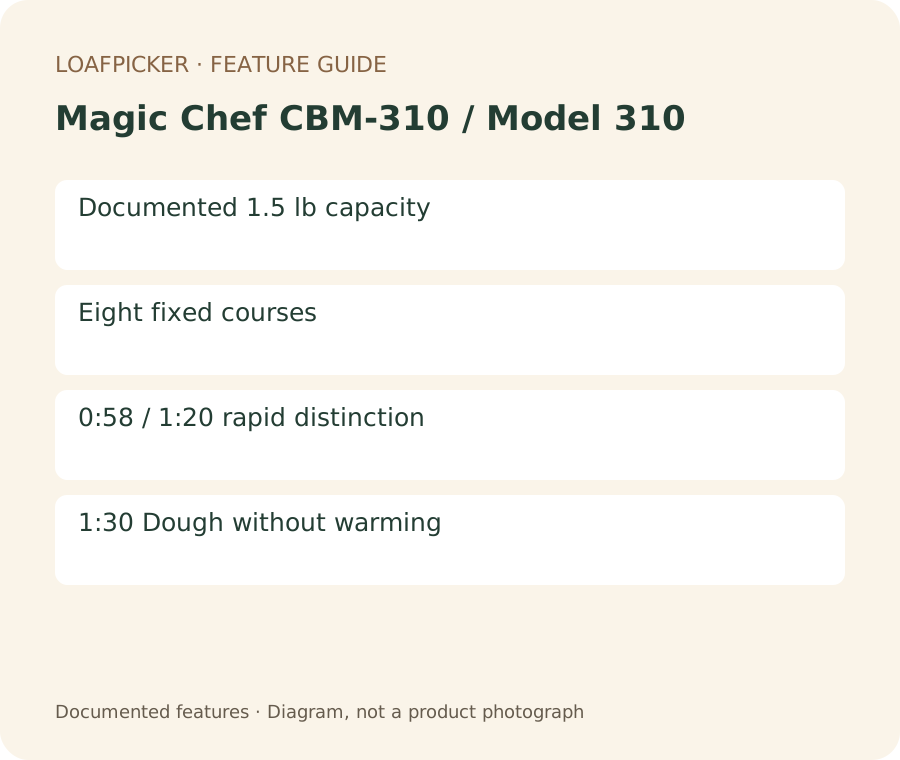
 Original LoafPicker feature diagram. Product references appear below. Not a product photograph.
THE FIT AT A GLANCE
At a glance
Conventional smaller loaves, 58-minute Super Rapid Basic or 1:20 Super Rapid Whole Wheat with their prescribed recipes.
Eight fixed courses, no GF course or adjustable fermentation, and no Dough/Bake delay.
Shop this model on Amazon ↗Affiliate link · Model search.
The Magic Chef CBM-310, identified as Model 310 in its original booklet, is an older one-and-a-half-pound bread maker with eight fixed programs. Its useful distinctions are simple to describe: a fifty-eight-minute Super Rapid Basic course, a separate eighty-minute Super Rapid Whole Wheat course, and a dough program that stops before baking. It is an owner and secondhand comparison for conventional bread, rather than a machine with a documented dedicated gluten-free program or editable fermentation.
The original Model 310 owner's manual provides the controls, timing chart and recipe guidance. A CBM-310 manual index associates the fuller model designation with that booklet. Its detailed timing chart explains what each course does beyond the brief descriptions. Check the actual machine's label and panel before applying the instructions.
One-and-a-half pounds is a documented capacity, not a size menu
The manual cover explicitly describes an automatic one-and-a-half-pound bread maker. Its controls show program, crust, time and start/stop selections, without an independent loaf-size button. That makes the intended batch easier to understand than a claim of several selectable sizes. It does not establish a tested one-pound formula or permission to make the larger batches used by a two-pound machine.
A smaller household may find the intended capacity suitable, particularly if a larger appliance regularly produces more bread than needed. A family preparing several sandwiches daily should consider whether that batch meets demand. Inspect the supplied recipe quantities rather than judging the empty pan visually. The manual warns against loading larger quantities, because excess dough can give poor results or damage the appliance.
The shortest course has a specific recipe tradeoff
Super Rapid Basic takes fifty-eight minutes. The manual calls for extra yeast, warm water and suitable bread-machine flour, and notes that the result can be lower than a regular loaf and have a somewhat different taste. This is a recipe-specific shortcut for a particular need. It does not promise that the normal Basic formula will behave identically when run through the fastest program.
Super Rapid Whole Wheat is a separate one-hour-twenty-minute course, again using its prescribed ingredients. Regular Whole Wheat takes three hours forty minutes. The distinction matters when planning food for a deadline: an eighty-minute whole-wheat process is not the same as the fifty-eight-minute white-bread option. It also gives the buyer a concrete comparison between speed and the longer standard rise schedule.
The ordinary presets are easy to distinguish
Basic takes three hours, French three hours fifty minutes, and Sweet two hours fifty minutes in the chart. French includes additional kneading and rising for its intended style, while Sweet addresses richer doughs whose sugar and fat influence browning. Three crust choices provide some adjustment without changing the machine into an editor for every process stage.
The timing table is useful because it shows where the user is expected to intervene. Basic, Whole Wheat, French and Sweet have addition signals; the two Super Rapid courses do not. An owner can therefore plan a conventional raisin loaf differently from a plain rapid loaf. A generic description saying the machine “makes bread quickly” would miss those practical differences.
Additions are manual, and Dough has no warming period
The addition signal tells the cook to add ingredients such as raisins or nuts after early kneading. The manual explains that this later timing helps prevent delicate additions from being mashed. There is no automatic release basket. If a recipe needs that signal, someone must return to the kitchen even when the machine is otherwise running a fixed bread program.
Dough takes one hour thirty minutes. Although its brief description emphasizes mixing and kneading, the detailed timing table also includes rises and a short squeeze stage. It finishes without baking and has no Keep Warm period. Plan to remove and shape the dough for the recipe's external baking steps, rather than leaving it inside as though a finished bread loaf were being held warm.
Bake is a fixed finishing function
Bake runs for one hour and is described for previously prepared or commercial dough. The booklet also mentions making jam with that setting, but there is no separate Jam course in the eight-program menu. Neither use establishes independently adjustable fermentation or a complete homemade cycle. A cook adapting a slow dough would need to manage the process outside the fixed presets.
For someone whose main use is shaped rolls or pizza, the Dough program can still be valuable: it handles a defined preparation schedule, leaving shape and final baking with the cook. The limitation is flexibility. There is no verified control for extending one individual rise while retaining the rest of a saved automatic sequence.
The timer explicitly excludes Dough and Bake
The completion timer reaches thirteen hours, with ten-minute adjustments, and includes the selected bread program's duration. The manual specifically prohibits using it for Dough or Bake. It also says not to delay fresh milk or eggs, and to keep yeast away from liquid and salt. These restrictions matter more than the maximum number when choosing an overnight recipe.
Power-failure memory lasts up to twenty minutes according to the booklet, a different figure from many newer machines. The manual advises starting afresh with new ingredients when the outage duration is uncertain. After eligible baking programs, an hour of warming includes repeated reminder beeps, and the maker recommends prompt removal. Inspect the pan, paddle, drive and label on any used example; the CBM-310's appeal is its clear smaller conventional batch and distinct rapid options, with fixed controls and manual additions as the main tradeoffs.
Documented specifications
- Model
- CBM-310 / Model 310
- General loaf sizes
- 1.5 lb
- Dedicated GF course
- No
- GF capacity basis
- No dedicated gluten-free course is documented for this model.
- Automatic add-ins
- No
- Complete adjustable cycle
- No
- Body dimensions
- Not confirmed in the primary sources used here