Literal SU booklet identity is established, but unauthenticated reproduction and conflicting hardware editions require unit matching before buying use.
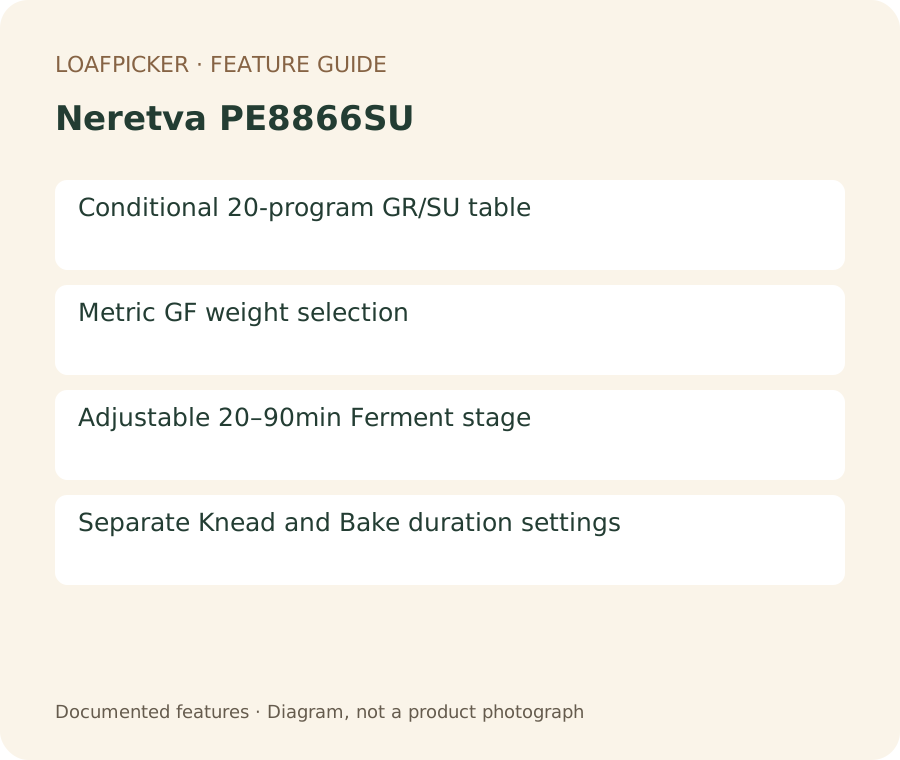 Original LoafPicker feature diagram. Product references appear below. Not a product photograph.
THE FIT AT A GLANCE
At a glance
Owners whose label, rotary controls and program table match the reproduced PE8866GR/SU booklet.
Exact SU is printed in the booklet, but manufacturer-hosted authenticity and current hardware edition are unresolved.
Shop this model on Amazon ↗Affiliate link · Model search.
The PE8866SU has a clearer documentary connection than the similarly named mint-green MLK record: a reproduced instruction booklet explicitly prints “PE8866GR/SU” and identifies green or silver finishes. It provides a real course table, recipes and control instructions. The remaining limitation is provenance and edition. The recovered copy is user-uploaded rather than a download authenticated on Neretva's current maker site, and its hardware specifications differ from some retail descriptions. This record therefore remains a conditional owner reference, excluded from ordinary buying matches.
Neretva's own website confirms that it markets a silver twenty-in-one family with dual-heater and ceramic-pan claims, but does not display an exact model cross-reference. An owner can use the booklet below if the rating plate, controls and supplied recipe book agree. A current retail page and an older family booklet should not be blended into an imagined unit with every favorable feature from both.
The metric settings are the dependable starting point
The reproduced book gives 750g and 900g weight choices. Its recipe headings attach pound descriptions that do not agree consistently with later 1.65lb marketing. Keeping the metric labels avoids pretending that those are exact mathematical conversions or guaranteed finished-loaf weights. It also avoids applying an ordinary-bread capacity to every other course. The functions table enables weight selection for the first nine bread programs, including Gluten Free, but not for dough, cake, fermentation or Homemade.
The ordinary recipes are differentiated by both timing and ingredients. Basic takes about three hours at the smaller label and three hours five minutes at the larger. French is longer, while the program called Quick Bread still uses yeast and takes over two hours. That is a different recipe category from a baking-powder cake. Someone using a familiar banana-bread recipe should choose according to its leavener and the matching recipe instructions, rather than assume the word “quick” has the same meaning on every machine.
The GF course has a documented control boundary
Program 9 is explicitly Gluten Free, and the table enables its metric weight, crust and delay controls. Its stated times are approximately three hours twenty minutes and three hours twenty-five minutes for the two labels. The recipe uses a gluten-free flour formulation with yeast and xanthan gum. That establishes more than a general suggestion to put a GF recipe on Basic, while stopping short of a promise that any commercial blend behaves identically.
For a buyer, the critical verification is that the actual panel and supplied book contain this same program 9 and control table. The reproduced booklet does not establish a separately verified finished capacity in pounds, and no pound value is entered for the GF course. Its recipe system is also a better starting point than a generic recipe scaled to an advertised maximum. Ingredient absorption and structure still determine whether an adaptation is appropriate.
Ferment offers a real adjustable stage; Homemade remains less clear
The functions table describes a Ferment program with a default forty-five minutes and an adjustable twenty-to-ninety-minute range. The associated instructions give 35°C as the rising temperature. That is meaningful evidence of adjustable fermentation duration, unlike a machine that only supplies fixed Dough and Bake programs. It does not establish user-adjustable temperature or an unlimited proofing interval.
The booklet also lists an adjustable Knead interval of eighteen to thirty minutes and Bake of ten to ninety minutes. These provide separate stages an owner can manage. They do not by themselves prove that the machine stores a complete custom sequence. A Homemade program is named, but the recovered instructions do not clearly show a full stage-by-stage editing and saving procedure. Full-cycle customization remains unconfirmed rather than being inferred from that name.
There is another reason to read the table carefully: the Ferment recipe section mistakenly tells the owner to select program 14, while the contents and program table identify Ferment as 15 and Pizza Dough as 14. That is an internal instruction conflict, not an invitation to guess which setting is active. An owner should confirm the displayed program on the physical machine and use the exact supplied edition. Nor does an adjustable warm rise establish a maker recommendation for every maintained sourdough starter.
Delay support differs across bread and dough
The table permits delayed completion for Basic, Sweet, French, Whole Wheat, Potato, Corn, Sugarless and Gluten Free. Quick Bread is excluded. It also marks Toast Dough and Pizza Dough as delay-compatible, even though they have no weight or crust choice and do not finish with a warm-holding stage. These are more informative distinctions than a general fifteen-hour-timer claim. The interval describes completion planning, and the book warns against delaying perishable egg or dairy recipes.
Sweet-bread additions such as raisins are described as hand additions at a signal. The recovered evidence does not establish an automatic inclusion container for this exact edition or a menu whitelist for one. A buyer wanting an unattended fruit loaf should therefore verify hardware rather than transfer the automatic dispensers advertised on other Neretva families. Included paddle quantity also needs care: the booklet lists one paddle, while some retail package descriptions list two, which does not establish two active kneading shafts.
Resolve hardware and care before ordering parts
The reproduced booklet rates its PE8866GR/SU at 120V, 60Hz and 550W and gives 290 × 246 × 285mm without labeling dimension order. Some retail descriptions instead give 565W, different dimensions and ceramic-pan wording. The booklet calls its pan nonstick without identifying ceramic. None of these discrepancies should be repaired by choosing a likely conversion or assuming that all coatings and assemblies are interchangeable.
The booklet permits dishwasher cleaning of its pan and paddle while excluding the main appliance, but that permission must stay attached to the matched edition. A replacement pan with a different coating may have its own care requirements. The unresolved hardware association is the main tradeoff: the course table is unusually useful, yet a purchase still needs a matching label, complete pan assembly and authentic supplied instructions. This assessment reports those documented possibilities without claiming a baking trial, noise test, price or current parts stock.
Documented specifications
- Model
- PE8866SU
- General loaf sizes
- 750g booklet setting / 900g booklet setting
- Dedicated GF course
- Yes
- GF capacity basis
- The conditional PE8866GR/SU booklet permits 750 g and 900 g selections on Gluten Free program 9 and supplies matching recipes. Conflicting pound labels are not treated as exact equivalents.
- Automatic add-ins
- Not confirmed
- Complete adjustable cycle
- Not confirmed
- Body dimensions
- Not confirmed in the primary sources used here