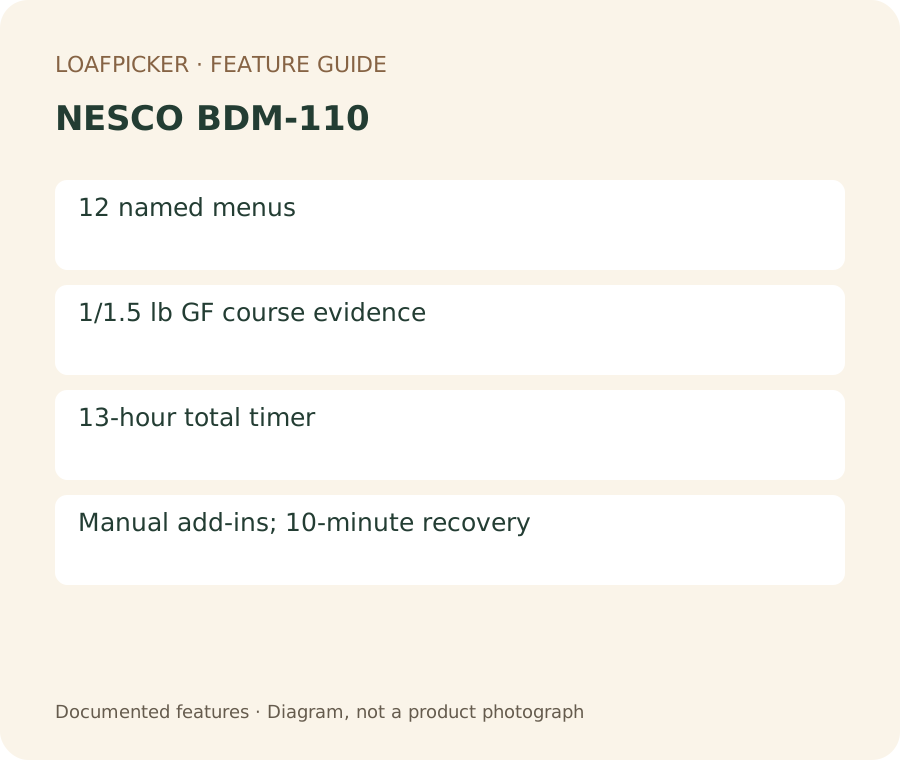
 Original LoafPicker feature diagram. Product references appear below. Not a product photograph.
THE FIT AT A GLANCE
At a glance
Documented one- and one-and-a-half-pound conventional or gluten-free courses with manual add-ins.
Supplied recipe program numbers conflict with the named menu table and need manufacturer clarification.
Shop this model on Amazon ↗Affiliate link · Model search.
The NESCO BDM-110 has a clear small-loaf purpose: its own manual identifies one-pound and one-and-a-half-pound choices, a dedicated gluten-free course and manual add-in prompts. It also has a documentation weakness that matters in daily use. Several recipe instructions cite program numbers that conflict with the manual's menu table. The machine can therefore be assessed from an exact manufacturer source, but its recipe pages should not be repeated as a corrected operating guide. The distinction is between documented controls and inconsistent instructions, not a claim about the quality of bread it produces.
Its size range is a real boundary
NESCO lists BDM-110 separately from BDM-100 in its official manual index. The linked guide names BDM-110 and specifies 120 V, 60 Hz and 580 W. This is stronger evidence than an unsourced reseller specification and keeps the two NESCO models separate. The size choice is one or one-and-a-half pounds; there is no documented two-pound position. A household expecting to make larger batches should treat that as a practical limit rather than assuming that a different recipe can simply fill the pan further.
The smaller range may suit someone who wants a modest batch and can use the corresponding recipe quantity. It is less attractive when a larger loaf is the main objective or when the user expects several sizes on every specialty process. Capacity describes the machine's intended recipe range, not a measured guarantee of finished loaf mass. The actual pan, paddle and label should still be checked on a used unit, particularly where an advertised ASIN has not been securely cross-referenced. NESCO manual index; BDM-110 manual.
The gluten-free course has unusually useful size evidence
The manual's description of program six explicitly discusses both supported loaf weights and says the course does not include a second rise. This gives a firmer basis for the gluten-free size choices than inferring them from a general capacity label. It also describes an add-in alert at a remaining display time for each weight. Those displayed times are prompts within the running course. They are not documented total cycle durations and should not appear in a comparison chart as completed-bread times.
The inspected manual documents the GF course and sizes, but does not provide a clearly identified starting formula in its recipe section. That leaves a useful distinction for a buyer: the named course and two weights are documented, while the best starting formula remains a separate question. Ask NESCO for the appropriate recipe and current clarification before relying on a particular flour blend or ingredient sequence. Nothing in this research supports a promise about loaf texture, dietary suitability or the result of adapting a conventional recipe.
Recipe numbers need to be checked against menu names
The clearest conflict is straightforward. The menu table assigns program two to Whole Wheat and program three to French. The French recipe then instructs the reader to select two, while Honey Whole Wheat points to three. Other recipes also contain questionable references. An owner following numbers alone could select a different course from the one named by the recipe. This is a substantive usability issue in the document, even though it does not prove a fault in the machine.
The sensible next step is to obtain manufacturer clarification and compare it with the physical menu labels. Until NESCO resolves the conflict, select a recipe only with label-matched course guidance. The same restraint applies to broad instruction wording about adjustable time: it does not provide a complete stage-programming procedure. A buyer comfortable with verified named courses may tolerate this documentation issue; someone who wants an entirely straightforward supplied recipe guide should weigh it more heavily.
A timer does not remove the need to attend to ingredients
The documented timer reaches thirteen hours including the baking process. That is a finish-time window, rather than thirteen extra hours added to a full course. The manual excludes perishable ingredients from delayed recipes. It also uses manual prompts for additional ingredients, so a recipe that expects a later addition still requires attention. A person planning an unattended bake needs to check both requirements: whether the ingredients may wait and whether an add-in step occurs after the cycle begins.
The exact menu-by-menu delay exclusions were not established, and this record does not turn a general timer instruction into permission for every course. Likewise, the ten-minute power-recovery window concerns a brief interruption; it is not a saved personal recipe or a way to pause fermentation indefinitely. These features can support a routine, but they should not be combined into a claim of unrestricted overnight flexibility. The chosen recipe and named course remain the relevant unit of planning.
Useful variety, with limits on what “programmable” means
The twelve-menu list includes Dough, Blend, Cake, Jam, Yogurt and Bake alongside bread courses. Quick uses baking soda or powder, so it should not be matched as a rapid yeast-bread program merely because its name sounds fast. Dough prepares material for further work, whereas Bake supplies heating without the mixing and resting stages. Those separate functions may be useful for an owner who understands the next step, but they do not establish a stored custom sequence for an experimental loaf.
Yogurt duration can be adjusted within the stated range; that specific adjustment is not evidence of editable bread temperatures or saved fermentation stages. NESCO's manual index provides a route for obtaining original copies and lists a support telephone, which is valuable when asking about the recipe conflicts. Replacement-part stock and service response were not tested. The BDM-110 is a plausible documented choice for smaller conventional or gluten-free batches when its manual-add-in workflow is acceptable. Its chief documented tradeoff is the need to resolve recipe instructions before treating the supplied book as dependable step-by-step guidance.
Documented specifications
- Model
- BDM-110
- General loaf sizes
- 1 lb, 1.5 lb
- Dedicated GF course
- Yes
- GF capacity basis
- Official Program #6 description explicitly addresses 1.0 and 1.5 lb; countdown values are add-in prompts, not total runtimes.
- Automatic add-ins
- No
- Complete adjustable cycle
- Not confirmed
- Body dimensions
- Not confirmed in the primary sources used here