Original branded packet is recoverable, but the maker-hosted filename and external model association do not settle exact 5836/5838 packet equivalence.
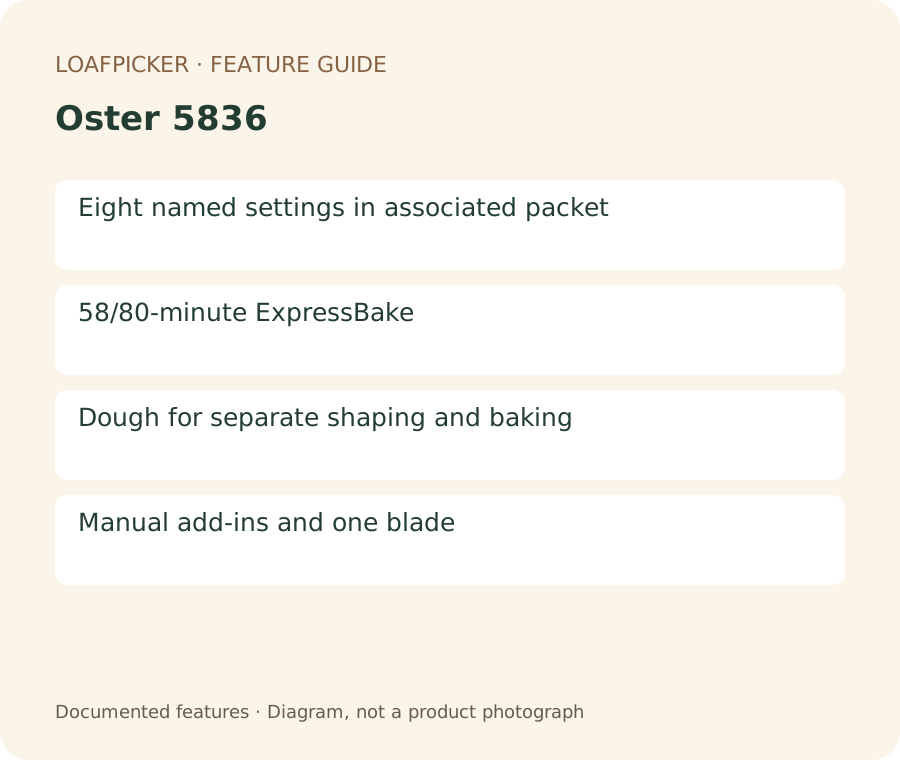 Original LoafPicker feature diagram. Product references appear below. Not a product photograph.
THE FIT AT A GLANCE
At a glance
Owner reference for a machine whose panel agrees with the P.N.102819 instructions.
Legacy model association needs checking, and ExpressBake excludes timer and crust adjustment.
Shop this model on Amazon ↗Affiliate link · Model search.
The Oster 5836 is most useful today as a legacy machine with recoverable instructions, recipes and clear ExpressBake limitations. Its documentation supports a more specific assessment than a bare used-market listing, but it also exposes a model-association problem. The 5836-associated manual is a 76-page packet carrying publication number 102819. A newly recovered Oster/Newell-hosted PDF carries that same publication number while its filename contains 005838. The interior does not explicitly resolve the model relationship. This page therefore preserves the 5836 separately and explains the packet rather than declaring two models interchangeable.
The publication number is the useful starting point
A booklet's cover, last page and control illustration provide a practical way to identify which instructions an owner has. ManualsLib associates P.N. 102819 with 5836 and also lists related suitability information, but that association is external to the maker's PDF. The recovered manufacturer-hosted document is valuable primary material; its filename alone cannot settle every machine it covers. A used buyer should compare the actual control panel and booklet, particularly before following a numbered setting from a different Oster packet.
The detailed menu in this packet has eight settings: Basic, Whole Wheat, French, Sweet, two ExpressBake settings, Dough and Bake. That compact menu is easier to interpret than a retailer's unexplained count of “settings,” which may combine menu and crust choices. It also gives an owner a quick compatibility check: if the physical panel has a substantially different arrangement, pause before using this guide. A broad claim that the machine makes many kinds of bread should not override that mismatch. 5836-associated manual; Oster/Newell P.N. 102819 PDF.
ExpressBake offers two different scheduling choices
The packet describes 58-minute and 80-minute ExpressBake settings. They are alternatives with their own recipe requirements, rather than a promise that every ordinary recipe can be accelerated. The manual explains that these breads can be shorter and denser, with a darker, thicker crust, and that the longer fast setting can produce a taller loaf. Those are manufacturer descriptions, not results observed for this research. They provide a useful expectation to discuss when speed matters more than reproducing a conventional long-cycle loaf.
A material correction concerns size. The early ExpressBake tutorial uses a 1.5 lb recipe, but the manufacturer-hosted P.N. 102819 also includes 58-minute White Bread recipes for both 1.5 and 2 lb in its later recipe section. The tutorial is not a 1.5 lb-only restriction. Nor does the presence of both recipes uniquely identify the separate 5838 packet. Owners should match the recipe, selected setting and publication, instead of using that one feature to decide that two machines must be identical.
The fast cycle gives up useful controls
The ExpressBake instructions exclude the delay timer and crust-color adjustment. That changes the everyday decision more than the headline time. Someone wanting a fast loaf can start it when ready to prepare the ingredients, while someone wanting a delayed overnight finish needs a suitable conventional recipe and setting. A fast course and a long delay are separate workflows. The machine's timer does not establish that the fast course can sit loaded until a convenient start time.
The booklet also gives specific yeast and liquid guidance for ExpressBake. An owner should consult the matching recipe directly rather than applying the temperature and yeast choices from a Basic loaf. That is particularly important with a used machine supplied without its book: the fast-cycle label is not enough to reconstruct the method. The maximum delayed-start range was not established in this research, so a precise overnight scheduling claim would go beyond the evidence.
Dough is useful without implying custom programming
The Dough setting supports a different kind of flexibility: the machine prepares dough that the user then shapes, allows to rise and bakes in an oven. That can be useful for rolls or pizza where the pan's final loaf shape is not the goal. It does require a second stage of work and separate baking equipment. It should not be described as a fully automatic finished artisan loaf, and it does not establish a stored custom cycle with individually programmable mixing, rising and baking stages.
Bake appears in the detailed menu and the packet includes jam-related instructions. This is a reason to read the recipe's sequence carefully, not to invent a separate automatic Jam program. Likewise, a coffee-cake dough recipe would not establish a dedicated Cake menu. The available menu does not name Gluten-Free. That is a documented absence of a dedicated course in this packet; it is not proof that no adapted recipe could ever work. No model-specific gluten-free recipe was established here.
Buying or retaining a legacy unit
The instructions document one kneading blade, a removable pan and warming for up to an hour. For a used example, completeness and condition deserve attention before recipe variety: a missing blade, unsuitable replacement pan or damaged coating can prevent the intended workflow. Current replacement-part stock was not verified. A listing that merely says “works” does not settle whether the pan locks correctly or the blade matches the shaft. Those checks belong to the actual unit, not to the historical specification.
This is a reasonable owner-reference candidate when its controls and P.N. 102819 booklet agree, and when the intended task fits the documented conventional, ExpressBake or dough workflows. It is less suitable as a purchase chosen around a gluten-free course, saved custom programming or a verified modern support package. Confirm the electrical label before use, particularly for an imported unit; an exact voltage/frequency/wattage combination was not established. Oster still provides a breadmaker support route, but this research does not promise that it can supply the required legacy parts. Oster support.
Documented specifications
- Model
- 5836
- General loaf sizes
- 1.5 lb, 2 lb
- Dedicated GF course
- No
- GF capacity basis
- No dedicated GF menu or exact GF recipe established in the associated P.N.102819 packet.
- Automatic add-ins
- No
- Complete adjustable cycle
- Not confirmed
- Body dimensions
- Not confirmed in the primary sources used here