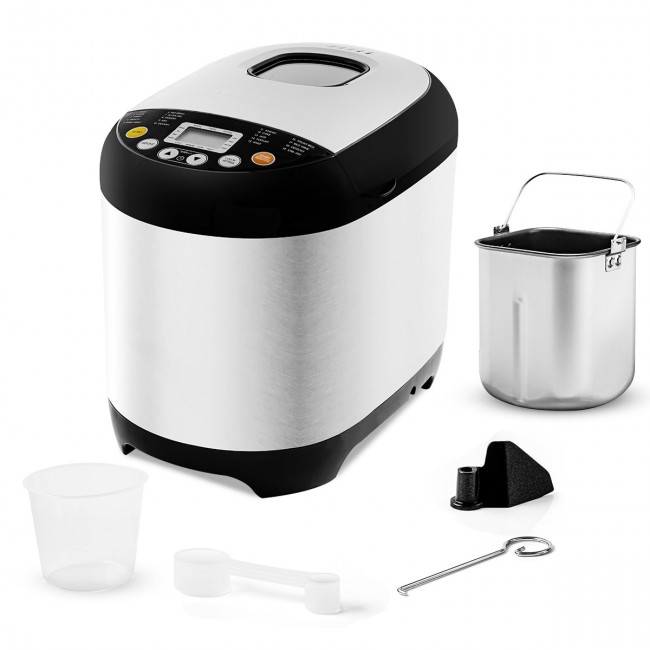
 OVENTE BRM5020B. Product photo: OVENTE.
THE FIT AT A GLANCE
At a glance
Documented specialty-menu and GF controls for someone able to add ingredients manually.
GF recipe weight is unstated and its eggs/milk exclude long delay; outage wording is ambiguous between 10 and 15 minutes.
Shop this model on Amazon ↗Affiliate link · Model search.
The black OVENTE BRM5020B has a useful chain of primary evidence: its brand page identifies the exact SKU and UPC and links the BRM5020 series manual. That manual confirms a dedicated gluten-free course, three gram-based size choices and manual ingredient prompts. The practical appeal is a broad menu with documented controls. Its limitations are equally specific: add-ins require someone nearby, the supplied gluten-free recipe has no stated finished loaf weight, and the power-interruption wording leaves an unresolved interval. This is a document-based assessment, not a report of measured loaf quality.
Use the gram labels when size matters
OVENTE markets the machine using rounded one-, one-and-a-half- and two-pound language. The manual's actual selectors are 500, 750 and 1000 grams. Those are not exact conversions of the marketing labels. For an owner following a recipe or a shopper comparing a small batch, the values printed on the controls are the more precise reference. A nominal “one-pound” match should therefore retain the gram label, rather than suggesting the control is exactly 454 grams.
The manual restricts size and crust controls to programs one through seven. Gluten Free is number seven, so all three documented gram selections apply to that course. This is stronger evidence than simply combining a capacity claim with a specialty-menu name. It does not mean every process in the nineteen-menu list offers the same adjustments. Jam, yogurt or dough should be assessed from their own instructions, not from the bread selectors. Exact black BRM5020B page; linked BRM5020 manual.
A gluten-free recipe is included, but its weight is not specified
The manual contains a gluten-free recipe and directs it to program seven. It describes one rise before baking, but it does not label that recipe with a finished loaf weight. The existence of three active size selections does not supply the missing recipe label. An owner should seek clarification about the intended selector position rather than guessing from the general maximum capacity. This research also did not establish a total runtime for each gluten-free size.
That distinction matters if the main reason for buying is a smaller specialty loaf or a fixed serving schedule. The machine documents the required kind of course and selector flexibility, while the recipe-to-size connection remains incomplete. A complete comparison should show both pieces. It should not invent course times or imply that a flour mixture will succeed simply because the machine has a Gluten Free label. The recipe evidence is useful, but it does not replace an actual outcome test.
Add-ins are a scheduled human step
For programs one through seven, the machine sounds ten beeps when additional ingredients should be poured in. This includes the gluten-free course. The instructions tell the user to open the lid and add them; there is no automatic ingredient-dispenser workflow. Someone who is nearby during a bake may find that entirely workable. Someone expecting nuts or dried fruit to enter while away from home should not treat the alert as equivalent to a compartment that releases them automatically.
The same distinction affects dough use. A broad menu list does not establish an add-in prompt on every non-bread course, because the manual limits the described prompt to the first seven programs. If a dough recipe needs a later addition, check the appropriate method directly. This is a good example of why feature matching should follow documented course eligibility: the machine can have both a Dough menu and an ingredient alert without those features necessarily operating together.
Delay depends on the recipe as well as the course
The fifteen-hour timer includes the complete breadmaking course within the selected total. Jam, program thirteen, is excluded. The manual additionally discourages delayed Whole Wheat operation because of potential results, and excludes recipes containing perishable ingredients from timer use. These are different restrictions: one is a control limitation, one is course guidance, and one depends on what has been loaded into the pan. They should remain visible rather than becoming a blanket fifteen-hour promise.
This is especially relevant to the included gluten-free recipe, which uses eggs and milk. Even when the course is not the named timer exception, that recipe's ingredients prevent treating it as an unattended long-delay recipe under the manual's guidance. A buyer who wants breakfast ready after an overnight wait needs an explicitly suitable formula and method. Keep Warm serves completed bread for a limited period; it does not solve the ingredient problem or establish a custom fermentation schedule.
Nineteen functions offer variety, not full cycle programming
The list includes separate mixing, kneading, dough, cake, jam, yogurt and rice-related functions. Quick uses baking powder or soda, so it is not evidence for a rapid yeast loaf. Dough prepares material that requires further work; Knead does not add a rising or baking process. Those distinctions help someone decide whether the menu supports their intended task without confusing a collection of presets with a custom editor. No saved personal bread program or temperature editor was established.
The manual specifies 120 V, 60 Hz and 550 W. Check that rating against the offered unit, especially for an import. Its outage section promises continuation after a ten-minute interruption but says a reset follows interruptions longer than fifteen minutes, leaving the intervening period unclear. Do not turn that into a precise fifteen-minute recovery guarantee. OVENTE supplies a support email, telephone and conditional one-year warranty language; parts stock and response quality remain untested. The BRM5020B fits a shopper who values documented gram selectors and manual-add-in baking, provided the remaining recipe and interruption questions are acceptable.
Documented specifications
- Model
- BRM5020B
- General loaf sizes
- 500 g / 750 g / 1000 g
- Dedicated GF course
- Yes
- GF capacity basis
- Nominal pound labels only: actual selectors are 500/750/1000 g. Size controls apply to #1–7, including GF #7. Supplied GF recipe has no stated finished weight.
- Automatic add-ins
- No
- Complete adjustable cycle
- Not confirmed
- Body dimensions
- Not confirmed in the primary sources used here