Verified Japanese domestic 100 V appliance; retained as a regional owner reference and excluded from direct US buying matches.
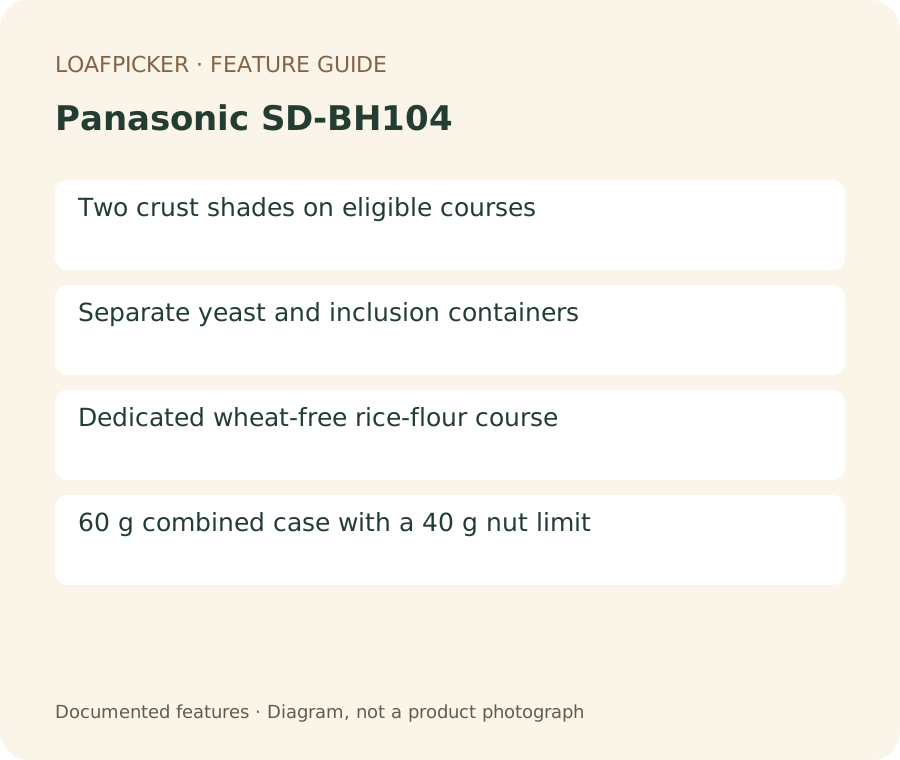 Original LoafPicker feature diagram. Product references appear below. Not a product photograph.
THE FIT AT A GLANCE
At a glance
Japanese-market owners following the exact bread, rice-flour and Hoshino recipes.
100V Japan-only design; fixed programs, two crust shades and stricter nut capacity than later BH models.
Shop this model on Amazon ↗Affiliate link · Model search.
The SD-BH104 makes sense as an owner reference for a Japanese domestic machine, especially when the goal is a regular small loaf rather than a large menu of cooked foods. Its manual documents white, soft, French, whole-wheat, cooked-rice and two different rice-flour breads, alongside dough, cake and chocolate. The important buying boundary comes before those features: this is a 100V Japanese appliance. Panasonic explicitly describes it as designed for Japan and says it cannot be used in countries with different supply voltage or frequency. It belongs outside ordinary US bread-machine recommendations.
This assessment follows Panasonic's exact SD-BH104 manual and product specifications. It does not assume that the controls or ingredient limits of a later BH model apply. The BH104 has light and standard crust settings, for example, rather than a universal three-shade selector. Crust adjustment is available only on the courses marked in the manual. French and whole-wheat bread do not acquire an adjustable crust merely because the panel has a crust button.
Understand the batch before comparing capacities
Panasonic describes a one-kin format. That Japanese loaf designation should remain a Japanese designation, rather than becoming an invented exact pound setting. The ordinary white loaf uses 250g of flour, while the rapid loaf uses 280g and the natural-yeast loaf uses 300g. These are recipe inputs, not three selectable finished-loaf weights. The FAQ specifically says that halving the recipe does not produce a supported half-loaf program: kneading and degassing would no longer suit the reduced batch.
The course times help decide how the machine would fit a day. White bread takes approximately four hours, soft bread four hours twenty minutes, and French or whole-wheat bread five hours. Rapid bread takes two hours but has its own recipe, including different flour and yeast amounts. Melon bread is an attended two-hour-fifteen-minute project; its cookie topping is added by the owner after about fifty-five minutes. These are distinct workflows, rather than interchangeable speed settings for any recipe.
The rice-flour distinction is substantial
The two rice-flour courses serve different ingredients. The wheat-containing version uses a different formulation from the wheat-free version. The latter is a dedicated rice-flour course without wheat, taking about one hour fifty-five minutes, and the manual explicitly supplies a recipe using 300g of gluten-free rice-bread mix. That is documented GF-specific programming, although it does not establish a particular pound capacity or a GF loaf-size selector.
The alternative wheat-free recipe is equally specific: it combines the named rice flour with a prepared paste of glutinous-rice flour, syrup and water. This is not permission to put an arbitrary bag of rice flour into the wheat-free course. Panasonic names the appropriate flour or dedicated mix. A prospective owner who cannot obtain an equivalent specified ingredient system should see ingredient sourcing as part of the decision. The manual also warns that using the reservation timer above 25°C can worsen the result, even though the course technically supports reservation.
The dispenser needs ingredient-specific planning
A separate yeast container handles dry yeast, and the raisin/nut container can add suitable inclusions automatically. The latter has a combined maximum of 60g, but the BH104 has tighter limits for some individual ingredients: nuts are limited to 40g, peas to 30g, olives to 20g, and ham or bacon to 50g. It would be misleading to describe this simply as a 60g nut dispenser. Pieces also need the preparation specified by the manual, including small cuts and removal of excess moisture where required.
Ordinary breads, both rice-flour breads and the bread-dough program have the inclusion function. Pizza dough does not. Wet, sticky or easily melted additions, including cheese and chocolate, require hand addition at the signal; the owner has a three-minute interval. Small seeds go into the pan initially. That distinction matters if the intended benefit is an unattended loaf with ingredients the container cannot release reliably.
Timing and fermentation boundaries
The reservation feature sets a completion time, with up to thirteen hours for supported dry-yeast breads and ten hours for the natural-yeast loaf. It is not thirteen hours added to the baking cycle. The table excludes rapid bread, melon bread, ordinary dough and pizza dough from reservation. Bread dough takes an hour and pizza dough forty-five minutes, after which shaping and oven work remain with the owner.
The natural-yeast section is a defined Hoshino workflow: approximately twenty-four hours to prepare the starter, seven hours for the loaf or four hours for dough. Panasonic's FAQ explicitly says homemade natural yeast tends to have unstable fermentation strength and recommends Hoshino. This is therefore not a recommendation for an arbitrary maintained sourdough starter. Nor does a collection of fixed programs establish independently adjustable fermentation timing, a complete custom cycle or user-set fermentation temperature.
Condition matters more than a long feature list
The specified body is approximately 24.1cm wide, 30.4cm deep and 32.2cm high, weighing about 6kg. Allow additional room to open the lid and remove the pan; those body dimensions are not operating clearance. The electrical table lists a 370W heater and a motor rated at 80W on 50Hz or 75W on 60Hz. Those separate component ratings should not be repackaged as a guessed single total rating.
For an existing unit, inspect the coated pan, kneading paddle and two release containers before buying accessories or ingredients. Panasonic specifies gentle hand cleaning and excludes the dishwasher for the pan and paddle. The historical parts list identifies paddle ADD96-1431 and complete pan ADA12-169; the list is useful for identification, not evidence of current availability. A sound BH104 can suit someone who wants its documented Japanese recipes and bread-focused menu. An incomplete unit, unavailable rice mix or a need for programmable wild-starter fermentation changes that decision substantially.
Documented specifications
- Model
- SD-BH104
- General loaf sizes
- 1斤 Japanese one-loaf format
- Dedicated GF course
- Yes
- GF capacity basis
- Dedicated Rice Flour WITHOUT Wheat course, with an explicit 300 g gluten-free rice-bread-mix recipe. This is flour input, not a documented finished-pound capacity; no loaf-size selector.
- Automatic add-ins
- Yes
- Complete adjustable cycle
- Not confirmed
- Body dimensions
- 9.49 × 11.97 × 12.68 in (W × D × H)