Verified Japanese domestic 100 V model; retained as regional owner reference and excluded from direct US buying matches.
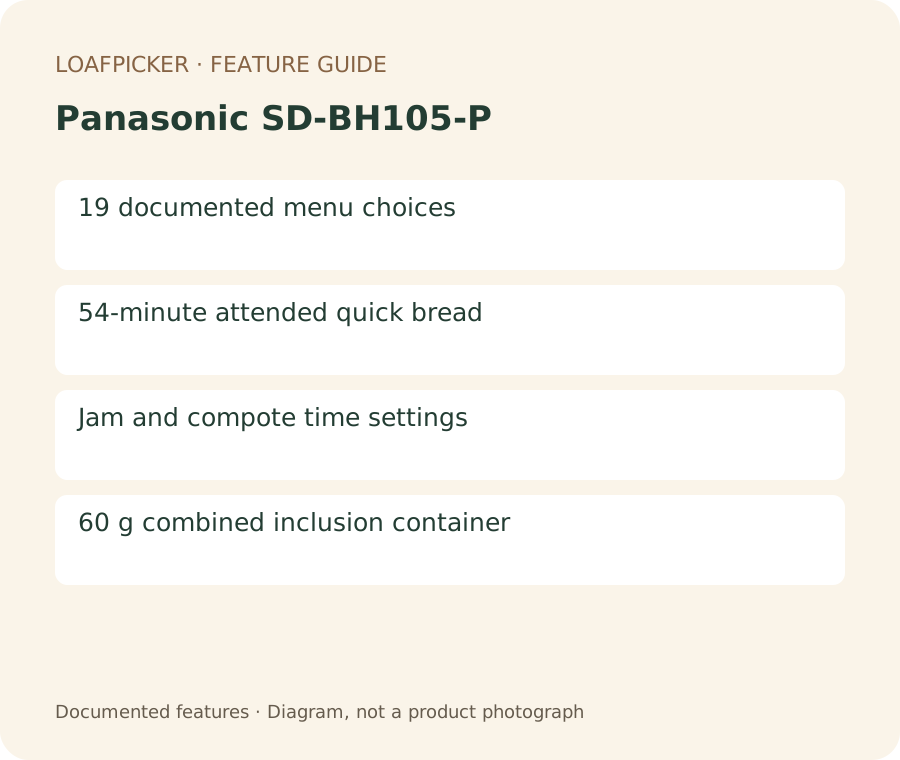 Original LoafPicker feature diagram. Product references appear below. Not a product photograph.
THE FIT AT A GLANCE
At a glance
Japanese-market owners wanting defined bread routines plus attended quick bread and fruit cooking.
100V Japan-only; two crust shades,60g case, fixed fermentation and no BM mochi/noodle equipment.
Shop this model on Amazon ↗Affiliate link · Model search.
The SD-BH105-P is the pink Japanese-market version of the SD-BH105. Panasonic's support page explicitly identifies that suffix, while its operating book covers the base model. Its useful distinction is the combination of familiar bread routines with quick bread, jam and compote. Those additions can make an existing machine worth keeping in a kitchen that uses them. They do not turn it into a programmable fermentation appliance, and its 100V Japan-only electrical specification keeps it outside routine US buying matches.
The manual gives nineteen course/menu combinations, including starter preparation. Counting them is less informative than separating the jobs they perform. A white loaf takes approximately four hours, a softer loaf four hours twenty minutes, French and whole-wheat loaves five hours, and the rapid bread two hours. The quick-bread program is something else: it uses baking powder and finishes in about fifty-four minutes. Someone shopping specifically for a fast yeast loaf should not confuse that recipe category with the rapid bread course.
Which extra menus would actually earn their place?
Quick bread requires attention almost immediately. The owner scrapes down flour after approximately two minutes and shapes the mixture after a further minute. Cake also has a flour-scraping step. These details matter more than the claim that a machine can make cake: they determine whether it fits a morning when nobody can return to the kitchen. The melon-bread option likewise needs its separately prepared cookie topping placed on the dough after about fifty-five minutes.
Jam has a setting range of approximately ninety to one hundred fifty minutes, while compote runs for about one to two hours. Those adjustable cooking times belong to their cooking programs. They are not evidence that bread kneading or fermentation stages can be edited. Chocolate takes approximately seventeen minutes. In contrast, this BH model does not list the BM series' noodle/pasta and mochi courses or the later 106 generation's soy-scone and rice-French programs. A buyer wanting those specific foods should look at the actual menu rather than the family name.
A one-kin machine, without a pound selector
Panasonic's recipes use a one-kin Japanese loaf format. The white loaf contains 250g flour, the rapid loaf 280g, and the Hoshino natural-yeast loaf 300g. These inputs do not establish a menu of exact finished weights in pounds. The manual also says a half-sized recipe does not suit its programmed kneading and degassing, so reducing every ingredient by half is not a supported small-loaf setting.
Crust choices are light and standard. This is an important limit for the BH105-P: some related Panasonic models offer three shades, but this manual explicitly says two. Furthermore, crust control is restricted by course. French, whole-wheat and wheat-free rice-flour bread follow their own program behavior. The whole-wheat recipe starts at a fifty-fifty blend of bread flour and whole-wheat flour; the instructions discuss broader proportions and lower loaf height as the whole-wheat share rises. A whole-wheat label therefore needs the recipe context.
Rice flour means choosing the correct course and flour
The BH105 separates rice flour containing wheat from rice flour without wheat. The wheat-free course takes approximately one hour fifty-five minutes and has a specific recipe using 300g of gluten-free rice-bread mix. It is a dedicated GF-specific course, although the evidence does not establish a selectable GF pound weight. The other rice-flour course, taking approximately two hours thirty minutes, uses a wheat-containing formulation and cannot stand in for it.
The wheat-free instructions also offer a named rice flour combined with a prepared glutinous-rice-flour and syrup paste. Panasonic warns owners to follow the ingredients and quantities, and says changing the oil or adding milk products can spoil that formulation. This is a narrow, documented recipe system rather than a general claim that every gluten-free flour blend works. The reservation function is available, but the manual cautions that reservation above 25°C can worsen the bread. Someone relying on timed wheat-free loaves needs to plan around both the recipe and room conditions.
Inclusions and reservations have separate rules
The dry-yeast dispenser and raisin/nut dispenser do different jobs. The inclusion container holds up to 60g in total, including combinations of ingredients. This manual permits up to 60g nuts within that total, unlike the smaller nut allowance in the earlier BH104. Suitable dry fruit and prepared nuts can be released automatically. Cheese, chocolate and wet or sticky ingredients go in by hand at the signal, within three minutes; tiny seeds go into the pan at the start.
The course table allows the inclusion feature for ordinary bread dough and the wheat-free rice-flour course, but not pizza dough. Dough takes about sixty minutes, and pizza dough about forty-five, with neither supporting delayed completion. Supported dry-yeast breads can finish up to thirteen hours after setting, while the natural-yeast loaf has a ten-hour maximum. Rapid and attended melon bread are excluded. Perishable additions also need their ingredient-specific reservation restrictions respected.
Natural yeast and the condition of an older unit
The Hoshino workflow comprises a twenty-four-hour starter-preparation course followed by a seven-hour loaf or four-hour dough course. The FAQ says homemade natural yeast can have unstable fermentation strength and directs owners to Hoshino. A baker maintaining an unrelated sourdough culture should not interpret “natural yeast” as a documented recommendation for it. There is no verified user programming of a complete bread cycle or fermentation temperature here.
The body measures approximately 24.1 × 30.4 × 32.7cm in width, depth and height and weighs about 6kg. The electrical table lists 100V at 50/60Hz, a 370W heater and an 80W/75W motor depending on frequency. For ownership, pan coating, shaft condition and both dispenser doors deserve inspection. Gentle hand washing is specified for the pan and paddle; the dishwasher is excluded. The historical parts list names paddle ADD96-1431 and pan assembly ADA12-169, useful identification details without any promise of current stock.
Documented specifications
- Model
- SD-BH105-P
- General loaf sizes
- 1斤 Japanese one-loaf format
- Dedicated GF course
- Yes
- GF capacity basis
- Dedicated Without Wheat rice-flour course uses an explicit 300 g GF rice-bread-mix recipe; ingredient weight is not finished pounds and no size selector is documented.
- Automatic add-ins
- Yes
- Complete adjustable cycle
- Not confirmed
- Body dimensions
- 9.49 × 11.97 × 12.87 in (W × D × H)