Verified Japanese domestic 100 V model; retained as regional owner reference and excluded from direct US buying matches.
 Original LoafPicker feature diagram. Product references appear below. Not a product photograph.
THE FIT AT A GLANCE
At a glance
Japanese owners using cooked-rice French bread, specified GF rice bread or attended soy-scone recipes.
100V Japan-only with a 60 g inclusion case; no BM noodle/mochi/Danish menus or documented full custom fermentation.
Shop this model on Amazon ↗Affiliate link · Model search.
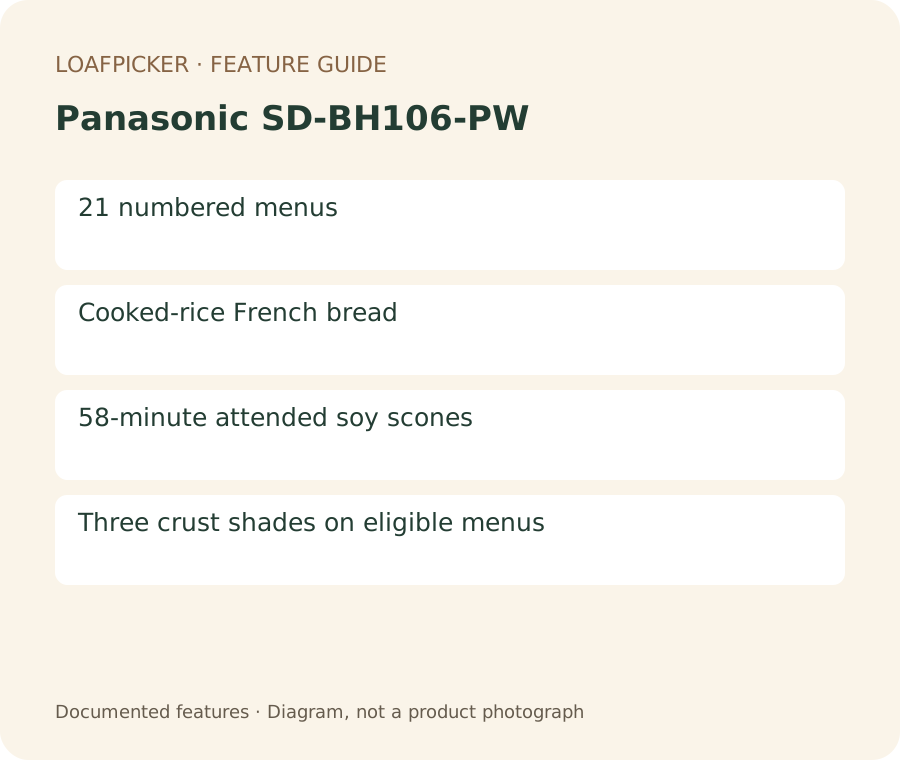
The SD-BH106-PW is useful to distinguish from both the older BH105 and the taller BM106. Panasonic confirms the -PW variant on its own support page, and the base-model manual documents twenty-one menus. Among the additions are cooked-rice French bread and soy scones. The BH106 retains a smaller 60g inclusion container and lacks the BM106's Danish-style bread, mochi and noodle/pasta programs. For an owner comparing similar Japanese machines, these are more useful differences than the shared Panasonic badge.
This is a Japanese domestic 100V model, rated for 50/60Hz. Its manual explicitly limits the design to Japan and says it cannot be used where supply voltage or frequency differs. The review therefore serves identification and ownership research, rather than an ordinary US purchase recommendation. No claimed baking test, current price or accessory availability is needed to understand what the documented machine can do.
Cooked rice and rice flour are three different decisions
The standard cooked-rice bread uses bread flour with cooled cooked rice. It takes approximately four hours. The rice-French menu takes about four hours forty minutes and aims at a different style, with its own recipe. Neither means that the machine mills raw rice. The FAQ says cooked rice should be cooled to approximately 30°C or below; frozen rice must be thawed and brought to room temperature first. Recipe preparation remains important even with an automatic program.
Separate rice-flour menus cover wheat-containing and wheat-free formulations. The wheat-containing program takes roughly two hours thirty minutes; the wheat-free one takes one hour fifty-five minutes. The latter is menu 10, and its exact recipe includes 300g of explicitly gluten-free rice-bread mix. It therefore constitutes a dedicated GF-specific course. It does not establish a pound-size setting, selectable GF finished weight, or unrestricted compatibility with any blend carrying a gluten-free label.
Panasonic also gives a wheat-free route using a named rice flour and a separately made paste containing glutinous-rice flour, syrup and water. The instructions insist on the specified ingredient system and warn that oil substitutions or dairy additions can prevent success. An owner who wants to adapt a favorite wheat-free recipe should recognize the limits of the documented recipe before treating the course name as an endorsement of the adaptation.
Fast bread and soy scones still need attention
The ordinary white, soft, rapid, French and whole-wheat programs run approximately four hours, four hours twenty minutes, two hours, five hours and five hours respectively. The one-kin format is a Japanese loaf designation, not a collection of exact pound buttons. Different courses use different flour amounts, so a recipe's 250g or 280g input should not be mistaken for the weight of the finished bread.
The fifty-four-minute quick-bread program uses baking powder. Soy scones take about fifty-eight minutes and have a distinct ingredient formulation, including the manual's kinako or specified soy-flour alternatives. Both require a flour-scraping intervention soon after starting and a later shaping step. Someone wanting to load the machine and immediately leave should choose a suitable unattended bread course instead of assuming every short menu is hands-off. Melon bread is also attended, with its cookie topping added after approximately fifty-five minutes.
A dispenser that serves bread dough, but not pizza dough
The raisin/nut container has a combined 60g limit. Dry fruit and prepared nuts can be added automatically, with pieces reduced to the sizes in the book. The container is separate from the yeast dispenser; yeast and inclusions are not interchangeable loads. Wet or sticky additions, cheese and chocolate require the manual-addition signal. Small seeds are loaded initially into the pan. These practical rules determine whether the machine delivers the unattended workflow a particular recipe needs.
The menu table marks inclusion support for ordinary breads, the wheat-free rice-flour menu, ordinary bread dough and Hoshino natural-yeast dough. Pizza dough is excluded. Bread dough takes about an hour and pizza dough forty-five minutes, and neither allows delayed completion. The distinction is especially useful when an owner sees that one dough program supports the raisin button and another does not: that is documented program behavior, not necessarily a fault.
Reservation and fermentation do not provide full custom control
Supported dry-yeast loaves can finish up to thirteen hours after setting. The minimum interval differs: white bread begins at four hours ten minutes, rice-French at four hours fifty minutes, and wheat-free rice flour at two hours five minutes. Rapid and melon bread are excluded. Three crust shades are provided on eligible courses, but French, whole-wheat and wheat-free rice flour still have course-specific restrictions. A timer or crust button is not available everywhere simply because it appears on the panel.
Natural-yeast bread takes seven hours after its starter has been prepared, and natural-yeast dough takes four hours. Starter preparation takes approximately twenty-four hours. This is the documented Hoshino system. The FAQ expressly discourages homemade natural yeast because its fermentation strength can be unstable. It should not be promoted as a verified program for an unrelated maintained sourdough culture. The manual does not establish independently adjustable bread fermentation timing or temperature, or a complete editable cycle.
The ownership check
At approximately 24.1cm wide, 30.4cm deep and 32.7cm high, the BH106 body is lower than the BM106's 34.5cm specification, but both need space above the lid. Weight is approximately 6kg. The electrical table separately lists a 370W heater and an 80W motor at 50Hz or 75W at 60Hz. Those are component ratings, rather than a reason to invent a summed headline wattage.
Check the pan coating, paddle fit, rotating shaft, yeast release and inclusion door on any older example. Panasonic requires gentle hand cleaning of the pan and paddle and excludes dishwasher use. Its historical parts page names paddle ADD96-1431 and pan assembly ADA12-169. An intact BH106-PW can be a sensible keeper for its defined Japanese bread and scone recipes. It is a weaker fit when the real need is mochi, noodles, a larger inclusion load or adjustable wild-starter fermentation.
Documented specifications
- Model
- SD-BH106-PW
- General loaf sizes
- 1斤 Japanese one-loaf format
- Dedicated GF course
- Yes
- GF capacity basis
- Dedicated menu 10 Rice Flour WITHOUT Wheat with 300 g explicitly GF-labeled mix recipe. No exact finished-pound setting or GF size button.
- Automatic add-ins
- Yes
- Complete adjustable cycle
- Not confirmed
- Body dimensions
- 9.49 × 11.97 × 12.87 in (W × D × H)