Verified Japanese domestic 100 V model; retained as regional owner reference and excluded from direct US buying matches.
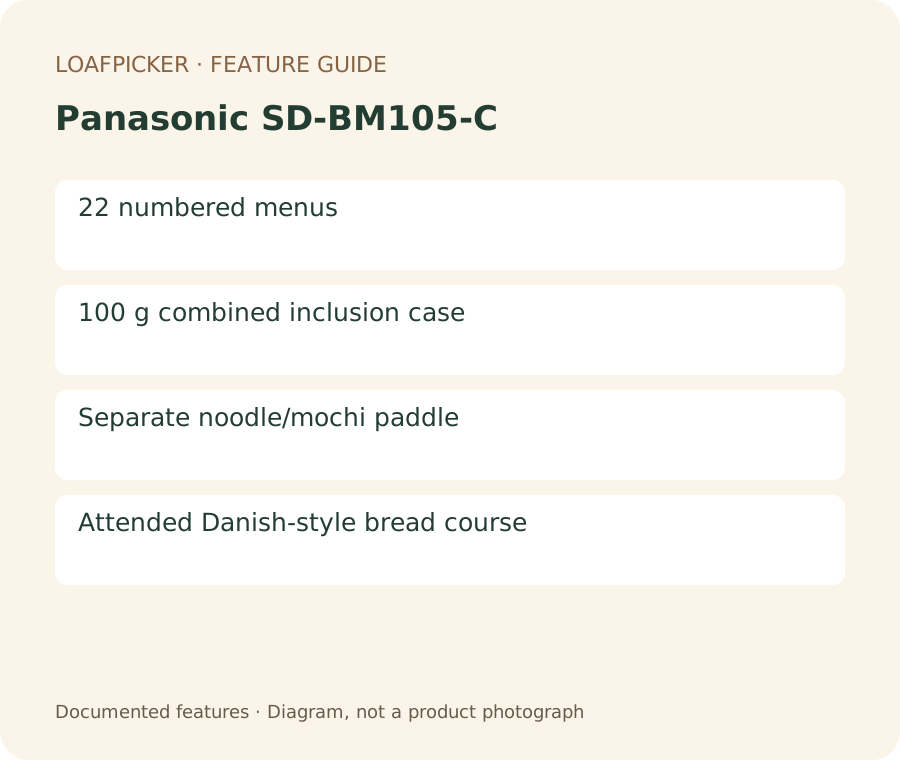 Original LoafPicker feature diagram. Product references appear below. Not a product photograph.
THE FIT AT A GLANCE
At a glance
Japanese-market owners who will use mochi, noodle dough and attended Danish-style bread.
100V Japan-only; special tools and attended recipes matter, while bread stages remain fixed.
Shop this model on Amazon ↗Affiliate link · Model search.
The beige SD-BM105-C is more than a color variation of the contemporary BH105. Panasonic's maker support page confirms the -C designation, and its BM105 manual includes twenty-two menus, a 100g inclusion container and separate bread and noodle/mochi paddles. It adds Danish-style bread, mochi and noodle/pasta preparation to the bread and cooking choices. These are meaningful reasons to identify an existing unit correctly before buying parts or following a neighboring model's instructions.
The regional limitation is equally specific. Panasonic rates this machine at 100V, 50/60Hz and explicitly says it is designed for Japan, with no use or after-sales service in countries with different supply voltage or frequency. This is an ownership and import-reference assessment, not a normal US-market recommendation. Its useful capabilities do not erase that limitation.
The BM functions justify checking the paddle inventory
Mochi takes approximately an hour and uses the dedicated noodle/mochi paddle. The process includes opening the lid after the specified point, approximately fifty or fifty-five minutes depending on the preparation. It is not an entirely unattended bread-like cycle. The specification table gives a glutinous-rice load of 280–420g. That is an ingredient capacity for mochi, not an alternative loaf weight and not evidence that the machine mills ordinary raw rice for bread.
The noodle/pasta course takes approximately fifteen minutes and also uses the special paddle. It prepares dough; rolling, cutting, shaping and cooking the noodles remain separate work. The table specifies 300g flour. A used machine supplied with only a bread paddle therefore loses a material part of its documented versatility. The historical parts list identifies the bread paddle as ADD96-1431 and the noodle/mochi paddle as ADD82-150-K0, which helps establish what is missing without promising that replacements are currently stocked.
Danish-style bread is an attended project
The three-hour Danish-style bread course requires butter to be added by hand approximately twenty-five minutes after starting. Panasonic's FAQ specifies butter cut into roughly 1cm cubes and frozen overnight; unfrozen butter melts too soon to produce the intended effect. The program does not support the automatic inclusion function, reservation or selectable crust. It should be chosen by someone willing to perform that preparation and return at the right time, rather than someone expecting a delayed breakfast loaf.
Melon bread is another attended specialty, taking about two hours fifteen minutes with cookie dough placed on top after approximately fifty-five minutes. Standard white bread, soft bread, French and whole-wheat breads provide more conventional routines at roughly four hours, four hours twenty minutes, five hours and five hours. The two-hour rapid bread uses a specific yeast recipe. The fifty-four-minute quick bread instead uses baking powder and needs early scraping and shaping. Similar-sounding speed claims describe different foods.
Capacity is a Japanese recipe format
The BM105 uses a one-kin loaf format. A standard white recipe uses 250g flour, rapid bread 280g and the Hoshino natural-yeast loaf 300g. It does not follow that these are selectable finished-loaf weights in pounds. The FAQ also rejects simply halving the ingredients, because its kneading and degassing would no longer match the smaller batch. Someone seeking a supported very small loaf should not assume a proportional reduction solves the problem.
The machine offers three crust shades on the courses marked for that function. French and whole-wheat bread, Danish-style bread and wheat-free rice-flour bread retain their own restrictions. A bread machine can have a crust button and still omit that option from particular programs. The same applies to reservation: the table, rather than the general feature list, determines what can be timed.
A dedicated wheat-free course with specified ingredients
Menu 9 is rice-flour bread containing wheat; menu 10 is rice-flour bread without wheat. The latter takes approximately one hour fifty-five minutes and provides an exact recipe using 300g of gluten-free rice-bread mix. That supports a dedicated GF-specific course designation, while leaving exact pound capacities unspecified. The wheat-containing rice-flour course cannot be substituted when the intended recipe excludes wheat.
The other wheat-free recipe uses a named rice flour plus a prepared glutinous-rice-flour, syrup and water paste. Panasonic requires the specified ingredients and warns against changes such as different oil or dairy additions. The recipe is more constrained than a broad “works with gluten-free flour” promise. Reservation is available for this course, but the manual warns that using it above 25°C can worsen the result. Ingredient sourcing and room conditions therefore belong in the ownership decision.
What the larger container can automate
The raisin/nut container can hold up to 100g combined. That is a larger documented allowance than the BH105's 60g, and it can matter to someone regularly making inclusion breads. The machine still distinguishes suitable dry additions from sticky, wet or melting ingredients that require hand addition. Small seeds go into the pan initially. The yeast container is separate and has its own purpose.
Inclusion support extends to ordinary bread dough, wheat-free rice-flour bread and the defined Hoshino dough course. It does not extend to pizza dough or Danish-style bread. Ordinary dough takes sixty minutes and pizza dough forty-five, with no delayed completion. Supported dry-yeast loaves can be reserved up to thirteen hours ahead; Hoshino bread has a ten-hour completion limit. The twenty-four-hour Hoshino starter-preparation course and seven-hour loaf course are fixed workflows, not proof of a fully programmable bread sequence.
Where the versatility stops
Panasonic explicitly says homemade natural yeast can have unstable fermentation strength and recommends Hoshino. A maintained wild sourdough culture is therefore outside the documented recommendation. Adjustable jam or compote cooking time does not establish adjustable bread fermentation or user-set temperature. These distinctions matter to a baker who wants to control every rise independently.
The body measures approximately 24.1 × 30.4 × 34.5cm in width, depth and height and weighs about 6kg. Check clearance above the lid as well as the footprint. Inspect the coated pan and both paddles before accepting an older unit. Panasonic specifies gentle hand washing and excludes dishwasher cleaning for the pan and paddles. A complete BM105-C is most compelling when its mochi, noodle and attended specialty-bread workflows will actually be used; otherwise, its extra equipment and height add less practical value.
Documented specifications
- Model
- SD-BM105-C
- General loaf sizes
- 1斤 Japanese one-loaf format
- Dedicated GF course
- Yes
- GF capacity basis
- Dedicated menu 10 Rice Flour WITHOUT Wheat, exact 300 g GF rice-bread-mix recipe; no finished-pound size selector or fixed pound capacity established.
- Automatic add-ins
- Yes
- Complete adjustable cycle
- Not confirmed
- Body dimensions
- 9.49 × 11.97 × 13.58 in (W × D × H)