Verified Japanese domestic 100 V model; retained as regional owner reference and excluded from direct US buying matches.
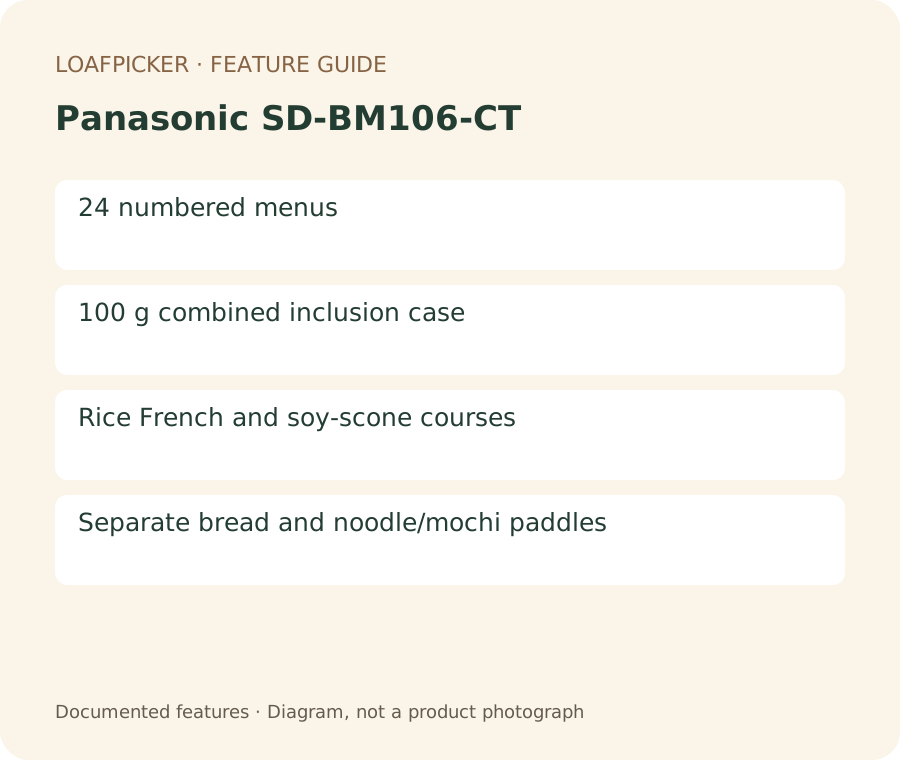 Original LoafPicker feature diagram. Product references appear below. Not a product photograph.
THE FIT AT A GLANCE
At a glance
Japanese owners using the broader cooking menu and both alternative paddles.
100V Japan-only; attended specialties and fixed Hoshino recipes do not provide a programmable wild-starter machine.
Shop this model on Amazon ↗Affiliate link · Model search.
The SD-BM106-CT combines twenty-four documented menus with a 100g inclusion container and separate bread and noodle/mochi paddles. Its most useful distinction within this group is the combination: rice-French bread and soy scones from the 106 generation, plus the BM line's Danish-style bread, mochi and noodle/pasta preparation. Panasonic's own support page identifies the exact -CT variant, so the base SD-BM106 operating book has a defensible model connection.
The buying boundary is regional. The rating is 100V at 50/60Hz, and Panasonic explicitly describes the product as Japan-only, excluding use where voltage or frequency differs. This review is therefore useful for identifying and understanding an existing Japanese machine. It should not be read as a routine US appliance recommendation or as a claim that an electrical workaround has been approved.
Twenty-four menus do not mean twenty-four unattended jobs
For conventional bread, the principal choices are white at approximately four hours, soft at four hours twenty minutes, rapid at two hours, and French or whole wheat at five hours. Cooked-rice bread takes four hours, while cooked-rice French bread takes four hours forty minutes. Those last two start with cooled cooked rice and wheat flour. They do not grind raw rice, and they are distinct from the rice-flour programs.
Several appealing menus need an owner nearby. Danish-style bread requires prepared frozen butter to be added around twenty-five minutes after starting. Melon bread needs its cookie topping placed after about fifty-five minutes. The fifty-four-minute quick-bread and fifty-eight-minute soy-scone courses call for early scraping and shaping. Cake also has a scraping step. A person seeking a machine that can be loaded before leaving should choose among the genuinely unattended recipes rather than count every specialty as equivalent convenience.
The special paddle changes what a complete used machine includes
The mochi course takes about an hour, with an instruction to open the lid at the specified late stage. It uses 280–420g glutinous rice according to the capacity table. The noodle/pasta course takes about fifteen minutes with a 300g flour capacity, leaving later shaping, cutting and cooking to the owner. These are different tasks from the ordinary bread-dough program, which kneads and ferments for about an hour, or pizza dough at forty-five minutes.
Both mochi and noodles use the dedicated noodle/mochi paddle. A second paddle in this package is therefore a different tool, not evidence of two paddles kneading bread simultaneously. The historical parts section names bread paddle ADD96-1431 and noodle/mochi paddle ADD82-150-K0. Before valuing an older BM106 for its versatility, check that both are present and that the pan shaft and coating are sound. Current replacement availability is not established by an old parts list.
Read the rice-flour course number carefully
Menu 10 makes rice-flour bread containing wheat; menu 11 makes rice-flour bread without wheat. Menu 11 runs approximately one hour fifty-five minutes and the manual explicitly supplies a 300g gluten-free rice-bread-mix recipe. That qualifies as a dedicated GF-specific course. It does not justify converting the Japanese loaf designation into a precise pound setting or claiming a selectable GF pound capacity.
Panasonic also documents a wheat-free formulation using a named rice flour and a prepared paste of glutinous-rice flour, syrup and water. It tells the owner to use the specified flour or appropriate dedicated mix, and warns that oil changes or dairy additions can spoil the formulation. A familiar wheat-free mix from another recipe is not automatically interchangeable. Reservation is supported, but the instruction book cautions against reserving this bread above 25°C because the outcome can deteriorate.
The general batch format is one kin. Recipe flour inputs vary: approximately 250g for the ordinary white loaf, 280g for rapid bread and 300g for Hoshino bread. Those figures describe ingredients for separate courses, not a menu of finished weights. The FAQ says that a half-quantity batch does not match the programmed kneading and degassing. This is a useful limit when comparing the BM106 with machines offering an explicit small-loaf selector.
Automatic additions still have a whitelist
The combined inclusion-container limit is 100g. Dry fruit and properly prepared nuts are suitable automatic additions, within the ingredient guidance. Sticky or wet ingredients and melting additions such as cheese or chocolate require hand addition at the signal. Tiny seeds are loaded into the pan before starting. The separate yeast dispenser should be kept conceptually separate from this container; neither function means every ingredient can be stored overhead and released later.
The table enables the inclusion feature for ordinary breads, menu 11 wheat-free bread, ordinary bread dough and the specific Hoshino loaf and dough programs. It excludes pizza dough and Danish-style bread. Three crust shades are available only on marked menus. Reservation likewise follows a table: supported dry-yeast breads can finish up to thirteen hours after setting, and the Hoshino loaf up to ten. Dough, pizza, rapid bread and attended specialty programs do not inherit that feature.
Natural yeast is a defined recipe system
The starter-preparation program takes roughly twenty-four hours, followed by a seven-hour Hoshino loaf or four-hour Hoshino dough cycle. The FAQ explicitly says homemade natural yeast tends to have unstable fermentation strength and recommends Hoshino. That warning matters more than a broad interpretation of the words “natural yeast.” An owner maintaining a different wild starter should not treat the machine as a documented sourdough recommendation.
No full editable bread sequence, independent bread-fermentation timer or adjustable fermentation temperature was established in this manual. Jam, compote and finishing adjustments belong to their particular tasks. They do not create a general custom baking system. A baker who mainly wants to manage the duration of each rise should decide on that requirement before being drawn to the broad cooking menu.
Space and care complete the decision
The specified body is approximately 24.1cm wide, 30.4cm deep and 34.5cm high, with a mass near 6kg. The lid needs additional operating room. The ratings separately list a 370W heater and an 80W motor at 50Hz or 75W at 60Hz. Panasonic requires gentle hand cleaning of the coated pan and paddles and excludes the dishwasher. A complete, well-kept BM106-CT is most useful to an owner who intends to use its particular Japanese recipes and special tools; it offers less advantage when the only desired job is a basic loaf.
Documented specifications
- Model
- SD-BM106-CT
- General loaf sizes
- 1斤 Japanese one-loaf format
- Dedicated GF course
- Yes
- GF capacity basis
- Dedicated menu 11 Rice Flour WITHOUT Wheat with explicit 300 g GF rice-bread-mix recipe; Japanese recipe input is not an exact finished-pound control.
- Automatic add-ins
- Yes
- Complete adjustable cycle
- Not confirmed
- Body dimensions
- 9.49 × 11.97 × 13.58 in (W × D × H)