Verified Japanese domestic 100 V model; retained for regional owners and excluded from direct US buying matches.
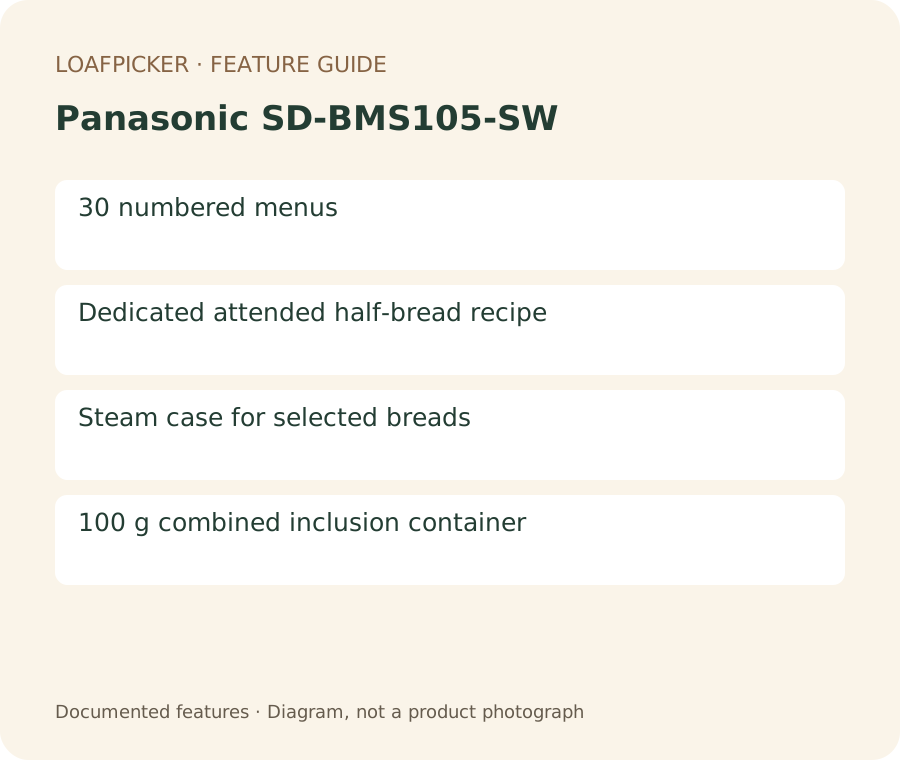 Original LoafPicker feature diagram. Product references appear below. Not a product photograph.
THE FIT AT A GLANCE
At a glance
Japanese-market owners who will use shaped small breads, steamed recipes and the special accessories.
100 V Japan-only design; Half Bread requires shaping and steam-case transfer, while fermentation remains fixed.
Shop this model on Amazon ↗Affiliate link · Model search.
The SD-BMS105-SW is a Japanese bread machine whose accessory set changes the buying decision. Its thirty-menu book includes half bread, pale bread, filled buns and steamed bread as well as ordinary loaves, dough, mochi and noodles. Several of those jobs use a steam case and require the owner to handle dough partway through. A used example with its pan and bread paddle can therefore be incomplete for the very features that distinguish this model.
Panasonic's support page confirms the exact -SW suffix, and the operating manual identifies the SD-BMS105 base model. The electrical boundary is also clear: 100V, 50/60Hz and a design explicitly limited to Japan. This assessment is for identification and ownership research, with the model excluded from routine US buying matches. It does not claim a baking trial or an approved way to adapt the electrical supply.
Half bread is a separate project
Menu 16 makes half bread in approximately two hours fifty-five minutes. The recipe uses 150g bread flour and is labeled a half-kin batch. Around eighty minutes after starting, the owner removes the dough, divides and shapes it, cleans the bread pan and removes the paddle, then puts the shaped dough into the steam case above the pan. The instructions specify no water in the pan for this particular operation. Work must be completed within the permitted interval before the program resumes.
This is meaningful small-batch support, but it is not a small-loaf button applied to every recipe. It is also not the same automatic half-loaf workflow documented on some later Panasonic models. An owner wanting to set a half loaf before bed should notice that this menu has neither reservation nor inclusion and crust controls. The FAQ directs half-sized baking to this specific course rather than approving an across-the-board reduction of other recipes.
Where the broader menu helps
The regular white loaf takes approximately four hours, pain de mie four hours fifty minutes, soft bread four hours twenty minutes, and the rapid loaf one hour fifty-five minutes. French, rye and whole-wheat breads take about five hours. These choices provide different recipe and timing routes, rather than a single loaf with an arbitrary speed slider. Panasonic's Japanese one-kin format and flour quantities remain in their original terms; no exact pound settings are established.
Brioche takes around three hours fifteen minutes and requires butter to be added partway through. Danish-style bread and melon bread also have their own attended steps. Steamed bread uses the steam accessory, while mochi and noodle/pasta dough use the separate noodle/mochi paddle. The book additionally includes sweet bean paste, jam, compote, cake and chocolate. The practical question is which of these preparations the household will actually make, since equipment completeness and time beside the machine vary by job.
Coarse mixing is useful, but it is not cycle programming
The raisin/nut container holds up to 100g combined, and the yeast container is separate. Suitable dry fruit and prepared nuts can be released automatically. Wet, sticky or melting additions still require hand loading at the signal, and tiny ingredients have their own instructions. The container's maximum is not a universal permission to add any 100g mixture to any recipe.
A coarse-mixing option is available on selected menus to help preserve the shape of delicate additions. Panasonic calls for recipe adjustments, including extra water on applicable recipes and frozen chocolate when that ingredient is used. Selecting gentler mixing is a useful control over how additions are handled; it does not show that the owner can rewrite fermentation stages or save a complete custom bread cycle. The table permits inclusions on ordinary bread dough and wheat-free rice-flour bread, while pizza dough and the attended half-bread menu are excluded.
The wheat-free course has a defined ingredient system
Menu 12 is rice-flour bread containing wheat and menu 13 is rice-flour bread without wheat. The latter takes approximately one hour fifty-five minutes, and its recipe explicitly uses 300g gluten-free rice-bread mix. It is a dedicated GF-specific course, rather than a GF recipe placed on Basic. There is no verified GF size selection in pounds, and a recipe's flour input is not the finished loaf's weight.
The book also gives a wheat-free formulation with named rice flour and a prepared glutinous-rice-flour, syrup and water paste. Specified ingredients matter, and Panasonic warns against substitutions that change the formula. Availability of those ingredients is therefore part of the ownership decision. Reservation is technically supported, but the manual warns that rice-bread results can deteriorate when reservation is used above 25°C.
Timing and natural yeast remain bounded
Supported dry-yeast breads have completion reservations up to thirteen hours, while the Hoshino natural-yeast loaf has a ten-hour limit. Dough and pizza dough, rapid bread, brioche and attended specialty breads are not all reservation-compatible. The three crust shades likewise operate only on marked programs. The menu table is the useful guide when a button appears unavailable.
Hoshino starter preparation takes twenty-four hours, followed by a seven-hour loaf or four-hour dough program. The FAQ says homemade natural yeast can be unstable and recommends Hoshino. A maintained wild starter is therefore outside the documented recommendation. Fixed Hoshino routines and coarse mixing do not establish adjustable fermentation duration or temperature for bread.
The completeness check
The body is approximately 24.1cm wide, 30.4cm deep and 34.5cm high, with a mass of about 6.2kg. The manual lists the heater at 370W and the motor separately at 80W on 50Hz or 75W on 60Hz. Its historical parts section identifies bread paddle ADD96-168, noodle/mochi paddle ADD82-150-H, pan ADA12-168 and steam case ADA53-173. Those references help identify missing equipment; they do not establish present stock.
Panasonic requires gentle cleaning of the coated pan and paddles and excludes dishwasher use. Inspect the coating, shaft, dispenser doors and steam case before valuing an older unit. A complete BMS105-SW can reward someone interested in its particular shaped and steamed preparations. Its extra menu breadth offers less advantage when the main requirement is an unattended small loaf or independent sourdough fermentation control.
Documented specifications
- Model
- SD-BMS105-SW
- General loaf sizes
- 1斤 Japanese one-loaf format / 1/2斤 dedicated attended Half Bread recipe
- Dedicated GF course
- Yes
- GF capacity basis
- Dedicated menu 13 Rice Flour WITHOUT Wheat has an explicit 300 g GF rice-bread-mix recipe. No finished-pound selector or fixed pound capacity established.
- Automatic add-ins
- Yes
- Complete adjustable cycle
- Not confirmed
- Body dimensions
- 9.49 × 11.97 × 13.58 in (W × D × H)