Verified Japanese domestic 100 V model; retained for regional owners and excluded from direct US buying matches.
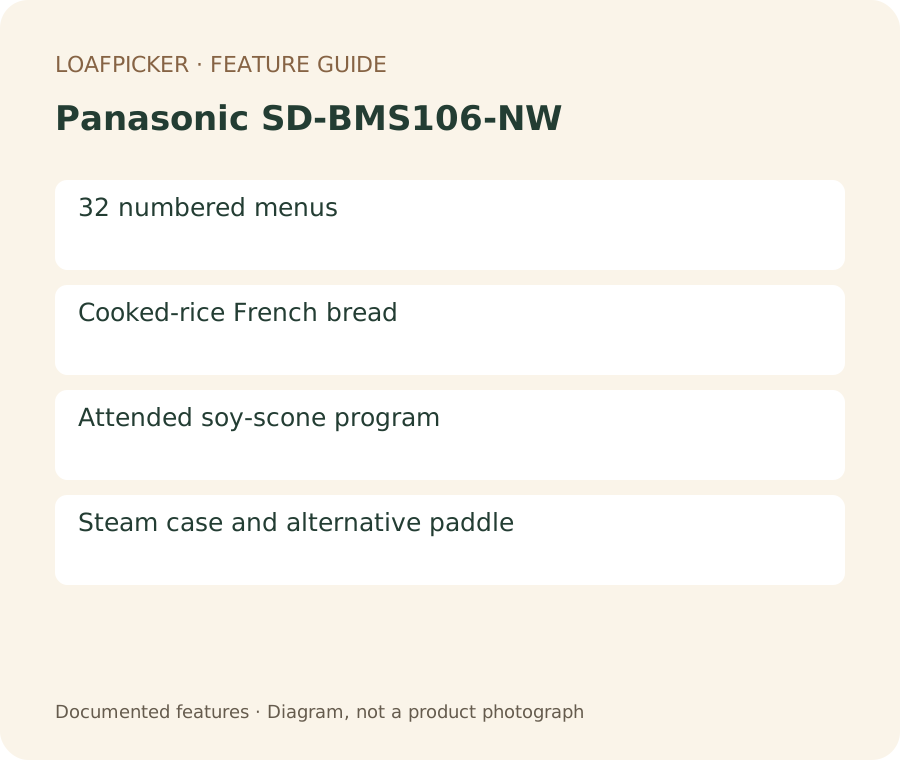 Original LoafPicker feature diagram. Product references appear below. Not a product photograph.
THE FIT AT A GLANCE
At a glance
Japanese owners using the steam case, alternative paddle and broader snack recipes.
100 V Japan-only; several specialty breads require attendance and the half-bread program cannot be reserved.
Shop this model on Amazon ↗Affiliate link · Model search.
The SD-BMS106-NW extends the BMS idea beyond ordinary bread: its thirty-two numbered menus include cooked-rice French bread, soy scones, shaped small breads, steamed bread, sweet bean paste, mochi and noodle dough. Panasonic confirms the -NW variant on its own support page. The exact operating book is more useful than a large menu count because it reveals which foods need shaping, which need a special paddle and which can actually finish while the owner is away.
This remains a Japanese domestic appliance. Its rating is 100V at 50/60Hz, and Panasonic explicitly limits the design to Japan and excludes operation under different voltage or frequency. The model is retained as a regional owner reference, rather than a routine US buying recommendation. The assessment follows maker documentation and does not imply a hands-on comparison of crust, noise or loaf texture.
The added recipes are specific jobs
Cooked-rice French bread takes approximately four hours forty minutes and uses cooled cooked rice with wheat flour. It is separate from the four-hour cooked-rice loaf and from the rice-flour programs. The name does not mean the machine grinds raw rice. For a household regularly saving cooked rice, that distinction helps identify the intended ingredient and the right recipe instead of improvising from the menu title.
Soy scones take roughly fifty-eight minutes. They join the fifty-four-minute baking-powder quick bread, ninety-minute cake and seventeen-minute chocolate preparations. Short duration does not make all of them unattended: quick bread and scones call for scraping and shaping soon after the start, while cake has a later scraping step. The book also includes jam, compote and sweet bean paste. These are useful only if their actual preparation fits the owner's habits.
The half-loaf menu is not the later automatic version
Menu 17 is half bread, labeled a half-kin preparation, taking around two hours fifty-five minutes. It requires the owner to remove and shape the dough after about eighty minutes, then use the steam case above the cleaned pan with the paddle removed. It is a dedicated small-batch recipe, not a loaf-size setting that scales French, rye or gluten-free bread. It has no reservation, crust or inclusion selection.
Pale bread, filled buns and steamed bread also make the steam accessory relevant. If a used machine is missing it, the loss affects several distinctive jobs rather than an incidental measuring tool. Ordinary bread still uses the bread paddle, while mochi and noodle/pasta preparation require a different paddle. Two alternative tools should not be described as simultaneous dual-paddle bread kneading.
Choose the bread routine by recipe and time
White bread takes approximately four hours, pain de mie four hours fifty minutes, soft bread four hours twenty minutes and rapid bread one hour fifty-five minutes. French, rye and whole-wheat breads take around five hours. Brioche takes three hours fifteen minutes and needs its butter addition; Danish-style and melon breads have separate attended steps. The machine uses a Japanese one-kin loaf format alongside its half-bread recipe, with no documented exact pound selector.
Three crust shades apply only to marked menus. French, rye, whole-wheat, half bread and other specialty courses have their own restrictions. A buyer who values a dark-crust option on one particular style should check that style's row rather than assume that every program inherits all panel functions. The same course-based approach applies to inclusions and reservation.
Inclusions have two levels of control
The separate yeast container and 100g combined raisin/nut container automate different ingredients. Suitable dry fruit and prepared nuts can be released without an owner present. Wet, sticky and melting ingredients, including cheese or chocolate, require the manual-addition signal. The limit applies to the combined contents, so 100g fruit plus another 100g nuts is not the documented container load.
Coarse mixing can help retain the shape of delicate additions on eligible programs. It is not a full custom cycle: Panasonic gives specific ingredient and water adjustments, not an editor for every knead and rise. Ordinary bread dough and the wheat-free rice-flour course support suitable additions; pizza dough does not. The defined Hoshino bread and dough programs also have inclusion support, but their existence does not endorse arbitrary sourdough cultures.
The wheat-free route requires the named flour system
Menu 13 uses rice flour containing wheat, while menu 14 is rice-flour bread without wheat. The latter runs approximately one hour fifty-five minutes and has a recipe using 300g explicitly gluten-free rice-bread mix. That supports classifying it as a dedicated GF-specific course. It provides no selectable GF capacity in pounds, and its one-kin recipe labeling should not be converted into an invented exact pound setting.
The manual also describes named rice flour with a prepared glutinous-rice-flour, syrup and water paste. Ingredient substitutions are constrained, including oil and dairy changes. A household unable to obtain a suitable specified mix should see that sourcing issue as part of the decision. The course permits reservation, but Panasonic warns that rice-bread reservation above 25°C can worsen the outcome.
What stays fixed
Supported dry-yeast breads can be reserved to finish up to thirteen hours after setting. Hoshino bread has a ten-hour limit. Bread dough takes an hour and pizza dough forty-five minutes, with no dough reservation. Hoshino starter preparation takes twenty-four hours before its seven-hour loaf or four-hour dough course. The FAQ explicitly says homemade natural yeast can have unstable fermentation strength and recommends Hoshino. There is no verified independent bread-proofing timer, editable full sequence or user fermentation-temperature control.
The approximately 24.1 × 30.4 × 34.5cm body weighs about 6.2kg and needs room above the lid. Its electrical table separates the 370W heater from the 80W/75W motor ratings. Check the pan coating, shaft, two release mechanisms, steam case and both paddles before accepting an older example. Panasonic excludes the dishwasher for the coated pan and paddles. The historical parts list names bread paddle ADD96-168, noodle/mochi paddle ADD82-150-K0, pan ADA12-168 and steam case ADA53-173; it does not prove current availability.
Documented specifications
- Model
- SD-BMS106-NW
- General loaf sizes
- 1斤 Japanese one-loaf format / 1/2斤 attended Half Bread recipe
- Dedicated GF course
- Yes
- GF capacity basis
- Dedicated menu 14 Rice Flour WITHOUT Wheat includes an explicit 300 g GF rice-bread-mix recipe. Flour input is not finished pounds; no GF size selector.
- Automatic add-ins
- Yes
- Complete adjustable cycle
- Not confirmed
- Body dimensions
- 9.49 × 11.97 × 13.58 in (W × D × H)