Verified Japanese domestic 100 V model; retained for regional owners and excluded from direct US buying matches.
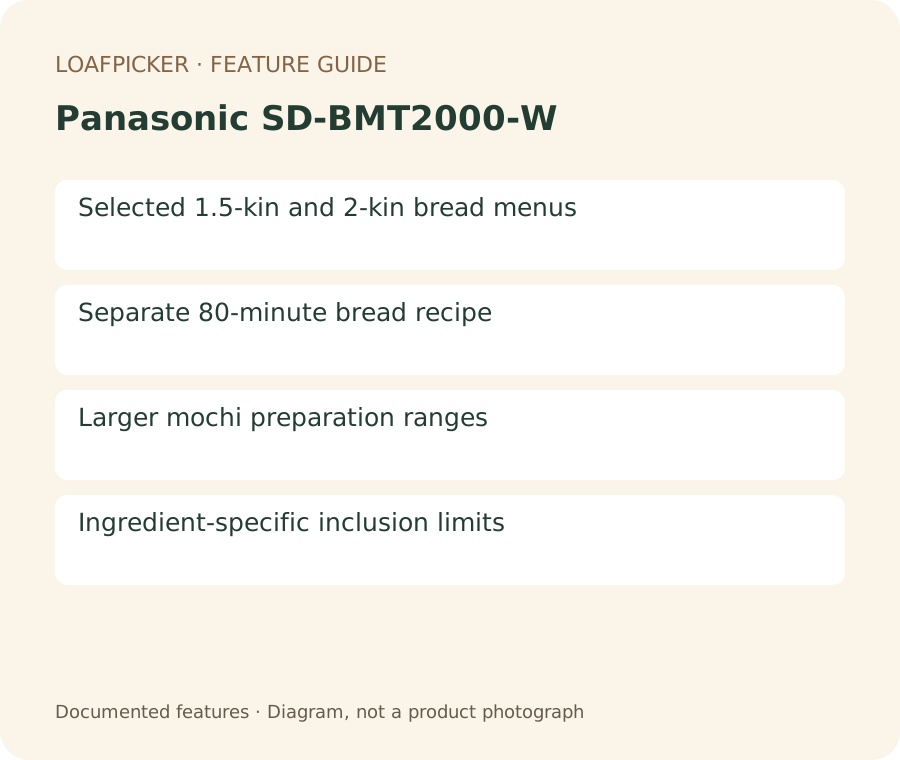 Original LoafPicker feature diagram. Product references appear below. Not a product photograph.
THE FIT AT A GLANCE
At a glance
Japanese households that need the documented larger bread or mochi batches.
100 V Japan-only; a larger body, recipe-specific sizes and an attended GF setup need planning.
Shop this model on Amazon ↗Affiliate link · Model search.
The SD-BMT2000-W is a larger Japanese bread machine with documented 1.5-kin and 2-kin bread menus and a substantial mochi capacity. Its forty numbered entries include paired sizes of several bread styles, so the count should not be read as forty unrelated recipes. The useful question is whether those larger batches suit the household and whether the owner has space for the body, lid and hot pan.
Panasonic confirms the white -W variant on its own support page. The manual rates it at 100V, 50/60Hz and 760W, explicitly describing it as designed for Japan and excluding use under different voltage or frequency. This is an ownership and regional-reference assessment, with the model outside routine US buying matches. Japanese kin designations are preserved here; they are not exact settings in pounds.
Two bread sizes do not apply to every menu
Several styles have separate numbered 2-kin and 1.5-kin entries, including pain de mie, standard white bread, soft bread, whole wheat and brioche. Standard white takes approximately four hours thirty minutes at 2 kin and four hours twenty-five minutes at 1.5 kin. Pain de mie takes around five hours fifteen minutes or five hours ten minutes. These are individual menu choices with their own recipe amounts, rather than evidence that every program has an independent size selector.
The eighty-minute bread course is a separate 2-kin recipe. It uses 500g flour and requires yeast to be dissolved in specified warm water before loading. That preparation is important: the short result is tied to a particular formula and process. The ordinary early-bake menus take about two hours ten minutes, while the baking-powder quick bread takes one hour ten minutes. All three are different routines, and the eighty-minute course has no inclusion, crust or reservation option.
The wheat-free course needs an early return to the machine
Menu 25 is rice-flour bread without wheat, taking approximately two hours fifteen minutes. The exact recipe includes 450g gluten-free rice-bread mix and is presented as a 2-kin preparation. This is a dedicated GF-specific course. It does not establish a pound capacity or a separate 1.5-kin GF selection simply because other breads have two sizes.
The owner must return after about five minutes to scrape down flour, add the dry yeast to its container as directed and restart. The manual explicitly says to perform those initial steps even when using reservation; the reserved waiting period begins afterward. That is a consequential distinction for someone wanting to load a wheat-free loaf and immediately leave. The timer exists, but the setup is attended.
The book also offers a named rice-flour formulation using a prepared glutinous-rice-flour and syrup paste. It constrains ingredients and warns against oil changes or dairy additions. Menu 24, rice flour containing wheat, is a different course. Neither cooked-rice bread nor cooked-rice French bread replaces the wheat-free recipe; those are wheat-flour breads incorporating cooled cooked rice. No raw-rice milling function is established.
The larger dispenser has ingredient-specific maxima
The raisin/nut container allows up to 150g dry fruit, but nuts have a 120g maximum. Other listed ingredients have their own preparation guidance and maximums. Panasonic also says the ingredients must not rise above the container rim and that some types will not fit up to their numerical maximum. It would be misleading to combine every listed maximum into one load or describe this as a universal 150g nut dispenser.
Suitable dry ingredients can be released automatically. Wet, sticky or melting additions, including cheese and chocolate, need hand addition at the signal. Coarse mixing can preserve delicate pieces on marked programs, with the recipe adjustments Panasonic specifies. Ordinary bread dough and the wheat-free rice-flour menu support suitable inclusions; pizza dough does not. The separate yeast container remains a distinct mechanism with a different load.
Dough and mochi are scaled differently
Ordinary bread dough takes approximately ninety minutes and uses a 450g flour capacity. Pizza dough takes forty-five minutes, also with its own specified formulation. Neither supports delayed completion. The longer ordinary dough time should not be replaced with the sixty-minute value from a smaller Panasonic model merely because the menu names are similar.
Mochi is split into two menu ranges: six to seven go and eight go to one sho, with the table specifying approximately 840–980g or 1,120–1,400g glutinous rice. The programs take about eighty or ninety minutes after the required washing and thirty-minute draining preparation. They require the noodle/mochi paddle and a later lid-opening step. Noodle/pasta kneading takes fifteen minutes with a 460g flour capacity; subsequent shaping and cooking remain outside the machine.
Specialty cooking does not create an editable bread cycle
The broader menu includes soy scones, cake, vegetable cake, jam and bean paste. Quick bread and soy scones have early scraping and shaping steps. Brioche requires butter partway through, and Arrange Bread requires owner work after approximately an hour. These are useful preparations for someone who plans to participate, but they should not all be counted as unattended convenience.
Supported dry-yeast breads can be reserved to finish within thirteen hours, while Hoshino bread has a ten-hour completion limit. Hoshino starter preparation takes twenty-four hours and its loaf takes approximately seven hours ten minutes; the dough course takes four hours. The FAQ discourages homemade natural yeast because its fermentation strength can be unstable and recommends Hoshino. No full bread-stage editor, independent bread-proofing duration control or user-set fermentation temperature was verified.
Space, equipment and condition
The approximately 25.6cm-wide, 38.9cm-deep and 38.2cm-high body weighs about 6.9kg. It needs additional clearance for opening the lid and lifting the larger pan. Check the pan coating and shaft, both release mechanisms and the correct alternative paddle before accepting an older example. Panasonic specifies gentle cleaning and excludes dishwasher use for the coated pan and paddles.
The historical parts list names bread paddle ADD96-183, noodle/mochi paddle ADD82-183-K0 and pan ADA12-183. Current stock is not established. The BMT2000-W is most compelling for an owner who needs its documented larger bread and mochi batches. It is less convincing when small batches, immediate unattended GF setup or adjustable wild-starter fermentation are the actual priorities.
Documented specifications
- Model
- SD-BMT2000-W
- General loaf sizes
- 1.5斤 selected bread menus / 2斤 selected bread menus
- Dedicated GF course
- Yes
- GF capacity basis
- Dedicated menu 25 Rice Flour WITHOUT Wheat uses 450 g GF rice-bread mix in a recipe labeled 2斤. No 1.5斤 GF menu or exact pound control inferred. Initial flour scraping is required even with reservation.
- Automatic add-ins
- Yes
- Complete adjustable cycle
- Not confirmed
- Body dimensions
- 10.08 × 15.31 × 15.04 in (W × D × H)