Verified Japanese domestic 100 V model; retained for regional owners and excluded from direct US buying matches.
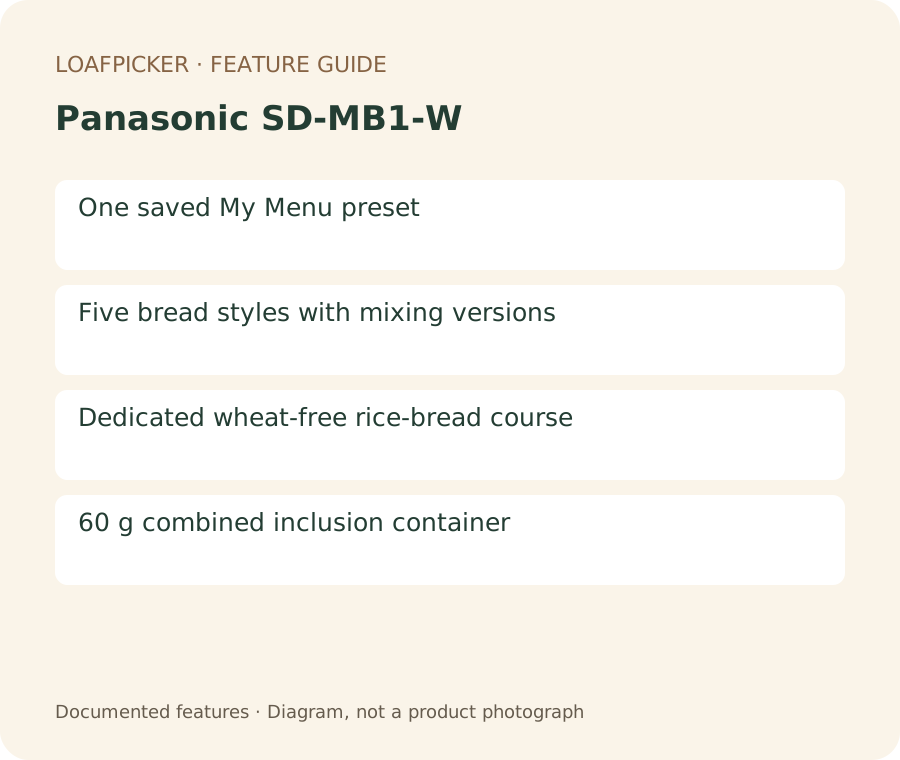 Original LoafPicker feature diagram. Product references appear below. Not a product photograph.
THE FIT AT A GLANCE
At a glance
Japanese owners repeating supported bread presets and wanting a convenient recall button.
100 V Japan-only; My Menu saves settings, while inclusion use and the narrower recipe list remain course-specific.
Shop this model on Amazon ↗Affiliate link · Model search.
The SD-MB1-W is a Japanese one-kin machine organized around twenty automatic entries and a My Menu shortcut. Its practical appeal is repetition: an owner can register a frequently used preset with the relevant settings and recall it without making the same selections each time. That is a different benefit from a programmable bread cycle. Panasonic's exact manual explains what can be saved, and its support page confirms the white -W variant.
The model is rated at 100V, 50/60Hz and 370W. Panasonic explicitly limits the design to Japan and excludes use where voltage or frequency differs. It is therefore an owner and regional reference rather than a routine US buying match. This assessment follows the maker's operating and recipe documents, with no claim of a hands-on bake, current stock or measured noise level.
What the twenty entries actually represent
The menu separates plain and “with mixing” versions of pain de mie, white bread, soft bread, rapid bread and French bread. Those paired entries account for much of the count. They make ingredient handling explicit, but they should not be interpreted as twenty unrelated bread styles. Pain de mie takes approximately four hours fifty minutes, white bread four hours, soft bread four hours twenty minutes and French bread five hours. Rapid bread takes about one hour fifty-five minutes.
There is also a two-hour-twenty-minute Quick Sweet loaf, separate from the fifty-four-minute baking-powder quick bread. The remaining menu covers two rice-flour bread types, Arrange Bread, ordinary dough, pizza dough, cake, chocolate and jam. It does not list a dedicated whole-wheat course, Hoshino starter or bread program, mochi or noodle/pasta program. Those omissions matter if a desired recipe is the reason for buying an older machine.
My Menu remembers a choice; it does not invent a new cycle
The instructions allow one menu to be registered. Applicable crust, reservation or jam-cooking-time settings can be included, and holding My Menu for three seconds saves the selection. Recalling it is a convenience for a repeated routine. The process does not present controls for editing knead duration, proofing stages, degassing or baking temperature. A favorite preset with remembered settings is not a complete custom sequence.
The internal lithium battery retains clock and previous-setting information. The manual notes that bread can still be baked without that battery, although memory functions are affected. This is a useful ownership distinction when an older unit forgets settings: loss of stored information is not automatically proof that the heater or motor is defective. Battery replacement should follow the documented holder orientation and procedure.
Use the “with mixing” menu for automatic inclusions
The machine has separate yeast and raisin/nut containers, and the latter holds up to 60g combined. Fruit and nut maxima are not additive: a mixed load must stay within the total. Suitable dry ingredients can drop automatically, while wet, sticky or melting ingredients such as cheese and chocolate require hand addition. The book gives preparation guidance, including small pieces and removal of excess moisture where required.
Automatic inclusion operation is documented through the five “with mixing” bread presets. The panel does not provide a general raisin option that can be assigned indiscriminately to every other menu. Wheat-free rice bread and the dough courses have no corresponding mixing version in the table. Someone whose main requirement is automatic fruit addition during a particular GF or dough workflow should not infer that compatibility from the presence of the container.
There is a further timer limitation for hand additions: the instructions say the manual-addition signal does not sound during reserved operation and that hand addition cannot be used when reserving. A recipe needing sticky or melting ingredients therefore has a different unattended-use boundary from one using suitable dry raisins in the container. This distinction is more useful than a broad statement that the machine has both a timer and a dispenser.
The wheat-free recipe has its own course
Menu 12 makes rice-flour bread containing wheat; menu 13 makes rice-flour bread without wheat. The wheat-free course takes about one hour fifty-five minutes and explicitly includes a recipe using 300g gluten-free rice-bread mix. That qualifies as dedicated GF-specific programming. It does not establish a selectable GF size in pounds or permission to scale the formula arbitrarily.
Panasonic also describes named rice flour with a prepared glutinous-rice-flour, syrup and water paste. The instructions require the specified ingredients and quantities, with warnings about oil changes and dairy additions. Reservation is supported on this course, but the manual cautions that rice-bread results can deteriorate when reservation is used above 25°C. Ingredient sourcing and room conditions remain part of a dependable routine.
Small batches and fermentation have clear limits
The recipes use a Japanese one-kin format, rather than a set of exact pound controls. The FAQ says halving ingredients does not match the machine's programmed kneading and degassing. There is no dedicated Half Loaf entry here. Ordinary bread dough takes approximately an hour and pizza dough forty-five minutes, with no delayed completion. Shaping, final proofing and baking outside the machine remain with the owner when using those dough programs.
The FAQ also says homemade natural yeast can have unstable fermentation strength. Unlike more elaborate Panasonic models, the MB1 does not list a separate Hoshino starter or loaf route. No documented independent bread-fermentation timer, temperature setting or full-stage editor was established. A baker maintaining an unrelated sourdough culture should not treat My Menu or fixed dough preparation as a maker endorsement for that use.
Condition and space before purchase
The body measures approximately 24.1cm wide, 30.4cm deep and 32.7cm high and weighs about 5.8kg. Lid clearance is additional. Inspect the coated pan, paddle, shaft and both release doors, and check the memory behavior if My Menu is important. Panasonic specifies gentle hand cleaning and excludes the dishwasher for the pan and paddle. The historical parts list identifies paddle ADD08-197 and pan ADA12-168 without establishing present availability. A complete MB1-W is most useful for someone repeating its supported bread recipes, rather than seeking the widest menu or editable fermentation.
Documented specifications
- Model
- SD-MB1-W
- General loaf sizes
- 1斤 Japanese one-loaf format
- Dedicated GF course
- Yes
- GF capacity basis
- Dedicated menu 13 Rice Flour WITHOUT Wheat explicitly uses 300 g GF rice-bread mix. No finished-pound selector or fixed pound capacity documented.
- Automatic add-ins
- Yes
- Complete adjustable cycle
- Not confirmed
- Body dimensions
- 9.49 × 11.97 × 12.87 in (W × D × H)