Verified Japanese domestic 100 V model; retained for regional owners and excluded from direct US buying matches.
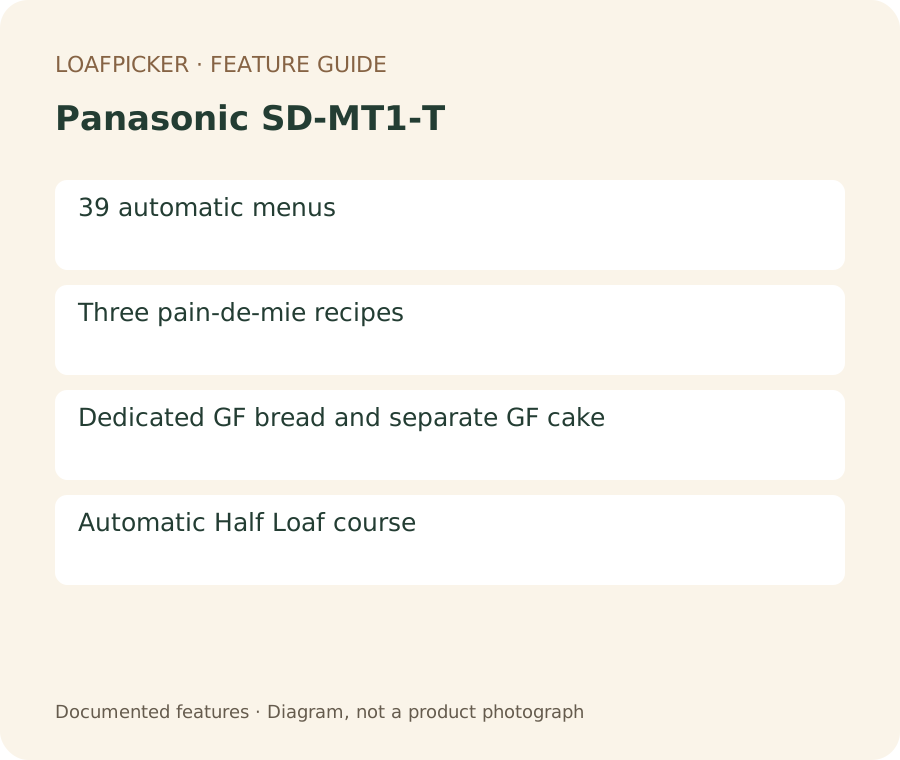 Original LoafPicker feature diagram. Product references appear below. Not a product photograph.
THE FIT AT A GLANCE
At a glance
Japanese owners using the three pain-de-mie recipes, automatic half bread or separate GF cake.
100 V Japan-only; many specialty foods require attendance and bread fermentation stages remain fixed.
Shop this model on Amazon ↗Affiliate link · Model search.
The SD-MT1-T is a Japanese one-kin model whose thirty-nine menus emphasize recipe variety rather than user programming. It includes three pain-de-mie styles, sandwich bread, an automatic Half Loaf course and a separate gluten-free cake program, alongside rice-flour bread without wheat. The useful ownership question is which of those particular recipes justify the broader menu. A long list alone does not establish adjustable fermentation stages.
Panasonic's support page confirms the exact brown -T variant and supplies both its operating and recipe books. The rating is 100V at 50/60Hz, with 430W rated consumption. The manual explicitly describes a Japan-only design and excludes use under different supply voltage or frequency. This is therefore a regional owner reference, excluded from routine US buying matches, with no claimed hands-on baking or noise test.
Several everyday breads have their own timing
Pain de mie takes approximately four hours fifty minutes, while the separate chewy and soft pain-de-mie variations each take about five hours. Ordinary white bread takes four hours, soft bread four hours twenty minutes and sandwich bread three hours. French, rye and whole-wheat bread take approximately five hours. These are defined recipe routes rather than a user choosing the duration of each rise.
The Half Loaf program takes around three hours thirty-five minutes and supports reservation. It is a separate recipe and does not provide a size toggle for every other bread. There is no basis for translating the Japanese one-kin and Half Loaf labels into exact pound settings. In particular, a smaller ordinary loaf does not establish a smaller GF loaf or automatic fruit additions on the half program, which lacks the inclusion option.
GF bread and GF cake are different menus
Rice-flour bread containing wheat is menu 20. Rice-flour bread without wheat is menu 21, taking about one hour fifty-five minutes. The latter includes an explicit recipe using 300g gluten-free rice-bread mix, so it is a dedicated GF-specific bread course. It has no documented finished-pound selector, and the flour input should not be treated as the finished loaf weight.
Menu 30 is separately named Gluten-Free Cake and takes approximately one hour forty minutes. It requires a flour-scraping intervention after about seven minutes. That cake program does not establish a different yeast-bread capacity or a way to substitute a cake recipe into the rice-bread course. For a household interested in both foods, the distinction is useful: the machine documents two different recipes and processing needs.
The wheat-free bread formulation is constrained. Panasonic supplies a named rice-flour and prepared-paste alternative as well as the dedicated mix recipe, and warns against unsuitable ingredient substitutions. The course can be reserved, with a caution that rice-bread results can worsen when reservation is used above 25°C. Choosing the correct flour system remains part of the work; the program title is not an assurance about every GF blend.
Fast options solve different problems
Rapid yeast bread takes approximately one hour fifty-five minutes, Quick Sweet bread two hours twenty minutes, and the sixty-minute bread program an hour. Each has its own recipe and preparation. The separate fifty-four-minute quick bread is chemically leavened and calls for scraping and shaping near the beginning. A buyer should identify the desired food and acceptable preparation before selecting the shortest number in the menu.
Eight-minute speed dough provides kneading, not a finished loaf or complete proof. Ordinary bread dough takes an hour and pizza dough forty-five minutes, after which shaping, final rising and baking remain separate. The dough programs do not support delayed completion. Their presence does not establish an independently adjustable warm rise or a stored custom bread sequence.
Automatic additions have both capacity and course limits
The raisin/nut container holds up to 100g combined. Suitable dry fruit and prepared nuts can be loaded for automatic release; wet, sticky and melting ingredients need hand addition at the signal. The yeast container is a different mechanism. Coarse mixing on eligible courses can help preserve delicate pieces, but the recipe adjustments and ingredient restrictions still apply.
The table enables suitable additions for ordinary bread dough and the wheat-free rice-flour course. Pizza dough, speed dough and Half Loaf do not inherit that option. Brioche, marble bread and Arrange Bread require owner attention for butter, marbling ingredients or dough work. A machine with a dispenser can still have several appealing recipes that cannot simply be loaded and left unattended.
Cooking breadth does not change the natural-yeast boundary
The menu includes soy scones, conventional cake, vegetable cake, chocolate, milk jam, fruit jam, compote, bean paste, mochi and noodle/pasta dough. Milk jam has its own adjustable cooking interval, approximately seventy to one hundred thirty minutes. That adjustment belongs to cooking milk jam; it does not expose the kneading or proofing stages of a bread cycle.
Hoshino starter preparation takes twenty-four hours before a seven-hour loaf or four-hour dough course. The FAQ says homemade natural yeast can be unstable and recommends Hoshino. A maintained wild starter is therefore outside the documented recommendation. Supported dry-yeast bread reservations reach thirteen hours, while Hoshino bread has a ten-hour completion limit. Three crust shades are available only on marked menus, rather than universally.
Check the two paddles and the pan
The body measures approximately 24.1cm wide, 30.4cm deep and 34.7cm high and weighs around 5.6kg. Additional lid-opening space is needed. The separate noodle/mochi paddle matters if those functions are part of the reason for keeping or buying an older example. It is an alternative tool, not a second paddle kneading bread at the same time.
Inspect the coated pan, drive shaft and both release doors, and follow Panasonic's gentle hand-cleaning instructions; the pan and paddles are excluded from dishwasher use. Present accessory availability is not established by the historical manual. A complete MT1-T is most useful for an owner who wants its specific pain-de-mie variations, automatic half bread and separate GF cake recipe. It is a weaker fit for someone whose main need is programmable wild-starter fermentation.
Documented specifications
- Model
- SD-MT1-T
- General loaf sizes
- 1斤 Japanese one-loaf format / ハーフ食パン dedicated Half Loaf course
- Dedicated GF course
- Yes
- GF capacity basis
- Rice Flour WITHOUT Wheat program 21 uses a 300 g gluten-free mix recipe. The separate gluten-free cake program does not establish another bread size. There is no documented exact pound setting.
- Automatic add-ins
- Yes
- Complete adjustable cycle
- Not confirmed
- Body dimensions
- 9.49 × 11.97 × 13.66 in (W × D × H)