Japan-only 100 V model; useful for owners/import identification, not ordinary US outlet use.
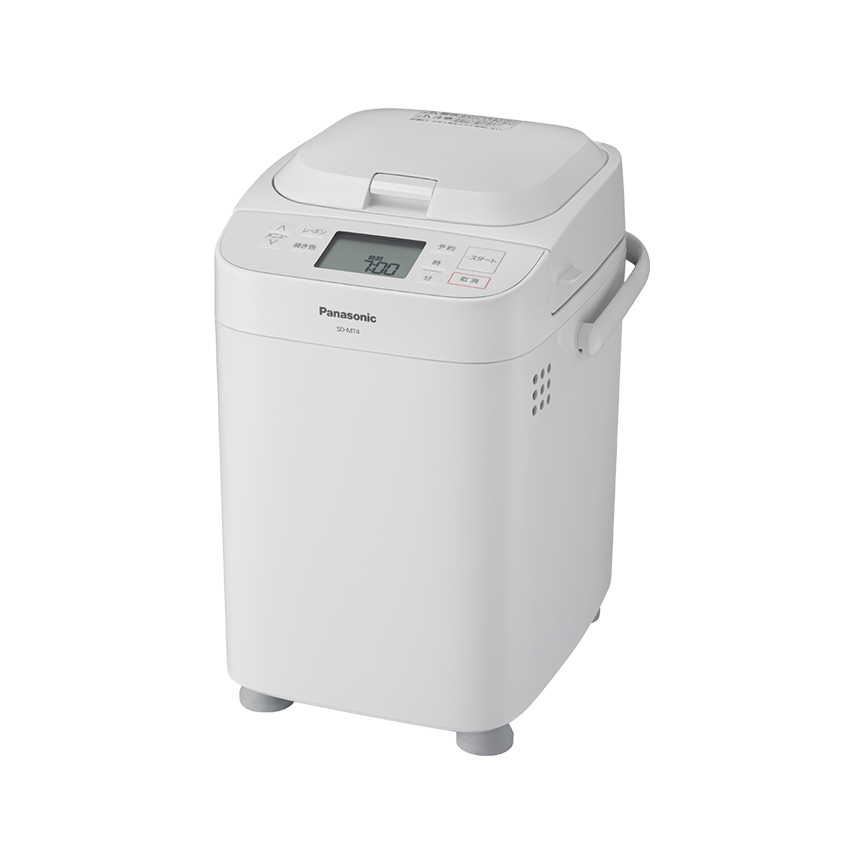 Panasonic SD-MT4-W. Product photo: Panasonic.
THE FIT AT A GLANCE
At a glance
A compatible Japanese-power household following automatic recipes and using the dedicated half-loaf preparation.
No MDX4 manual-stage controls;100 V market restriction and course/ingredient limits constrain unattended use.
Shop this model on Amazon ↗Affiliate link · Model search.
The white SD-MT4-W is a Japanese domestic home bakery rated at AC 100 V, 50/60 Hz and 430 W. It is an owner and import reference rather than an ordinary US-voltage recommendation. Panasonic's manual excludes use on foreign supplies with different voltage or frequency, and a historical overseas listing does not establish a US-rated variant. Confirm the exact appliance label and its intended market before evaluating its other features.
For someone using the intended supply, the MT4's appeal is its automatic recipe range in a body smaller than the SD-MDX4. It offers 41 menus, automatic yeast release, and a raisin/nut case. Panasonic's model comparison explicitly marks its manual-stage function absent. A buyer deciding between these two machines should therefore ask whether the routine centers on supported presets or on independently controlling kneading, proofing, and baking.
Look past the two-menu difference
The SD-MDX4 lists 43 automatic menus and separate stage controls; the MT4 lists 41 automatic menus. The more important distinction is what happens when the baker wants to depart from a preset. The MT4 does not provide the MDX4's manual process selection or its My Neri kneading-pattern memory. Remembering a previously used menu setting is not the same capability as storing an original process sequence.
Panasonic's model comparison is direct on that difference. The MT4 still has bread dough, pizza dough, an eight-minute speed-dough preparation, and udon/pasta dough. These are named recipes and tasks. Their presence supports a variety of dough work, but does not establish editable proofing temperature or complete custom-cycle memories. The machine is best evaluated against the recipes it actually supplies.
Its automatic bread choices include Pan de mie styles, standard and soft bread, sandwich bread, French, rye, whole-wheat, low-sugar, and rice-flour preparations. Non-bread menus extend to mochi, cake, jam, and other Japanese specialties. Some require scraping or another mid-course task, so “automatic menu” should not be interpreted as a promise that every preparation can be left entirely alone.
The smaller loaf is its own course
The manufacturer's labels are 1斤 and a dedicated half-loaf menu. They are not documented US-pound selector settings. The half-loaf recipe uses 180 g of flour, compared with 250 g for standard bread; it is not obtained by halving every standard ingredient. This is a useful option for a household wanting a smaller prescribed batch, provided the specific half-loaf recipe meets the need.
Other course quantities differ. The early-bake and 60-minute recipes use 280 g flour, while the wheat-free rice-flour course uses 300 g of its specified mix. The manual's specification table on page 90 makes those input quantities explicit. Finished bread weight cannot be inferred from them without additional evidence.
Time-saving modes also deserve separate names. The one-hour bread course, early-bake at roughly one hour and 55 minutes, and Quick Sweet at two hours and 20 minutes serve different recipes. If the requirement is a loaf within an hour, identify that exact course and its ingredients rather than relying on the presence of a rapid setting somewhere in the menu.
Wheat-free rice-flour bread has exact instructions
Printed pages 40–41 provide a model-specific recipe for menu 21, 米粉パン(小麦なし). It uses the specified こめの香 gluten-free mix, prescribed shortening, and an exact ingredient balance. Panasonic warns that changing the oil or adding dairy will not give the intended result. A flour scrape is required at the indicated point within the stated interval. These details establish meaningful recipe support while limiting the scope of ingredient substitution.
The exact SD-MT4 recipe book, pages 16–17, includes chestnut/sesame and cocoa/orange wheat-free variations. The evidence is therefore more specific than an unnamed “rice flour” option. However, neither a wheat-free course nor a gluten-free labeled mix establishes that a pan previously used for wheat is protected against cross-contact. The documented recipe and the owner's ingredient and cleaning practices remain separate matters.
Choose additions and reservation together
The raisin/nut case holds 100 g combined. It is not two separate 100 g allowances. Cheese, chocolate, sticky or wet ingredients, and tiny additions such as sesame require hand addition under the manual's instructions. Coarse mixing changes how suitable additions are incorporated; it does not remove those dispenser restrictions. A baker planning dry fruit has a different unattended workflow from one planning soft cheese or melted chocolate.
Reservation is available for a specified list of breads, generally up to 13 hours until completion. Prepared natural-yeast bread has a ten-hour limit. Rich Pan de mie, early-bake, Quick Sweet, 60-minute bread, low-sugar bread, Brioche, marble, arranged bread, and the dough and specialty tasks fall outside that broad reservation list. Page 24 supplies the course-specific rules, while ingredient restrictions further constrain perishable additions. There is primary manual evidence for these limits; retailer summaries are unnecessary.
Compare the counter space as well as the controls
Panasonic lists the MT4 at approximately 24.1 cm wide, 30.4 cm deep, and 34.7 cm high, weighing about 5.6 kg. The MDX4 is wider and substantially deeper at 26.3 by 35.6 cm, with a height of 35.3 cm. That may favor the MT4 where its automatic recipes are sufficient, though the usable space must also allow lid opening and pan removal. The official specifications provide the measurements.
Hand cleaning is required; the manual prohibits dishwasher washing of the coated pan and associated parts. It documents recovery after a power interruption of ten minutes or less, with possible effects on the result, but the inspected evidence does not establish a keep-warm duration. For the intended Japanese market, choose the MT4 around its prescribed smaller loaf, automatic recipe range, and footprint. Choose the MDX4 when separate process control is the reason for buying, and keep both outside an ordinary US 120 V shortlist.
Documented specifications
- Model
- SD-MT4-W
- General loaf sizes
- 1斤 / ハーフ食パン (dedicated half-loaf course)
- Dedicated GF course
- Yes
- GF capacity basis
- Exact menu 21 wheat-free rice-flour recipe uses 300 g specified GF mix; Japanese 1斤 recipe, no pound-size selector.
- Automatic add-ins
- Yes
- Complete adjustable cycle
- Not confirmed
- Body dimensions
- 9.4882 × 11.9685 × 13.6614 in (W × D × H)