Verified Japanese domestic 100 V model; retained for regional owners and excluded from direct US buying matches.
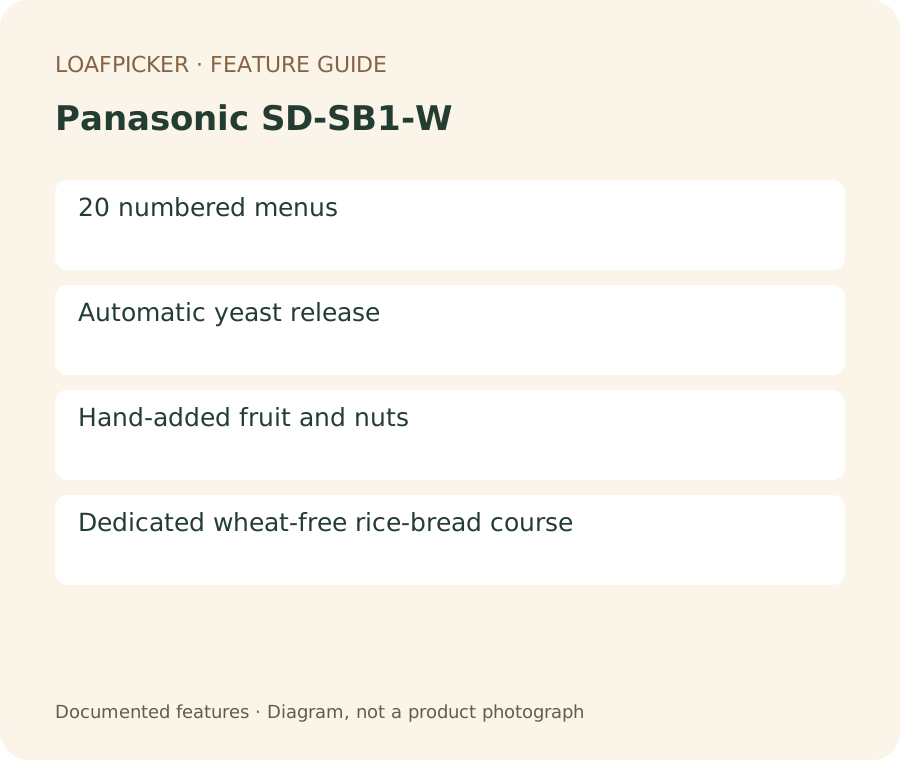 Original LoafPicker feature diagram. Product references appear below. Not a product photograph.
THE FIT AT A GLANCE
At a glance
Japanese-market owners making plain bread and willing to return for fruit additions or early GF scraping.
100 V Japan-only design; yeast releases automatically but fruit and nuts require hand addition.
Shop this model on Amazon ↗Affiliate link · Model search.
The SD-SB1-W makes an important distinction within Panasonic's Japanese bread-machine range: its yeast container releases yeast automatically, but it has no automatic raisin/nut container. The “with mixing” versions of several bread programs tell the owner when to add ingredients by hand. Someone buying specifically for an unattended fruit loaf should understand that workflow before being reassured by the general word “automatic.”
Panasonic's support page confirms the exact white -W variant, and the maker's operating book and menu sheet cover SD-SB1. Its rating is 100 V at 50/60 Hz with 370 W rated consumption. The manual explicitly limits the design to Japan and excludes use where voltage or frequency differs. This is therefore a regional owner reference, excluded from ordinary US buying matches.
What twenty menus mean here
The twenty entries include plain and “with mixing” versions of white, soft, rapid and French bread, plus two dry-natural-yeast entries. Those pairs explain part of the count. They are different ingredient-handling choices rather than twenty unrelated bread styles. White bread takes approximately four hours, soft bread four hours twenty minutes, rapid bread one hour fifty-five minutes and French bread five hours.
Quick Sweet bread takes approximately two hours twenty minutes. The separate fifty-four-minute quick-bread program uses baking powder and requires early scraping and shaping. Arrange Bread takes about two hours fifteen minutes with owner work around fifty-five minutes after starting. The remaining menu includes two rice-flour breads, dough, pizza dough, cake, chocolate and jam. It does not list a dedicated whole-wheat course, Half Loaf, Hoshino starter preparation, mochi or noodle/pasta program.
Fruit bread requires attendance
The white-bread “with mixing” recipe explicitly uses hand addition at the signal. The owner has a limited interval to open the lid, add the ingredients and restart. The yeast has already been dispensed by that point, so the instruction to open the lid belongs to that stage rather than to the start of the cycle. Following the signal matters more than estimating a time from another model.
The machine can display the remaining time until the addition point once it is determined. That helps an owner plan a return to the kitchen, but it is not a substitute for an ingredient hopper. The manual's example uses 100 g raisins in a particular white-bread recipe; it is a recipe amount, not the capacity of a nonexistent inclusion container or a permission to add that quantity to every program.
The distinction continues with the dry-natural-yeast “with mixing” entry. The menu name does not convert hand addition into automatic release. For a household making plain bread most days, automatic yeast timing may be the relevant convenience. For one that relies on overnight fruit or nut loaves without returning to the kitchen, the lack of automatic inclusions is a material tradeoff.
The wheat-free course has a real recipe and an early intervention
Menu 11 makes rice-flour bread containing wheat. Menu 12 is rice-flour bread without wheat, taking approximately one hour fifty-five minutes. The exact instructions include a recipe using 300 g gluten-free rice-bread mix. This supports a dedicated GF-specific bread course, rather than a GF recipe placed on an ordinary white-bread menu. No finished capacity in pounds or GF size selector is established.
The owner must return after approximately five minutes to scrape down flour and restart. Reservation is supported, but the initial handling requirement remains. Panasonic also supplies a named rice-flour and prepared-paste alternative, and tells owners to follow the specified ingredients and quantities. Its cautions about changing oil or adding dairy to that formula make ingredient sourcing part of the decision, rather than an afterthought once the machine is home.
The recipes use a Japanese one-kin format. Flour quantities describe recipe inputs, not precise finished weights in pounds. The FAQ rejects simply halving recipes because the programmed kneading and degassing would no longer match the reduced batch. A buyer needing a supported very small loaf should not treat this model as if it had a Half Loaf course.
Dry natural yeast is a defined ingredient route
Menus 13 and 14 make dry-natural-yeast bread in approximately four hours ten minutes. They use the type of dry natural yeast specified by the recipe rather than a starter that the owner prepares in a separate Hoshino program. There is no Hoshino starter-preparation entry in this twenty-menu book.
The FAQ expressly says homemade natural yeast can have unstable fermentation strength. The dry-natural-yeast menu is therefore not a documented recommendation for an arbitrary maintained wild starter. Nor do ordinary dough preparation and the My Menu shortcut establish user control over fermentation duration or temperature. Those capabilities remain unverified.
Reservation and My Menu have narrower jobs
Supported bread programs can be reserved to finish up to thirteen hours after setting. Rapid, Quick Sweet and attended specialty programs do not all support the timer. Ordinary bread dough takes approximately an hour and pizza dough forty-five minutes, with neither allowing delayed completion. Three crust shades apply only to marked programs, rather than every menu.
My Menu registers a frequently used preset with applicable settings so it can be recalled conveniently. It does not provide an editor for every knead, rest, rise and bake stage. Someone who repeats one supported loaf may value that shortcut; a baker trying to create a long custom fermentation needs a different kind of documented control.
Condition and parts identification
The body measures approximately 24.1 cm wide, 30.4 cm deep and 33.7 cm high and weighs about 5.6 kg. Allow extra room above the lid. Panasonic specifies gentle hand cleaning and excludes dishwasher use for the pan and paddle. Inspect the coating, shaft, paddle fit and yeast-release door before accepting an older example. The historical parts list identifies paddle ADD08-197 and pan ADA12-225; it does not establish current availability or interchange with a neighboring model. A complete SB1-W is most useful for its supported plain and attended inclusion breads, with its regional and recipe limits understood.
Documented specifications
- Model
- SD-SB1-W
- General loaf sizes
- 1斤 Japanese one-loaf format
- Dedicated GF course
- Yes
- GF capacity basis
- Menu 12 is a dedicated rice-flour bread course without wheat and uses a 300 g gluten-free rice-bread mix. No finished-pound setting or fixed pound capacity is established.
- Automatic add-ins
- No
- Complete adjustable cycle
- Not confirmed
- Body dimensions
- 9.49 × 11.97 × 13.27 in (W × D × H)