Exact original model cover verified, but authentic electrical edition and complete operating controls remain insufficiently recovered for a buying match.
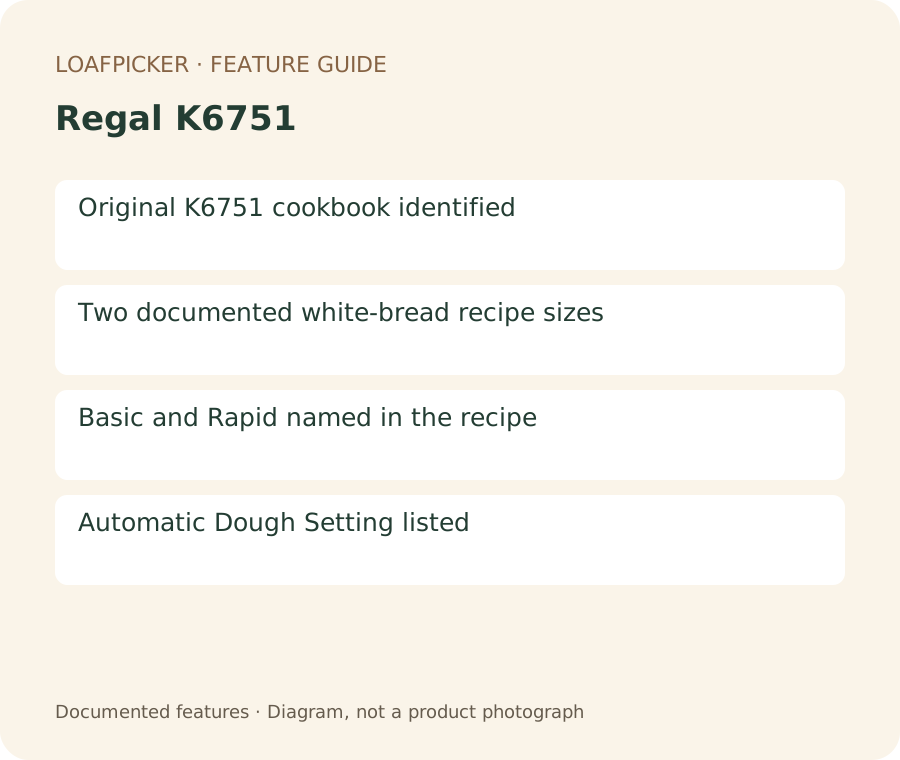 Original LoafPicker feature diagram. Product references appear below. Not a product photograph.
THE FIT AT A GLANCE
At a glance
Existing owners who can match the original book and start with its documented smaller white-bread recipes.
Original operating, electrical, timer and GF pages remain incomplete; modern generated summaries cannot fill those gaps.
Shop this model on Amazon ↗Affiliate link · Model search.
The Regal K6751 is best approached as an older breadmaker whose surviving documentation needs to be matched carefully to the machine. The authentic cover identifies a Regal Breadmaker Guide and Cookbook for model K6751. That establishes the model association. It does not establish that every specification repeated in a modern manual summary belongs to this exact machine. For an owner, the useful starting point is the original book, the markings on the appliance, and the controls actually present on its panel.
The strongest directly readable operating example is the original Classic White recipe. It supplies separate one-pound and one-and-a-half-pound ingredient columns and tells the owner to select Basic or Rapid. Those are real nominal recipe labels, so the K6751 can reasonably be described as having documented recipes at those two sizes. They do not prove that a separate size button changes every program. Someone replacing a missing book should preserve that distinction: a smaller ingredient column and an independently adjustable machine setting are different things.
What the white-bread recipe tells an owner
The one-pound column calls for six to seven ounces of water, while the one-and-a-half-pound column uses eight to nine ounces. The larger version uses three cups of bread flour. The liquid is given as a range deliberately. The accompanying guidance explains that weather, altitude, and measurement can change the amount needed, and recommends beginning with the smaller liquid quantity. This makes the recipe more informative than a fixed list of ingredients: it expects the owner to observe the dough during the early mixing period.
That observation is a practical reason to make an initial loaf while present. The book describes adding water a tablespoon at a time when the dough is too dense or knocks against the pan, aiming for a soft, pliable dough. This is an adjustment to the recipe during mixing, not evidence of a programmable fermentation editor. It also means that a reservation feature, even if confirmed on a particular unit, would not replace the first attempt at checking how flour and water behave together. Measuring consistently is the more useful starting point.
The recipe ends with the display reaching 0:00, pressing Stop, and removing the loaf. That is a documented sequence for this recipe. It should not be expanded into an unverified claim about how long the machine keeps bread warm, its power-failure memory, or the timing of every other course. Those details require the relevant operating pages from the matching book. A modern generated question-and-answer section is an unsuitable substitute for those pages, particularly when it offers precise numbers without showing the original control table.
A cookbook chapter is not a dedicated gluten-free program
The authentic table of contents includes a gluten-free bread chapter. That is useful evidence that the publisher supplied a route for owners interested in that type of baking. The accessible material does not establish the exact program instructions, ingredients, or weight controls for those recipes. Accordingly, this guide does not classify the K6751 as having a verified dedicated gluten-free course. It also does not turn the ordinary white-bread size columns into gluten-free capacities. Those are separate questions requiring the actual gluten-free recipe and operating directions.
The same caution applies to sourdough. A starter recipe or sourdough heading in a cookbook can describe food preparation without granting control over the machine’s rise times. It is not enough to recommend a fixed bread cycle for a homemade starter. Before attempting that use, an owner needs readable instructions showing how fermentation is managed, where the dough leaves the automatic sequence, and how baking is started. No such complete method was established in the material verified for this guide, so natural-starter suitability remains unconfirmed.
Dough preparation is a more defensible documented role
The table of contents explicitly identifies instructions for using an Automatic Dough Setting. That supports the existence of a dough function, although the full timing and eligibility rules were not recovered. For someone who already owns a working K6751, this is a promising chapter to locate in a complete original book. It may help with dough destined for shaping and baking outside the machine. The contents also list pasta, jam, and rice material, but chapter titles alone should not be treated as a verified list of automatic menu buttons.
Similarly, whole-wheat recipes do not by themselves prove a separate Whole Wheat course. Nor does the existence of a timer chapter establish a maximum reservation time or which foods are eligible. The original book has distinct settings, cycle-time, display, control-panel, cleaning, and timer sections. Those are the pages to consult before choosing a program, leaving ingredients unattended, or cleaning a part. This guide leaves those unresolved controls open instead of filling the gaps with settings from a visually similar Regal model.
What matters before buying a used example
A complete pan, its shaft and seal, and the correct kneading paddle are important parts of the buying decision. Matching the K6751 name on a listing is only the first step; an owner should compare the actual appliance and parts with the matching documentation and inspect their condition. This research did not establish an exact replacement-part number, a current replacement supply, dimensions, or an electrical rating from a readable original specification page. Those limitations make the machine an owner reference here, rather than a confidently matched US shopping recommendation.
The K6751’s clearest appeal is therefore a modest one: an existing owner can start from documented one-pound and one-and-a-half-pound white-bread formulas and a book that expects some hands-on dough assessment. A prospective buyer who needs verified gluten-free controls, unattended additions, detailed scheduling, or adjustable fermentation should obtain the missing original operating pages before relying on this model. The surviving recipe is useful; its usefulness is strongest when the gaps in the surrounding operating evidence remain visible.
Documented specifications
- Model
- K6751
- General loaf sizes
- 1 lb, 1.5 lb
- Dedicated GF course
- Not confirmed
- GF capacity basis
- The original contents includes a gluten-free chapter, but the relevant recipe and operating pages were not recovered. A dedicated gluten-free program and its capacity remain unconfirmed.
- Automatic add-ins
- Not confirmed
- Complete adjustable cycle
- Not confirmed
- Body dimensions
- Not confirmed in the primary sources used here