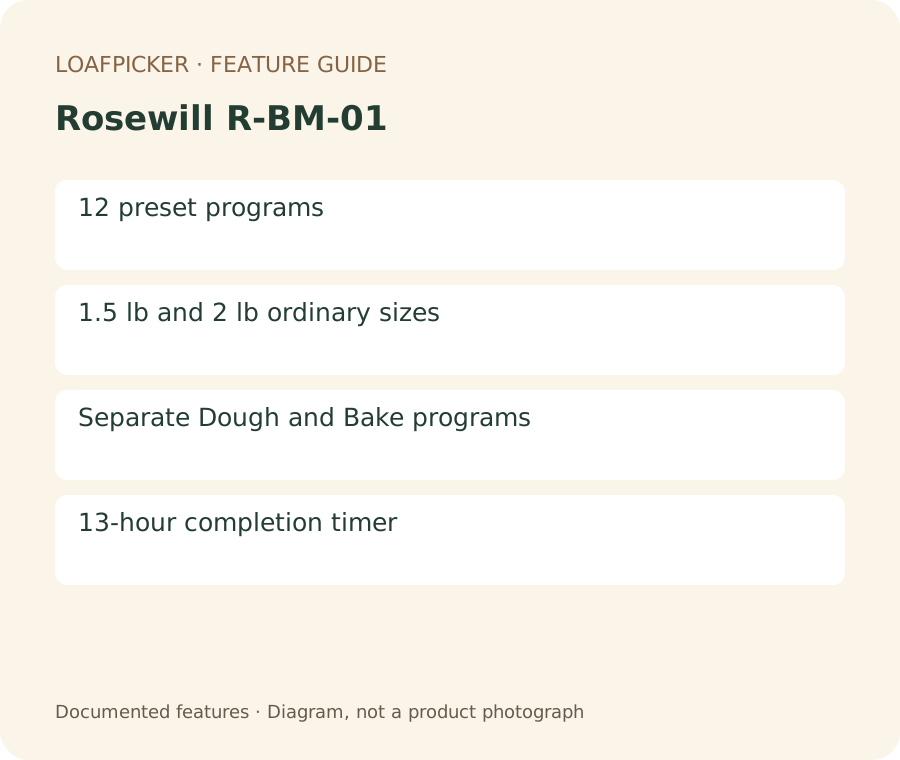
 Original LoafPicker feature diagram. Product references appear below. Not a product photograph.
THE FIT AT A GLANCE
At a glance
Owners wanting familiar ordinary bread presets, machine-prepared dough and documented 1.5 lb or 2 lb labels.
No dedicated GF course or automatic inclusion hopper; the rapid guidance contains conflicting temperature units.
Shop this model on Amazon ↗Affiliate link · Model search.
The Rosewill R-BM-01 suits an owner who wants familiar bread-machine controls and is willing to add ingredients by hand when the recipe calls for them. Its original manual describes twelve programs, a general choice of one-and-a-half-pound or two-pound loaves, three crust settings, and a completion timer extending to thirteen hours. It offers a dough course and a heat-only Bake course. Its limitations matter just as much: there is no dedicated gluten-free program, no documented automatic fruit-and-nut hopper, and no verified editor for the timing of a complete bread cycle.
The exact R-BM-01 retailer specification identifies 120 V, 60 Hz operation and gives dimensions of 15.00 inches wide, 11.02 inches deep, and 13.78 inches high. That is a useful footprint to check before buying an older example for a small counter. The specification also pairs its capacity with nominal one-and-a-half-pound and two-pound labels. These are ordinary bread sizes, not a promise that every menu offers both settings or that every finished loaf will weigh exactly the displayed amount.
The ordinary courses are the main reason to choose it
Basic, French, Whole Wheat, Sweet, and Sandwich provide the familiar choices most owners are likely to use. Basic starts with a medium crust and two-pound default. The Whole Wheat description includes a longer preheating period and advises against using the delay function for that course. That warning is relevant to anyone hoping to set whole-grain bread overnight: the presence of a timer on the control panel does not mean the manufacturer considers every bread program equally suitable for reservation.
The machine also includes Dough, Jam, Cake, and Bake. Dough kneads and raises dough without baking it, which makes it useful when the final shape belongs on a separate baking tray or in a conventional loaf pan. Bake supplies heat without a kneading or rising sequence. Those functions offer a degree of flexibility, but the manual does not establish adjustable fermentation stages or a saved custom cycle. They should not be presented as proof that this model can automatically accommodate the unpredictable timing of homemade natural starter.
Quick and Ultra Fast describe different methods
The program names need careful reading. Quick is described as a chemically leavened route using baking powder or baking soda. Ultra Fast I and Ultra Fast II are separate rapid yeast-bread programs, with the first associated with a one-and-a-half-pound loaf and the second with a two-pound loaf. Both are described as taking fifty-eight minutes. The manual warns that the result is denser. That makes the rapid option a compromise for speed rather than an equivalent replacement for a longer ordinary bread sequence.
There is also a problem with the printed water-temperature conversion in the Ultra Fast guidance: the Celsius and Fahrenheit ranges shown together do not agree. This guide does not silently choose one and turn it into a corrected Rosewill instruction. An owner should resolve that inconsistency with a reliable recipe and the matching documentation before following the rapid method. It is especially important because those short programs depend on their ingredient preparation; the short elapsed time alone tells very little about the finished bread.
For most buyers, the ordinary courses are the more defensible basis for evaluating the machine. Someone who mainly wants quick tea breads should read the Quick and Cake instructions separately instead of assuming that every menu with “quick” or “fast” in its name performs the same process. Someone who wants a long-fermented loaf should likewise avoid treating a fast cycle as an adjustment tool. The R-BM-01 offers preset methods, with the owner choosing the appropriate method and recipe.
Scheduling still depends on the ingredients
The thirteen-hour timer refers to the total interval until completion, rather than thirteen hours of additional waiting after an ordinary cycle. The manual gives ten-minute adjustments and warns against using perishable ingredients such as eggs, fresh milk, fruit, or onion in a delayed preparation. Recipe planning therefore comes before pressing the timer buttons. A bread that needs an attended addition also needs the owner to consider when that addition occurs. This machine does not supply a verified inclusion dispenser that removes that responsibility.
The manual describes an hour of keep-warm operation and a fifteen-minute power interruption memory. These are convenience features, not reasons to plan around uncertain household power or to leave a finished loaf indefinitely. Bread still needs removal and cooling according to the recipe. Dough-course timer eligibility was not established clearly enough in the verified material to promise a reserved dough session. Owners interested mainly in pizza or rolls should check that exact function before planning an unattended morning routine.
Cleaning and an older machine’s condition
The R-BM-01 instructions explicitly allow the pan and kneading paddle to be washed in a dishwasher. They also call for nonabrasive cleaning and describe soaking a stuck paddle in warm water for about thirty minutes. That permission applies to those removable parts, not the powered body: the main unit must not be immersed. The nonstick surface still deserves careful treatment, especially on a used machine where scratches or wear may already be present.
Before purchasing one secondhand, check that the correct pan and paddle are present, the pan locks properly, and the shaft area is in sound condition. The manual establishes how the model is intended to work; it cannot establish the condition of a particular used example or the availability of replacement parts today. The R-BM-01 makes the most sense for ordinary yeast bread and machine-mixed dough at its documented nominal sizes. Buyers whose priority is a dedicated gluten-free course, unattended inclusions, or saved fermentation settings have requirements this verified specification does not meet.
Documented specifications
- Model
- R-BM-01
- General loaf sizes
- 1.5 lb, 2 lb
- Dedicated GF course
- No
- GF capacity basis
- The original twelve-program menu has no dedicated gluten-free course. No exact gluten-free recipe capacity was verified.
- Automatic add-ins
- No
- Complete adjustable cycle
- Not confirmed
- Body dimensions
- 15 × 11.02 × 13.78 in (W × D × H)