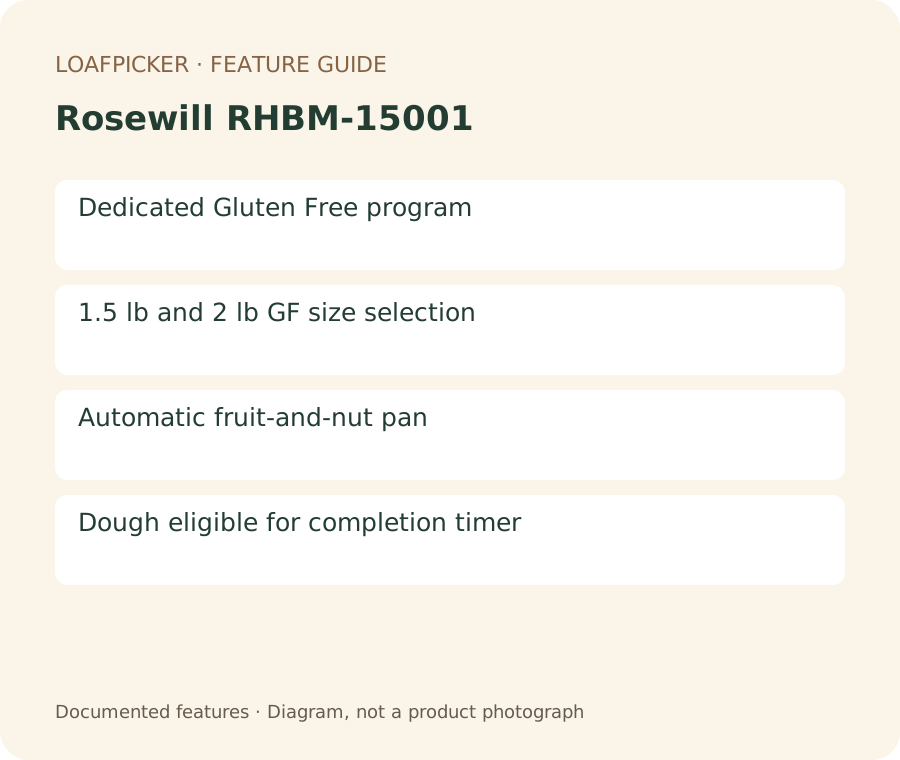
 Original LoafPicker feature diagram. Product references appear below. Not a product photograph.
THE FIT AT A GLANCE
At a glance
Owners who want a dedicated GF course with two documented weight choices plus ordinary automatic additions.
Dispenser guidance lacks a precise GF or dough whitelist, and the Quick description conflicts with its yeast recipe.
Shop this model on Amazon ↗Affiliate link · Model search.
The Rosewill RHBM-15001 adds two useful features to a familiar twelve-program breadmaker: a dedicated Gluten Free course and an automatic ingredient pan. Its manual documents one-and-a-half-pound and two-pound settings, including on the gluten-free course. It is an appealing combination for someone who wants an ordinary automatic bread sequence and a separate gluten-free option. The distinction to keep visible is that the manual does not provide an equally precise course-by-course list for automatic dispensing. A documented hopper does not settle every recipe’s inclusion workflow.
The exact manual identifies a 120 V, 550 W appliance. It describes a white plastic body, a single kneading paddle, and the ingredient pan above the bread bucket. The technical table gives length, width, and height as 10.2, 12.2, and 11.0 inches respectively. Because those labels do not clearly establish the conventional counter-width and front-to-back depth orientation, they should be checked against the actual unit before planning a tight shelf installation. The lid and ingredient pan also need accessible space above them.
The gluten-free controls are genuinely documented
Gluten Free is program 6. The loaf-size instructions exclude Quick, Dough, Jam, Cake, and Bake from size selection; they do not exclude Gluten Free. The recipe section also prints separate one-and-a-half-pound and two-pound gluten-free formulas using gluten-free flour. Together, the control instructions and recipe headings support two selectable nominal gluten-free sizes. This is stronger evidence than an ordinary two-pound capacity statement alone, and it makes the RHBM-15001 a more defensible match for buyers who specifically need a documented gluten-free course with a size choice.
That control evidence does not establish the outcome of every gluten-free mix. Ingredient composition, mixing behavior, and the recipe still matter, and this is a documentation-based guide rather than a baking test. It also does not establish that the machine’s automatic ingredient pan releases correctly during the gluten-free program. The manual’s general dispenser description says it adds fruit or nuts while making bread, but it does not name Gluten Free in a clear dispenser eligibility table. Owners should verify that workflow before loading additions and expecting an unattended release.
Hand-addition beeps and automatic release are separate evidence
The operating section lists audible addition prompts for Basic, French, Whole Wheat, Quick, Sweet, Rapid Bake, Cake, and Sandwich. Gluten Free is absent from that list. That is a list of hand-addition prompts, however, and it should not automatically be converted into a list of hopper-compatible programs. For ordinary bread, the general automatic fruit-and-nut description supports the intended dispenser role. For gluten-free, dough, or a manually managed fermentation, the verified instructions leave enough uncertainty to keep the automatic-addition claim unconfirmed.
This matters most to a buyer who needs the entire session to run while absent. A raisin loaf on a familiar ordinary bread course is a different task from adding seeds to gluten-free batter or enriching dough that will later be shaped elsewhere. The pan’s existence does not guarantee that each task has the same release point. Making a first recipe while present is a useful way to learn the exact sequence on the actual machine, but this guide does not substitute an imagined test result for the missing course rule.
The timer is relatively clear
The completion timer extends to thirteen hours, and the instructions exclude Rapid Bake, Jam, and Bake. That leaves Gluten Free and Dough eligible under the stated rule. Timer eligibility is useful, but the ingredient restriction still applies: eggs, fresh milk, fruit, and vegetables are examples the manual says not to leave waiting in a delayed preparation. Whole Wheat has its own caution that delay is not advisable. Scheduling therefore requires both a compatible program and a suitable formula, rather than simply selecting the longest available interval.
The pause function provides another limited convenience. The manual allows a pause of up to ten minutes; it is not a way to create an open-ended fermentation stage. Dough prepares dough without completing a baked loaf, and Bake supplies a separate heated stage. No complete adjustable bread-cycle editor was established. Someone shopping specifically for saved rise durations or a homemade natural-starter workflow should not interpret those ordinary functions as documented custom fermentation control.
Read the fast programs separately
Rapid Bake is described as a fifty-eight-minute method that produces denser bread. Its recipe is printed at one-and-a-half pounds. That recipe heading should not be expanded into a verified two-pound rapid formula simply because the general size controls exist. The manual also contains an inconsistency in its Quick material: the introductory description refers to baking powder or baking soda, while the printed Quick recipe uses yeast and warm water. An owner should resolve that mismatch before relying on the Quick program for a particular recipe.
The strongest buying case is consequently the clearly documented ordinary courses and selectable gluten-free sizes, rather than a claim that every short program is interchangeable. The standard menu also includes French, Sweet, Sandwich, Cake, Jam, Dough, and heat-only Bake. These are familiar preset roles. They offer several ways to use the appliance, but they do not turn it into a universal recipe converter or make every listed capacity apply to every menu.
Care and the used-machine decision
The manual explicitly permits dishwasher cleaning for the bread pan and kneading paddle, while also describing nonabrasive cleaning and warm-water loosening when needed. The powered body must not be immersed. A used example should be checked for its correct pan, paddle, and ingredient-pan components, as missing dispenser parts undermine one of the model’s main attractions. The RHBM-15001 is a reasonable documented choice for someone who values a dedicated, size-selectable gluten-free course. Its tradeoff is less precise automatic-addition guidance, plus recipe inconsistencies that reward careful reading before the first loaf.
Documented specifications
- Model
- RHBM-15001
- General loaf sizes
- 1.5 lb, 2 lb
- Dedicated GF course
- Yes
- GF capacity basis
- Gluten Free is program 6 and supports the loaf-size control. The original recipe also provides separate 1.5 lb and 2 lb formulas.
- Automatic add-ins
- Yes
- Complete adjustable cycle
- Not confirmed
- Body dimensions
- Not confirmed in the primary sources used here