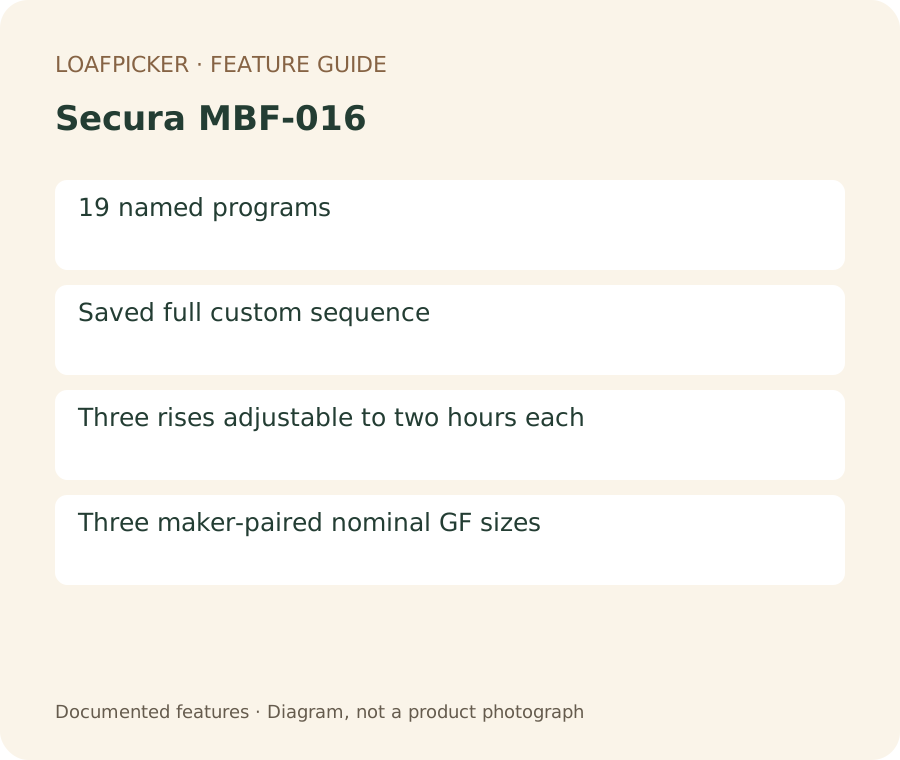
 Original LoafPicker feature diagram. Product references appear below. Not a product photograph.
THE FIT AT A GLANCE
At a glance
Owners who want saved timing for kneading, rest, three rises and baking, and will independently assess recipes.
Printed GF recipe uses unqualified cake flour; Natural Sourdough recipe uses yeast powder and is not a documented wild-starter method.
Shop this model on Amazon ↗Affiliate link · Model search.
The Secura MBF-016 deserves attention for its documented Custom program. Its original manual exposes three fermentation stages, each adjustable up to two hours, as part of a saved knead-rest-rise-bake sequence. That is a meaningful capability for someone who wants to work beyond fixed bread presets. The same manual supplies a dedicated Gluten-free program with three selectable weights. Its printed gluten-free formula, however, specifies “Cake flour (weak flour)” without identifying it as gluten-free. The controls are documented; that recipe should not be treated as a reliable gluten-free formula.
The exact electrical specification is AC 120 V, 60 Hz, 650 W, with a maximum stated loaf weight of 1,000 g. The manual explicitly pairs 500 g, 750 g, and 1,000 g with nominal 1.10 lb, 1.65 lb, and 2.20 lb labels. Those pound labels can therefore be retained as maker-provided equivalents, rather than conversions invented for this guide. The machine is a useful comparison for smaller households that want a lower nominal setting as well as a larger loaf, provided the selected course actually supports the weight control.
Custom means a complete editable sequence here
Program 19 provides adjustable first stirring, rest, second stirring, three fermentation stages, baking, and warming. The first stirring and second stirring each allow up to thirty minutes, as does the rest. Each fermentation stage allows zero to 120 minutes. Baking can extend to 120 minutes and warming to sixty minutes. The manual describes stepping through the stages with the loaf button, adjusting durations, and retaining the latest custom settings. This is substantially different from saving a favorite preset or merely selecting a separate Bake function.
The fermentation limits still deserve attention. They are finite timing controls, not a sensor that decides when any dough is ready. The book does not establish a user-adjustable fermentation temperature. A recipe that needs an unusually long rise may need attendance or a different arrangement. The Custom table also includes a reservation entry up to fifteen hours, while the surrounding button explanation treats Custom adjustments differently from ordinary delayed programs. This guide therefore does not promise a fully verified delayed custom sequence from that conflicting presentation.
The stage controls support manual management of fermentation, but they do not make every sourdough claim on the panel self-explanatory. Natural Sourdough is program 3, and its printed recipe uses a measured 0.5 g of yeast powder. That is not a documented homemade wild-starter method. An owner interested in a particular natural starter should assess the recipe’s timing needs against the custom limits rather than assume the name proves suitability. This research establishes timing flexibility without claiming a maker endorsement for an unverified starter workflow.
The gluten-free course and its recipe need separate judgments
Gluten-free is program 9. The loaf button is available on programs 1–10, so all three documented weight choices apply to it. There is even a shortcut button that advances to this course and can start it when held as directed. The recipe table also prints separate 500 g, 750 g, and 1,000 g columns. This is clear evidence of a dedicated, size-selectable gluten-free program, rather than a gluten-free recipe assigned to ordinary Basic bread.
The ingredient problem is equally clear in the original page image. The flour row says cake or weak flour, with no gluten-free qualification. Those terms alone do not identify a gluten-free ingredient, and this guide does not silently repair the recipe by substituting a blend and assuming the remaining liquid or yeast will suit it. Consequently, the machine can be cataloged as having a dedicated gluten-free course while the printed formula receives no gluten-free recommendation. A buyer whose main requirement is a dependable maker-supplied gluten-free recipe should consider that a material drawback.
Dough names do not all mean the same timing
The MBF-016 has separate Bread Dough, Pizza, Pasta, and Leaven programs. Bread Dough is listed at twenty-three minutes, Pizza at one hour twenty-five minutes, Pasta at twenty-three minutes, and Leaven at one hour twenty-four minutes. These distinctions matter when deciding whether the machine will merely mix dough or include the resting and rising expected by a particular recipe. The dedicated kneading shortcut points to Pasta program 13; it should not be described as a general editor for any stage of any program.
Reservation eligibility is also specific. The manual allows delayed completion on programs 1–10, 13, and 14, up to fifteen hours. That includes Gluten-free and the Pasta and Leaven modes, but excludes the Bread Dough and Pizza programs from the stated ordinary reservation list. A broad claim that “dough can be delayed” is therefore incomplete without naming the mode. Owners need to choose their program first, check the waiting ingredients, and then decide whether reservation is appropriate for that workflow.
Additions and care are more conventional
There is no documented automatic fruit-and-nut hopper. The instructions instead describe adding ingredients at the second-stirring prompt. Anyone who wants unattended inclusions should account for that required attendance, including when using a reserved bread cycle. Other programs include sweet bread, whole wheat, multigrain, buttermilk bread, cake, jam, yogurt, and a separate Bake function. Yogurt and Bake have their own adjustable duration ranges; that flexibility should not be confused with the editable bread sequence offered by Custom.
The parts instructions explicitly allow dishwasher cleaning for the removable pan, paddle, measuring accessories, and hook, and the care chapter repeats permission for the pan and paddle. Nonabrasive cleaning still matters for the nonstick surface. The powered body must not be immersed or placed in the dishwasher. For a used example, inspect the coating, shaft, paddle fit, and completeness of the removable parts before treating the feature list as a complete buying assessment.
The MBF-016’s strongest fit is an owner who wants documented saved stage timing and is comfortable judging a recipe against those controls. Its tradeoff is that the manual needs critical reading: the Natural Sourdough formula uses yeast powder, dough timing varies by named mode, and the gluten-free recipe has an unresolved ingredient flaw. That combination makes it more compelling as a configurable breadmaker than as a machine to buy solely for an unquestioned gluten-free recipe book.
Documented specifications
- Model
- MBF-016
- General loaf sizes
- 1.1 lb, 1.65 lb, 2.2 lb
- Dedicated GF course
- Yes
- GF capacity basis
- Gluten-free program 9 permits 500 g, 750 g and 1,000 g selections, paired by the maker with nominal 1.10 lb, 1.65 lb and 2.20 lb labels. The printed recipe specifies unqualified cake flour, so this model is excluded from gluten-free recommendations.
- Automatic add-ins
- No
- Complete adjustable cycle
- Yes
- Body dimensions
- Not confirmed in the primary sources used here