Verified 230 V 50 Hz European electrical edition; retained for regional owners and excluded from direct US buying matches.
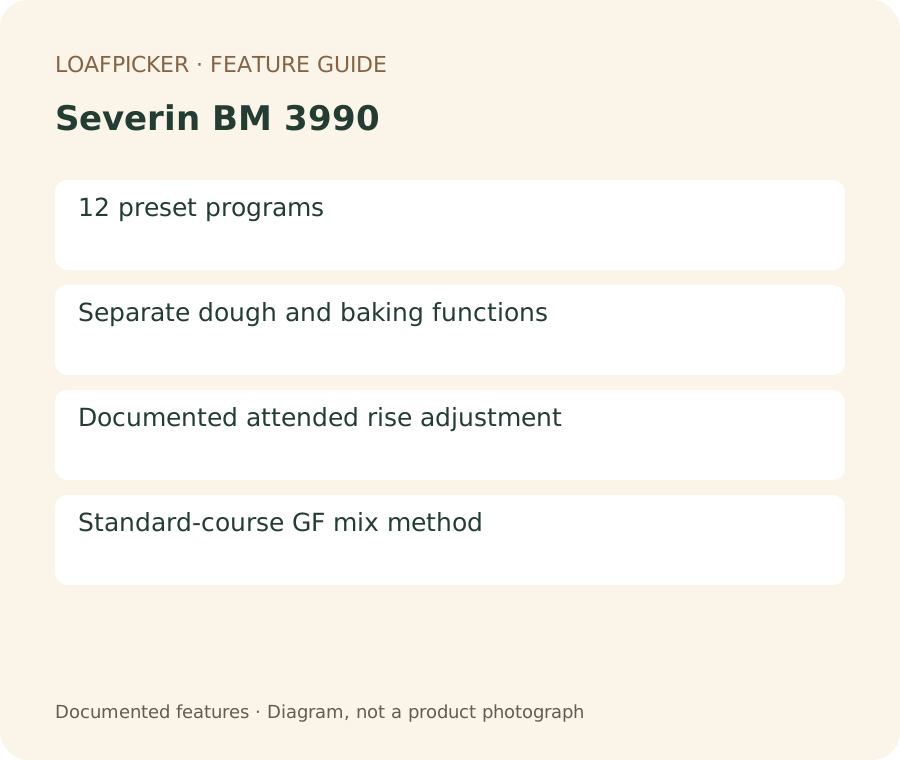 Original LoafPicker feature diagram. Product references appear below. Not a product photograph.
THE FIT AT A GLANCE
At a glance
Existing European owners who use familiar presets and can judge a separate rise before starting Bake.
230 V model; GF uses Standard, while short-program capacity labels conflict within the manual.
Shop this model on Amazon ↗Affiliate link · Model search.
The Severin BM 3990 is a twelve-program breadmaker whose original instructions identify a 230 V, 50 Hz, 600 W electrical edition. That makes the regional rating an essential part of the buying decision. It is useful as an owner reference for the matching European appliance, but it should not appear as a routine US electrical match. Its documentation is also a reminder that a gluten-free recipe route and a dedicated gluten-free menu are different features: Severin directs owners to Standard with a dark crust for its gluten-free mix method.
The manual supplies ordinary bread, dough, jam, cake, and separate baking functions. It also contains conflicting metric descriptions of the short-program capacities. Rather than convert those competing labels into seemingly precise pound settings, this guide retains the uncertainty. A buyer who needs a reliably documented small loaf setting should consult the actual panel and matching recipe table before choosing the model on the strength of a capacity number repeated in a listing.
Read the program names by their leavening method
The first three programs cover Standard, White or French, and Wholemeal bread. Cakes with Yeast is a separate program from the chemically leavened Biscuits or Pastry and Normal Cake options. The distinction matters because the word “cake” does not identify one universal mixing and rising process. A recipe using yeast needs a different sequence from one relying on baking powder. The manual’s menu descriptions are more useful here than simply counting twelve programs and assuming that each accepts any recipe from its broad category.
The two Short programs are both listed at fifty-eight minutes. Their capacity descriptions disagree within the book: the prose calls them 700 g and 1,000 g, while the cycle table gives 750 g and 900 g labels. That is a genuine documentation conflict, not a reason to choose whichever pair looks more convenient. Owners should resolve the correct formula for their exact unit before following a rapid recipe. This guide does not invent a harmonized capacity or a pound conversion to hide the disagreement.
For ordinary bread, size selection is documented on programs 1, 2, 3, 5, and 11. That is a useful course restriction. It does not make size selection available on every other menu, and it should not be applied to the Standard-course gluten-free route without reading the supplied mix directions. The ordinary recipes and the stated maximum flour quantity also use different yield references, so a single advertised “maximum loaf” is a poor substitute for the instructions governing a specific recipe.
Gluten-free preparation uses Standard
The gluten-free section recommends the Standard program and a dark crust. There is no dedicated gluten-free program among the twelve menu names. That means the BM 3990 does have a documented gluten-free recipe route, but it does not meet a request for a separate GF course. No nominal pound capacity for that route was established. Buyers should avoid transferring the weight of an ordinary wheat loaf to gluten-free batter merely because both are prepared in the same pan.
Severin also advises against using the timer for the gluten-free preparation. That specific instruction takes priority over the broader fact that Standard is generally among the timer-compatible programs. It is a practical limitation for someone who wants fresh gluten-free bread ready after an unattended overnight wait. The relevant question is whether the recipe can wait under the maker’s directions, not whether the timer buttons happen to accept a delayed time when Standard is selected.
Dough and a separate bake stage allow some attendance
Dough program 8 is listed at one hour thirty minutes and does not finish with a baked loaf. A separate Baking program supplies heat. The Baking description explicitly discusses modifying the rising phase according to the dough before starting baking. That is documented support for an attended workflow in which the owner judges fermentation and decides when to bake. It is more specific than inferring flexibility solely because two buttons happen to exist.
It is still not a saved full-cycle editor. The manual does not establish user-programmable rise durations or adjustable fermentation temperature. Nor does its separate-stage explanation establish a complete homemade natural-starter recipe. An owner may have room to manage dough manually within the documented workflow, but the decision depends on observing the dough and using an appropriate recipe. Someone who wants the entire process to follow a customized schedule without attendance should look for more explicit stage controls.
The timer has a course list and ingredient restrictions
The maximum completion interval is thirteen hours. The compatible program list is 1, 2, 3, 4, 5, 8, 10, 11, and 12, which includes Dough but excludes the two Short programs and Jam. The instructions caution against delayed recipes with perishable ingredients such as eggs, milk, or fruit, and against delaying a recipe that needs an attended addition. These rules matter together. A technically eligible program can still be a poor timer choice because of what is waiting in the pan or what the owner must add mid-cycle.
Additions are manual. The book describes audible prompts on the relevant bread and cake courses, and no automatic inclusion hopper is documented. That makes the BM 3990 more suitable for an owner who can respond to the prompt when using fruit or nuts. The absence of a hopper is not necessarily a problem for plain loaves or machine-prepared dough, but it changes the appeal for someone choosing a breadmaker specifically to avoid returning during a reserved cycle.
Care and regional suitability
The bread pan must not go in the dishwasher. The instructions call for hot water, mild detergent, and careful hand cleaning; a stuck paddle can be loosened with a roughly thirty-minute warm-water soak. They also warn against extended soaking because of the shaft seal. This is a useful distinction from some breadmakers whose pan and paddle are explicitly dishwasher safe. Matching the care instruction to the exact model helps preserve the parts that are hardest to replace on an older appliance.
The specifications list 420 mm length, 280 mm depth, and 305 mm height, with a weight of 5.7 kg. Check those original dimension labels against the appliance. The BM 3990 is most defensible for an existing owner with the correct 230 V edition, ordinary preset needs, and willingness to manage additions and some separate-stage baking. Its limitations are a non-dedicated gluten-free route, inconsistent short-course weights, and the lack of a saved complete custom sequence.
Documented specifications
- Model
- BM 3990
- General loaf sizes
- Metric short-course prose700/1000g conflicts table750/900g; no pound settings inferred
- Dedicated GF course
- No
- GF capacity basis
- The original gluten-free mix method uses Standard with a dark crust. There is no dedicated gluten-free course or verified nominal pound capacity for that method.
- Automatic add-ins
- No
- Complete adjustable cycle
- Not confirmed
- Body dimensions
- Not confirmed in the primary sources used here