Explicit Japan-only 100 V design; no ordinary US-voltage recommendation.
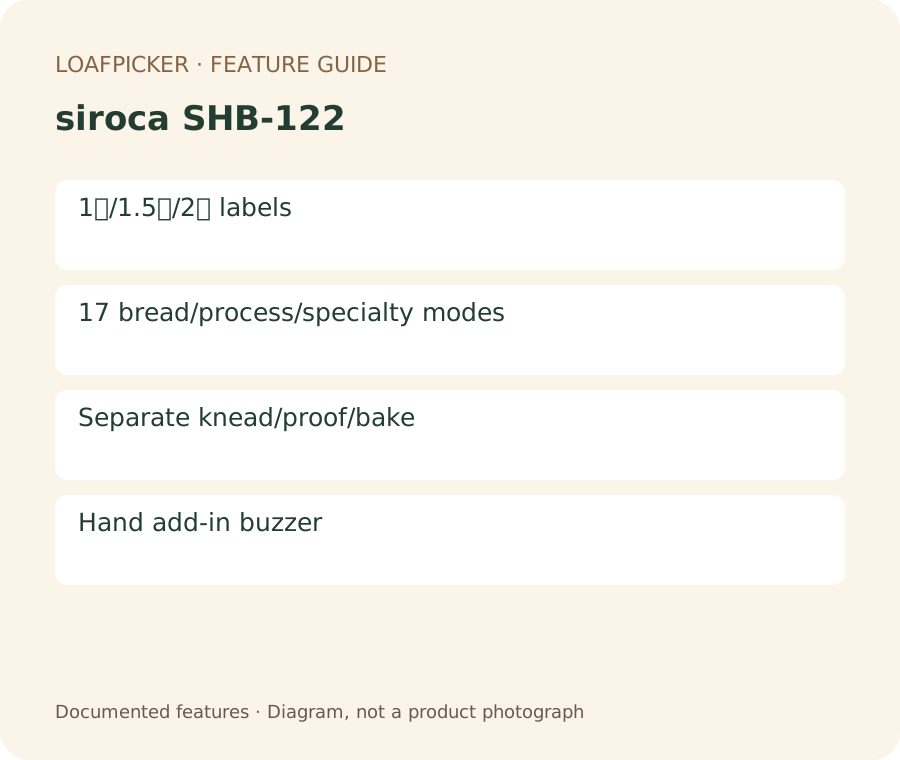 Original LoafPicker feature diagram. Product references appear below. Not a product photograph.
THE FIT AT A GLANCE
At a glance
A Japan-based owner making supported standard/French-style batches or running independent dough tasks.
No GF support or automatic dispensers;2斤 does not apply to soft/sweet/whole-wheat/cooked-rice recipes.
Shop this model on Amazon ↗Affiliate link · Model search.
The SHB-122 should be evaluated as a Japanese domestic appliance. Its manual specifies AC 100 V, 50/60 Hz, with a 500 W heater and 50 W motor, and explicitly says it cannot be used outside Japan. Overseas operation, repair, and parts service are excluded. This page is therefore an owner or import reference, not a standard recommendation for a US household outlet. A familiar-looking plug or an old Amazon title does not establish a different voltage rating.
Within that boundary, its main decision points are more specific than “large bread maker.” It offers three Japanese size labels, but several bread recipes cannot use the largest one. Its rice-flour course requires gluten-containing flour and expressly rejects gluten-free mixes. It also offers independent process tasks, which are useful for hands-on dough work but do not establish saved custom bread cycles.
Find the largest batch in the relevant recipe
The panel's labels are 1斤, 1.5斤, and 2斤. These remain Japanese recipe labels; no exact US-pound equivalents have been verified. Standard bread, rapid bread, French-style bread, and the gluten-containing rice-flour recipe supply all three sizes. Soft bread, sweet bread, and whole-wheat bread explicitly exclude 2斤. The cooked-rice variation also stops at 1.5斤. Those differences are documented in the SHB-122 manual, pages 25–27.
This changes the purchase decision for a household shopping primarily for a large whole-wheat loaf. The machine's 2斤 label does not meet that need through the supplied whole-wheat recipe. Conversely, someone planning the standard or French-style recipes has a documented larger-batch route. The actual recipe and available sizes should determine suitability before the overall maximum capacity enters the comparison.
The manual also warns that ingredient quantities and finished dimensions do not scale proportionally across the three labels. Its standard bread recipe uses different measured flour quantities for each size. Scaling an existing batch by a simple multiplier may therefore miss the intended recipe balance. Use the manufacturer's recipe corresponding to the selected size rather than treating the button as a universal batch converter.
Rice flour does not mean gluten-free here
Menu 7 is labeled 米粉パン(グルテン入り): rice-flour bread containing gluten. Page 21 says the course is formulated for a gluten-containing mix, is not suitable for wheat-allergy needs, and cannot use a gluten-free rice-flour mix. This is an explicit exclusion, not merely an absence of a Gluten-Free button. A gluten-free ingredient substitution should not be presented as supported operation.
The SHB-712 is a particularly relevant comparison because its exact manual separates gluten-containing and gluten-free rice-flour courses and specifies an alternative paddle for the latter. Both are Japanese 100 V appliances, so that comparison does not create a US-compatible recommendation. It simply identifies a material recipe difference for owners or buyers already operating within the intended market.
The SHB-122 manual also covers the separately coded SHB-122BK. Shared instructions do not establish the finish, retail bundle, or market identity of a unit described as SHB-122, SHB-122WG, or another suffix. Verify the physical model label and included parts when identifying a replacement machine or accessory.
The 17 modes include process tasks
The menu count covers bread, dough, noodles, mochi, jam, fresh butter, and separate kneading, proofing, and baking. It should not be read as 17 automatic bread loaves. Under the default 1斤 and normal-crust settings, standard bread takes about four hours and 15 minutes, rapid bread about two hours and 53 minutes, and rice-flour bread about two hours and 30 minutes. Size and crust selection change the timing.
The independent tasks provide kneading for 5–25 minutes, proofing for 5–110 minutes, and baking for 10–90 minutes. Their time controls set task duration. They are not delayed-start controls, and they do not show that the machine can store a user-designed sequence joining all three stages. A baker who wants to inspect dough and decide when to move on may find them useful. A baker expecting an unattended custom program needs a different documented capability.
Pizza and bread dough are also distinct options. Preparing dough does not complete the later shaping or oven baking. The udon/pasta task and other specialty modes widen the list of possible kitchen jobs, but the manual's recipe and quantity restrictions still govern them. Their presence is not evidence that every new dough formula falls within the intended use.
The timer changes the addition workflow
The timer reaches 13 hours including the chosen course's preparation time. Eligible programs are bread menus 1, 2, 3, 4, 6, and 7, plus pizza dough menu 12. Sweet bread and ordinary bread dough are excluded. The manual also prohibits delayed recipes using milk, eggs, juice, or vegetables because ingredients can deteriorate while waiting. These restrictions appear on page 24 rather than applying uniformly to the whole menu.
There are no automatic yeast or fruit/nut dispensers. The baker loads yeast as directed and adds fruit or nuts at the buzzer for an immediate compatible recipe. When the completion timer is used, the addition buzzer does not sound; additions must go in with the initial ingredients. Someone expecting intact fruit to be released automatically overnight should account for that workflow before choosing the machine.
Space and cleaning belong in the ownership decision
The SHB-122 measures approximately 28 cm wide, 32 cm deep, and 29.5 cm high. Its stated weight of about 3.9 kg excludes the pan, which matters when comparing it with a model whose quoted weight includes the pan. It uses a 1.4 m cord. These specifications support a counter-space comparison, but do not establish the extra clearance needed for opening and loading.
Bread courses provide up to 60 minutes of keep-warm. Prompt removal is still advised because holding can darken the crust. The pan and paddle require hand washing; a dishwasher or dish dryer is prohibited, and the whole pan must not be immersed. Choose this model reference for its supported standard and specialty recipes, with careful attention to which recipes actually offer 2斤. Exclude it when the central requirement is manufacturer-supported gluten-free bread, automatic additions, or ordinary US-voltage operation.
Documented specifications
- Model
- SHB-122
- General loaf sizes
- 1斤 / 1.5斤 / 2斤 (eligible recipes only)
- Dedicated GF course
- No
- GF capacity basis
- Menu 7 explicitly requires gluten-containing rice flour and rejects GF mixes/wheat-allergy use.
- Automatic add-ins
- No
- Complete adjustable cycle
- Not confirmed
- Body dimensions
- 11.0236 × 12.5984 × 11.6142 in (W × D × H)