Japanese domestic 100 V appliance; indexed owner/import reference only for US visitors.
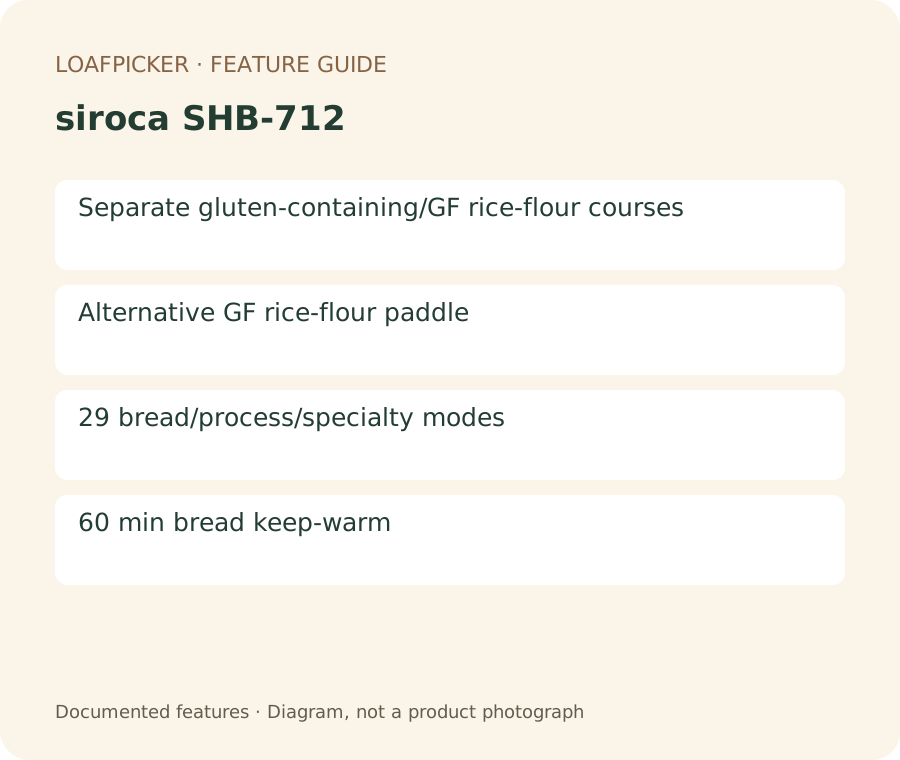 Original LoafPicker feature diagram. Product references appear below. Not a product photograph.
THE FIT AT A GLANCE
At a glance
A Japanese-power owner following the exact GF rice-flour recipe and using the supplied alternative paddle.
GF, soft, sweet, whole-wheat and cooked-rice recipes exclude 2斤; additions remain manual and delayed recipes lose add-in buzzer.
Shop this model on Amazon ↗Affiliate link · Model search.
The SHB-712's most useful distinction is the separation between its two rice-flour courses. Menu 9 uses gluten-containing flour; menu 10 is intended for gluten-free rice flour and requires the supplied rice-flour paddle. That is a substantive difference from the SHB-122, whose rice-flour course explicitly cannot use a gluten-free mix. It also has a major capacity qualification: the SHB-712's gluten-free recipe supports 1斤 or 1.5斤 and expressly excludes 2斤.
This remains a Japanese owner and import reference. The exact manual specifies AC 100 V, 50/60 Hz, a 500 W heater and 50 W motor, and says the machine is designed and sold for Japan only. Overseas use and service are excluded. Its documentation does not establish an ordinary 120 V US version, regardless of where an individual unit may be advertised.
Evaluate the gluten-free course as a whole process
The SHB-712 manual, pages 6 and 21–23, identifies the alternative rice-flour paddle and requires it for the gluten-free preparation. This is a different blade used in the same pan, not two bread paddles kneading simultaneously. A used machine missing that paddle has lost a component specifically called for by the supported recipe. Check for it before valuing the machine primarily for gluten-free rice-flour bread.
Menu 10 requires the specified こめの香 gluten-free rice-flour mix. At a work buzzer approximately 15 minutes after starting, the baker has five minutes to scrape flour from the pan's sides. The machine then proceeds. Under the default 1斤 and normal-crust setting, the course takes approximately two hours and 37 minutes. Different sizes and crust choices change the timing, so this is a recipe reference rather than a universal finish-time promise.
Page 33 supplies only 1斤 and 1.5斤 recipes and says the course does not support 2斤. The ordinary size selector therefore cannot justify a 2斤 gluten-free recommendation. For a household whose main requirement is the largest possible gluten-free batch, that exclusion may decide against the model even though the product's general capacity reaches 2斤. Japanese labels are retained here without invented pound equivalents.
A dedicated recipe and paddle also do not establish isolation from gluten in a shared machine. The manual asks users with food allergies to consult a clinician. Ingredient selection, cleaning, and the appliance's prior use remain relevant; a named course should not be presented as a medical safety guarantee.
Large-batch support varies across ordinary bread too
Standard bread, French-style bread, rye bread, and the gluten-containing rice-flour recipe include 2斤 preparations. Soft bread, sweet bread, whole-wheat bread, and the cooked-rice variation exclude that size, alongside the gluten-free recipe. The distinction appears in the recipe tables on pages 30–33. Matching only the maximum on the product page would overlook these household-level differences.
The machine's 29 modes include bread and specialty foods as well as independent processes. Two numbered fresh-cheese variants account for different room-temperature conditions. The count does not mean 29 standard bread loaves. The exact manual also excludes miso and amazake preparation, so those functions should not be borrowed from newer machines displayed beside the SHB-712 on the manufacturer's shared comparison page.
For plain bread, the default preparation is about four hours. Rapid bread is about two hours and 38 minutes, considerably different from treating “rapid” as an hour-long course. A household planning around the clock should compare these actual default times with the chosen recipe, rather than the speed-oriented name alone.
There are manual additions rather than automatic dispensers
Fruit and nuts are added by hand at a buzzer. Yeast is loaded according to the recipe rather than released from a separate automatic case. The lack of automatic dispensers matters if the intended routine is an unattended bread with additions. The additional rice-flour blade does not imply either automatic ingredient release or a dual-paddle bread pan.
The 13-hour completion timer is available for bread menus 1–5 and 7–10, plus pizza dough menu 18. Sweet bread, the natural-yeast courses, ordinary bread dough, and cake preparations are excluded. Recipes containing milk, eggs, juice, or vegetables must not use the delayed schedule. The timer includes the course duration, rather than adding 13 hours of waiting to it.
When a timer is set, the add-in buzzer does not sound, and fruit or nuts must enter with the initial ingredients. That can make a delayed recipe a different handling proposition from an immediate one. Follow the exact flour-scraping instructions for the gluten-free course as well; the add-in buzzer and the work buzzer perform different jobs. Timer eligibility alone does not tell the baker which intervention applies.
Independent tasks suit an attentive dough maker
The SHB-712 provides kneading for 5–25 minutes, proofing for 5–110 minutes, and baking for 10–90 minutes. These let an owner run an individual task, inspect the result, and choose the next action. The duration controls for those tasks do not establish delayed starts or stored complete knead-proof-bake cycles. If the priority is automatic custom sequencing, require evidence beyond the presence of standalone stage names.
Natural-yeast preparations are also documented, but with their specified starter and recipes. They should not be generalized into unrestricted wild-sourdough automation. For a dough project, identify whether a named course or an independent task actually matches the flour quantity and intended subsequent handling.
The body is approximately 26 cm wide, 36 cm deep, and 31 cm high, weighing about 4.15 kg including the pan. Compared with the SHB-122, it is narrower but deeper; those dimensions may matter more than the larger menu count on a crowded counter. Bread courses document 60 minutes of keep-warm, while the pan and blades require hand cleaning without dishwasher use or full pan immersion.
For compatible Japanese use, choose the SHB-712 reference around its exact gluten-free rice-flour process, alternative paddle, and wider specialty menu. Reject the assumption that every bread offers 2斤 or that delayed additions happen automatically. Those two limits are central to deciding whether its documented workflow fits the household.
Documented specifications
- Model
- SHB-712
- General loaf sizes
- 1斤 / 1.5斤 / 2斤 (eligible recipes only)
- Dedicated GF course
- Yes
- GF capacity basis
- Menu 10 exact GF rice-flour recipe allows 1斤/1.5斤 and explicitly excludes 2斤; no verified pound equivalents.
- Automatic add-ins
- No
- Complete adjustable cycle
- Not confirmed
- Body dimensions
- 10.2362 × 14.1732 × 12.2047 in (W × D × H)